Sonication verbessert Fenton Reaktiounen
Sono-Fenton reactions combine Fenton chemistry with high-power ultrasound to intensify hydroxyl radical formation, improve mass transfer, and accelerate oxidative degradation processes. For laboratories, pilot plants, and industrial users, Hielscher ultrasonicators provide a controllable and scalable way to improve advanced oxidation processes (AOPs) such as wastewater treatment, dye degradation, soil remediation, lignin pretreatment, and chemical decomposition.
Wat ass eng Sono-Fenton Reaktioun?
D'klassesch Fenton Reaktioun benotzt Wasserstoffperoxid (H₂O₂) an Eisenkatalysatoren fir héich reaktiv Hydroxylradikaler (•OH) ze generéieren. Dës Radikaler oxidéieren organesch Pollutanten, Faarwen, Léisungsmëttel, Kohlenwasserstoffer, Lignin an aner hartnäckeg Verbindungen. Wann Ultraschallbelaaschtung dobäigesat gëtt, nennt een de Prozess eng Sono-Fenton Reaktioun oder ultraschallgestierfte Fenton Reaktioun.
Ultraschall verbessert d'Fenton-Chemie op zwou komplementär Aart a Weis:
- Sonochemeschen Effekt: akustesch Kavitation fördert Waassersonolyse an zousätzlech Radikalerbildungen.
- Sonomechaneschen Effekt: Kavitatiounsmikrojets an Shear verbesseren d'Sturmzung, Katalysatorverbreedung, Interfaceberäich an Massentransfer.
For researchers and process engineers, the practical benefit is a more intensive oxidation process that can reduce reaction time, improve pollutant degradation, enhance catalyst utilization, and make Fenton-type treatments easier to scale.
Looking for an Ultrasonic Reactor for a Sono-Fenton Process?
Hielscher supplies ultrasonic processors, probes, flow cells, and pressurizable reactors for batch and inline sono-Fenton applications. Our team can help you select the right amplitude, sonotrode, reactor geometry, and power class for lab feasibility tests, pilot trials, or full-scale production.

Industrial ultrasonic inline reactor for large-scale sono-Fenton reactions.
Typesch Uwendungen
- Industriell Ofwaasserbehandlung
- Dye and textile effluent degradation
- Petrochemical wastewater treatment
- Soil and sediment remediation
- Lignin and biomass pretreatment
- Oxidative degradation of hazardous compounds
- Advanced oxidation process development
How Power Ultrasound Improves Fenton Reactions

When high-power ultrasound is coupled into a liquid, acoustic cavitation occurs. Microscopic vapor cavities grow during alternating pressure cycles and collapse violently during compression. This collapse creates localized hot spots with very high transient temperatures and pressures. In aqueous systems, cavitation can promote the formation of reactive species such as hydroxyl radicals and hydrogen peroxide.
In a Fenton or Fenton-like process, this cavitation-driven chemistry works together with iron-catalyzed H₂O₂ decomposition. At the same time, ultrasonic shear improves contact between oxidants, catalysts, suspended solids, and dissolved contaminants. This makes ultrasound especially valuable for:
- wastewater streams with poorly biodegradable organic contaminants;
- heterogeneous catalysts such as magnetite, goethite, TiO₂, or iron oxides;
- slurries, soil suspensions, biomass suspensions, and catalyst-loaded liquids;
- batch and inline advanced oxidation processes requiring reliable scale-up.
Benefits of Ultrasonic Sono-Fenton Reactors
- Higher oxidation intensity: ultrasound increases radical formation and improves oxidative degradation kinetics.
- Better catalyst utilization: cavitation disperses catalysts and improves liquid-solid contact.
- Shorter reaction times: intensified radical generation and mixing can reduce treatment time.
- Scalable reactor design: Hielscher offers laboratory, pilot, and industrial ultrasonic reactors with consistent amplitude control.
- Batch or inline operation: processes can be developed in beakers or batch tanks and transferred to continuous flow reactors.
- Prozess Iwwerwaachung: digital Hielscher ultrasonicators provide control over amplitude, power input, temperature, pressure, and processing time.
- 24/7 industrial operation: heavy-duty ultrasonic processors are designed for continuous full-load operation.

When Should You Consider Sono-Fenton Treatment?
Sono-Fenton treatment is most relevant when a conventional Fenton process is too slow, catalyst contact is limited, contaminants are difficult to oxidize, or suspended solids reduce process efficiency. It is also useful when a process must be developed from laboratory feasibility to industrial throughput without changing the basic oxidation chemistry.
| Process Challenge | How Ultrasound Helps | Typical Buyer Requirement |
|---|---|---|
| Slow pollutant degradation | Additional radical formation and improved mass transfer | Shorter reaction time and higher conversion |
| Poor catalyst-liquid contact | Cavitation disperses particles and refreshes catalyst surfaces | Reliable catalyst performance in slurry or heterogeneous systems |
| Scale-up from lab to pilot | Amplitude-controlled ultrasonic processors provide reproducible operating conditions | Process data that can be transferred to larger reactors |
| High-strength industrial effluent | Power ultrasound supports aggressive AOP conditions | Robust equipment for continuous treatment |
Important Process Parameters for Sono-Fenton Optimization
The efficiency of a sono-Fenton reaction depends on both chemical and ultrasonic parameters. During feasibility testing, Hielscher helps customers evaluate the relevant operating window for the specific wastewater, slurry, or reaction mixture.
- Ultraschall Amplitude: the main parameter controlling cavitation intensity at the sonotrode.
- Power density and energy input: determine the sonochemical intensity per treated volume.
- H₂O₂ concentration: affects radical generation and residual oxidant demand.
- Iron catalyst type and dosage: includes Fe2+, Fe3+, magnetite, goethite, TiO₂-assisted systems, or immobilized catalysts.
- pH and temperature: influence Fenton reaction kinetics, catalyst solubility, and radical pathways.
- Residenz Zäit: determines conversion in batch tanks or inline flow reactors.
- Drock: pressurizable ultrasonic reactors can intensify cavitation conditions in continuous operation.
Case Studies: Ultrasonically Enhanced Fenton Reactions
The positive effects of power ultrasound on Fenton and Fenton-like reactions have been studied for chemical degradation, decontamination, biomass pretreatment, and industrial wastewater treatment. The examples below show how ultrasound can improve radical formation, degradation rate, and process efficiency in different systems.
Sonocatalytic–Fenton Reaction for Enhanced Hydroxyl Radical Generation
Ninomiya et al. (2013) demonstrated that combining ultrasonication, TiO₂, H₂O₂, and iron catalyst significantly enhanced hydroxyl radical generation. The process was applied to lignin degradation as a pretreatment step for lignocellulosic biomass, supporting subsequent enzymatic hydrolysis.
Experimentell Setup: TiO₂ particles (2 g/L), H₂O₂ (100 mM), and FeSO4·7H₂O (1 mM) were added to the sample suspension. The suspension was sonicated for 180 min with the Hielscher UP200S / UP200St class ultrasonic processor using a probe sonotrode at 35 W ultrasonic power. The vessel was temperature-controlled at 25 °C.
Resultat: The sonocatalytic–Fenton reaction reached a DHBA concentration of 378 μM, compared with 115 μM for the Fenton reaction without ultrasound and TiO₂. Lignin degradation increased faster under sonocatalytic–Fenton treatment, indicating a strong synergy between ultrasound, catalyst, and Fenton chemistry.

Scanning electron micrographs (SEM) of kenaf biomass: (A) untreated control, (B) sonocatalytic treatment, (C) Fenton treatment, and (D) sonocatalytic–Fenton treatment. Pretreatment time: 360 min. Bars represent 10 μm.
(Bild a Studie: ©Ninomiya et al., 2013)
From Feasibility to Production
Start with a laboratory sonicator to determine the treatment window. Then scale to pilot and industrial ultrasonic flow reactors using controlled amplitude, flow rate, pressure, and temperature.
Naphthalene Degradation by Sono-Fenton-Like Soil Treatment
Virkutyte et al. (2009) investigated naphthalene degradation in soil by combining ultrasound and hydrogen peroxide. The highest degradation efficiency was achieved at high hydrogen peroxide concentration and low initial naphthalene concentration. With ultrasonic irradiation at 100, 200, and 400 W, degradation efficiencies of 78%, 94%, and 97% were reported, respectively.
The study used Hielscher ultrasonicators UP100H, UP 200 St,an an UP 400 St. The improved degradation was attributed to the synergistic effect of ultrasound and hydrogen peroxide, including radical formation and improved interaction with iron oxides in the soil matrix.

SEM–EDS micrograph of soil before and after ultrasound irradiation treatment.
(Bild a Studie: ©Virkutyte et al., 2009)
Sonochemical Oxidation of Carbon Disulfide
Adewuyi and Appaw demonstrated sonochemical oxidation of carbon disulfide (CS₂) in aqueous solution at 20 kHz and 20°C. CS₂ removal increased with ultrasound intensity, which was linked to stronger cavitation and increased radical formation. The study indicates that sonochemical oxidation can be an effective method for removing carbon disulfide from aqueous streams.
Sono-Fenton Behandlung fir Faarf- a Textilwaasser
Faarf-enthaltend Effluenzen aus Textil- a verwandte Industrien kënne schwéier ze behandelen sinn, well vill Faarwen a Faarf-Nebeneprodukter hartnäckeg, faarweg a schlecht biologesch ofbaubar sinn. Fenton a Fenton-ähnlech fortgeschratt Oxidatiounsprozesser ginn wäit verbreet fir d'Degradatioun vu Faarwen ze benotzen. Ultraschall kann dës Prozesser verbesseren duerch d'Erhéijung vun der Radikalgeneratioun, Katalysatorverdeelung an Massentransfer.
Reaktive Rout 120 Faarfdegradatioun

Garófalo-Villalta et al. (2020) studied the degradation of Reactive Red 120 dye (RR-120) in synthetic water. Homogeneous sono-Fenton treatment with iron(II) sulfate and heterogeneous sono-Fenton treatment with goethite-based catalysts were compared. In 60 min, the homogeneous process achieved 98.10% dye degradation, while the heterogeneous process with goethite achieved 96.07% degradation at pH 3.0.
The study also found that modified catalysts improved the degradation performance compared with bare goethite. COD, TOC, and BOD/COD measurements showed that sono-Fenton treatment not only decolorized the solution but also improved the biodegradability of residual organic compounds. The picture shows the hielscher up100h used in the experiments.
Heterogene Sono-Fenton Degradatioun vum Azofaarf RO107
Jaafarzadeh et al. (2018) demonstrated removal of the azo dye Reactive Orange 107 (RO107) using a sono-Fenton-like process with magnetite (Fe₃O4) nanoparticles as catalyst. The Hielscher UP400S / UP400St class ultrasonicator equipped with a 7 mm sonotrode was used to generate acoustic cavitation.
Resultat: Complete azo dye removal was achieved at 0.8 g/L magnetite nanoparticles, pH 5, 10 mM H₂O₂, 300 W/L ultrasonic power, and 25 min reaction time. In real textile wastewater, COD was reduced from 2360 mg/L to 489.5 mg/L over 180 min. The authors identified ultrasonic power as one of the essential factors influencing RO107 degradation rate in the heterogeneous Fenton-like system.
Léiert méi iwwer héich effizient Magnetitsynthese mat Sonikatioun!

RO107 Ofbau bei pH 5, 0.8 g/L MNPen, 10 mM H₂O₂, 50 mg/L RO107, 300 W ultraschall Kraaft, an 30 min Reaktiounszäit.
Etude a Bild: ©Jaafarzadeh et al., 2018.
Hielscher Ultrasonicatoren fir Sono-Fenton a fortgeschratt Oxidatiounsprozesser
Hielscher Ultrasonics entwéckelt a fabrizéiert héichleeschtungs Ultraschallprozessoren a Reactorë fir haart Aarbecht sonochemesch Uwendunge, inklusiv Fenton Reaktiounen, Sono-Fenton Reaktiounen, Sono-Fotochemesch Reaktiounen, an aner fortgeschratt Oxidatiounsprozesser. Systemer si verfügbar vu kompakt Laborausrüstung bis industriell Ultraschall-Reactoren fir kontinuéierlech Produktioun a Behandlungsstréim.
Virdeeler vun Hielscher Sono-Chemical Reaktoren
- Batch- a Inline-Reaktor-Konfiguratiounen
- Laboratory, pilot, and industrial power classes
- 24/7/365 Operatioun ënner voller Laascht
- Suitable for small volumes, high flow rates, and scale-out installations
- Pressurizable and temperature-controlled reactors
- Robust sonotrodes for chemical and slurry applications
- Easy installation, cleaning, and process integration
- Digital control, data recording, and optional automation
- Reliable scale-up from beaker trials to industrial flow reactors
Ultrasonic Equipment Selection for Sono-Fenton Processes
The table below gives an indication of suitable Hielscher ultrasonicators for typical batch volumes and flow rates. Final equipment selection depends on process chemistry, target conversion, residence time, solids content, temperature, pressure, and required energy input.
| Batch Volume | Duerchflossrate | Recommandéiert Apparater | Typical Use |
|---|---|---|---|
| 1 bis 500 ml | 10 bis 200 ml/min | UP100H | Feasibility tests, sample screening, catalyst evaluation |
| 10 bis 2000 ml | 20 bis 400 ml/min | UP200Ht, UP 400 St | Laboratory optimization and small pilot trials |
| 0.1 bis 20 L | 02 bis 4 l/min | UIP2000hdT | Pilot scale, process validation, small production |
| 10 bis 100 L | 2 bis 10 l/min | UIP4000hdT | Industrial treatment lines and high-throughput AOP |
| na | 10 bis 100 l/min | UIP16000 | Large-scale continuous processing |
| na | Larger flow rates | Clusters of UIP16000 | Scale-out installations for very high throughput |
How to Start a Sono-Fenton Feasibility Test
For a reliable equipment recommendation, Hielscher typically reviews the chemistry, target contaminants, treatment volume, flow rate, oxidant dosage, catalyst type, pH range, temperature limits, and required conversion. For lab trials, a lab or bench-top probe ultrasonicator such as the UP200Ht, UP400St, or UIP1000hdT is commonly used to determine the required energy input and process window.
For continuous operation, Hielscher can configure ultrasonic flow cells and inline reactors with controlled residence time, pressure, temperature, and power input. This allows direct comparison of treatment performance at different amplitudes and flow rates.
Let Us Help You To Improve Your Fenton Reaction!
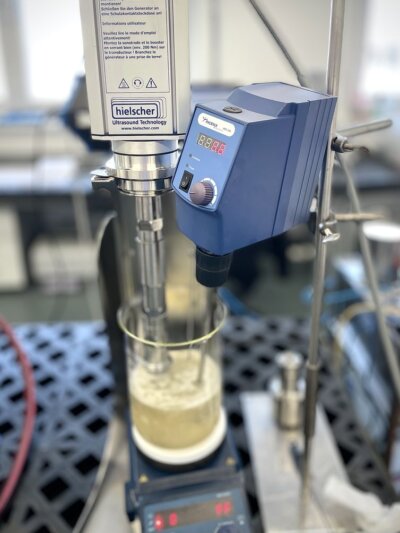
Sonochemical Batch-Astellung mam UIP1000hdT (1000 Watt, 20 kHz) fir sono-Fenton Reaktioune.
Dacks gestallte Froen iwwer Sono-Fenton Reaktiounen
Wat ass de Ënnerscheed tëscht Fenton a Sono-Fenton-Behandlung?
Fenton-Behandlung benotzt Waasserstoffperoxid an Eisenkatalysatoren fir Hydroxyl-Radikaler ze generéieren. Sono-Fenton-Behandlung füügt Kraaft-Ultraschall dobäi. Ultrasonic Kavitatioun erhéicht d'Radikalerbildung a verbessert d'Mëschung, de Kontakt mam Katalysator an de Massentransfer.
Kann Sono-Fenton-Behandlung fir industriell Ofwaasser benotzt ginn?
Yes. Sono-Fenton treatment is used in process development for industrial wastewater, dye effluents, petrochemical wastewater, contaminated slurries, and other streams containing recalcitrant organic compounds. Industrial feasibility depends on the contaminant load, oxidant demand, catalyst system, treatment target, and energy balance.
Can ultrasound reduce chemical consumption?
Ultrasound can improve the utilization of oxidants and catalysts by intensifying radical formation and mass transfer. Whether chemical consumption can be reduced must be confirmed in trials using the actual wastewater or reaction mixture.
Is the process scalable?
Yes. Hielscher ultrasonicators are designed for scalable process development. Results from laboratory tests can be transferred to pilot and industrial systems by controlling amplitude, energy input, residence time, temperature, pressure, and reactor geometry.
Which ultrasonic processor is suitable for my process?
The right processor depends on sample volume, flow rate, target conversion, solids content, viscosity, operating temperature, and pressure. Hielscher offers laboratory ultrasonicators, pilot systems, and industrial ultrasonic reactors for continuous processing.
What is the Sono-Ozonation process?
Sono-ozonation is an advanced oxidation process that combines ozone treatment with high-power ultrasound to generate more reactive radicals and improve mass transfer in liquids. This synergy accelerates the degradation of organic pollutants, dyes, microbes, and recalcitrant compounds in water or wastewater compared with ozonation alone.
Explore the advantages of Sono-Ozonation!
Literatur / Referenzen
- Kazuaki Ninomiya, Hiromi Takamatsu, Ayaka Onishi, Kenji Takahashi, Nobuaki Shimizu (2013): Sonocatalytic–Fenton reaction for enhanced OH radical generation and its application to lignin degradation. Ultrasonics Sonochemistry, Volume 20, Issue 4, 2013. 1092-1097.
- Nematollah Jaafarzadeh, Afshin Takdastan, Sahand Jorfi, Farshid Ghanbari, Mehdi Ahmadi, Gelavizh Barzegar (2018): The performance study on ultrasonic/Fe₃O4/H₂O₂ for degradation of azo dye and real textile wastewater treatment. Journal of Molecular Liquids Vol. 256, 2018. 462–470.
- Virkutyte, Jurate; Vickackaite, Vida; Padarauskas, Audrius (2009): Sono-oxidation of soils: Degradation of naphthalene by sono-Fenton-like process. Journal of Soils and Sediments 10, 2009. 526-536.
- Garófalo-Villalta, Soraya; Medina Espinosa, Tanya; Sandoval Pauker, Christian; Villacis, William; Ciobotă, Valerian; Muñoz, Florinella; Vargas Jentzsch, Paul (2020): Degradation of Reactive Red 120 dye by a heterogeneous Sono-Fenton process with goethite deposited onto silica and calcite sand. Journal of the Serbian Chemical Society 85, 2020. 125-140.
- Ahmadi, Mehdi; Haghighifard, Nematollah; Soltani, Reza; Tobeishi, Masumeh; Jorfi, Sahand (2019): Treatment of a saline petrochemical wastewater containing recalcitrant organics using electro-Fenton process: persulfate and ultrasonic intensification. Desalination and Water Treatment 169, 2019. 241-250.
- Adewuyi, Yusuf G.; Appaw, Collins (2002): Sonochemical Oxidation of Carbon Disulfide in Aqueous Solutions: Reaction Kinetics and Pathways. Industrial & Engineering Chemistry Research 41 (20), 2002. 4957–4964.
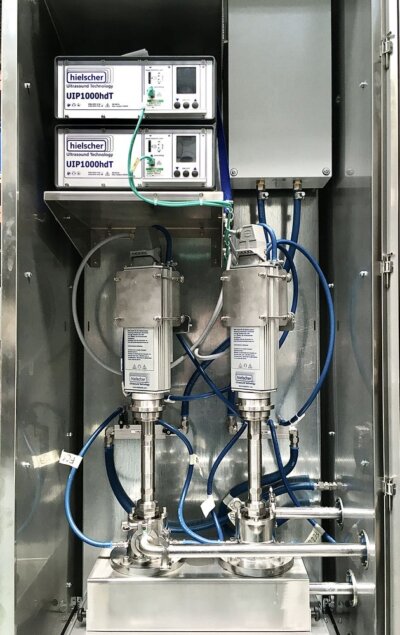
Industrial sonicators of the model UIP1000hdT in a flow-through cluster setup for sonochemical reactions

Hielscher Ultrasonics manufactures high-performance ultrasonic processors from Laboratoire zu industrial size.