Biodegradéierbar Nanosphären produzéieren
Biodegradéierbar Mikro- an Nanosphäre kënnen an engem kontinuéierleche, kontakt- a kontaminéierte Prozess produzéiert ginn, dee liicht ënner sterile Bedéngungen lafen kann.
Aféierung
Biodegradable micro- and nanospheres (MS, NS) made of poly(lactide-coglycolide) (PLGA) or other materials are very potent drug and antigen delivery systems with inherent potential for drug and antigen targeting. Present methods to produce PLGA NS are typical batch processes and suffer from difficulties of upscaling under sterile conditions. Here, we present a novel and elegant method to produce PLGA nano-spheres in a continuous, contact- and contamination-free process that can be readily run under sterile conditions. During the entire manufacturing process, the product is in direct contact only with sterile glass and Teflon® tubes. The process can be run in a closed system to prevent any environmental contamination.
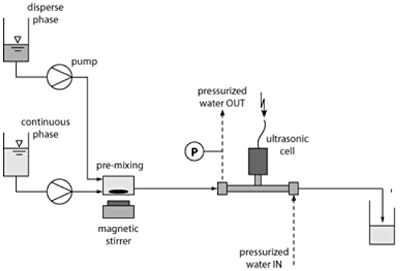
Scheme of setup for a contamination-free synthesis of nanparticles using the Hielscher non-contact sonication flow-cell Dmini
Method of Ultrasonic Contact-Free Nano-Sphere Production
PLGA50:50 nanoparticles (Resomer® RG503H, Boehringer Ingelheim) were produced using a modified solvent extraction/evaporation process. PLGA dissolved in dichloromethane (2 or 5%) was dispersed in aqueous 0.5% (w/w) PVA-solution by means of the novel experimental set-up involving a contact-free flow-through ultrasonication cell Dmini. The coarse O/W-dispersion was first premixed by a magnetic stirrer and then homogenized in the contact-free ultrasonic flow-through cell Dmini (flow rates of O- and W-phases were at 1:8). The initially formed PLGA-solvent nanodroplets gradually solidified during the passage in the tubes to become PLGA nanoparticles. Final hardening of the particles was achieved in a larger volume of 0.5% PVA solution.
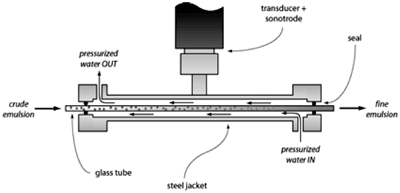
Ultrasonic non-contact flow cell Dmini for contamination-free nanoparticle synthesis
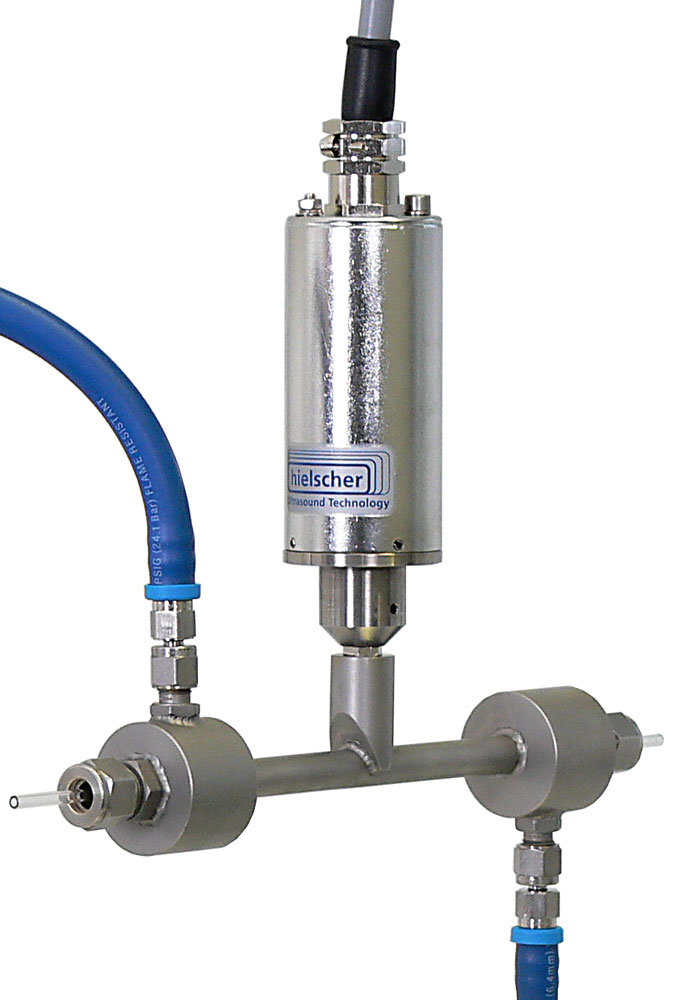
UIS250 Dmini – Ultrasonic Mini Flow Cell for non-invasive, sterile sonication
Resultater
Nanopartikele mat engem mëttleren Duerchmiesser vu 485 nm goufen einfach aus enger 2% PLGA Léisung an DCM bei 32W Sonikatiounskraaft virbereet (Tab. 1). D'Gréisst Verdeelung war mono-modal mat engem liichte tailing (Fig. 3A). Nanopartikelgréissten verlängert vun 175 op 755 nm laut den 10 an 90% Percentile. Widderhuelbarkeet vum Produktiounsprozess war konsequent gutt, wéi reflektéiert duerch nëmme kleng Variabilitéit am mëttleren Partikelduerchmiesser. Senkung vun der 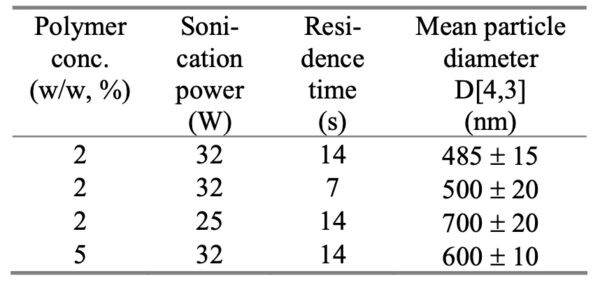 Table 1. Mean diameter of PLGA50:50 nanospheres prepared under different conditions. Mean of two batches ± absolute deviation.[/caption]
Schlussendlech gouf déi méi hydrophil PLGA fir déi méi hydrophobe a méi niddereg Molekulargewiicht PLA ausgetauscht ouni merkbar Ännerungen an der Partikelmëttelgréisst a Gréisstverdeelung. Keng Differenzen goufen an der Morphologie vun de verschiddene Chargen vu Partikelen aus 2% Polymerléisungen virbereet. Si hunn all perfekt sphäresch Formen a glat Flächen ausgestallt (Fig. 3B). D'Partikel aus der 5% PLGA-Léisung waren awer manner kugelfërmeg, hunn liicht wrinkly Flächen gewisen, a Fusioune vun zwee oder heiansdo méi Partikelen (Fig. 3C).

Fig. 3: PLGA Nanopartikel. (A): Gréisst Verdeelung vun Partikel preparéiert op Polymer Konzentratioun / sonication Muecht vun 2% / 32W, 5% / 32W, an 2% / 25W%; Openthaltszäit = 14 s. (B), (C): SEM Biller vu Partikele virbereet aus 2 a 5% Polymerléisungen, respektiv. Openthaltszäit = 14s; sonication Muecht = 32W. Baren representéieren 1 Mikron.
(Studie a Biller: © Freitas et al., 2006)
Discussion and Conclusion
The ultrasonic flow-through cell was found to be well suited for emulsion-solvent extraction/evaporation based production of biodegradable polymeric nanospheres. Future research will be directed towards scaling-up the process and increasing the power input to yield even finer emulsions. In addition, the suitability of the cell for the preparation of water-in-oil emulsions, e.g. for further processing into drug-loaded microspheres, will be studied.
Literatur
- Freitas, S.; Hielscher, G.; Merkle, H. P.; Gander, B.: A Fast and Simple Method for Producing Biodegradable Nanospheres, in: European Cells and Materials Vol. 7. Suppl. 2, 2004 (page 28). This study was presented at the Swiss Society of Biomaterials.
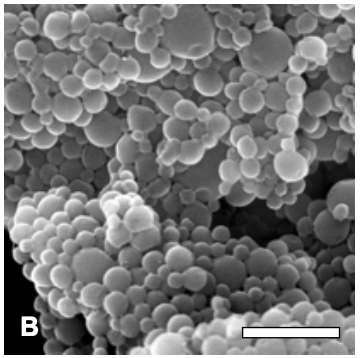
SEM image of ultrasonically synthesized nano-spheres prepared from 2% polymer solution