Sterile Syringe Sonication for Reliable Drug Suspension Homogeneity
Sterile syringe sonication introduces a precise, non-invasive way to disperse particles, emulsify liquids and homogenize biomedical suspensions directly in sealed syringes or closed vials. For injectable drug suspensions, diagnostic samples and cell-based liquids, uniformity is critical: every aliquot, every injection and every analytical subsample should contain the same particle concentration and composition. Manual shaking is often inconsistent, operator-dependent and difficult to standardize. Ultrasonic agitation offers a more reproducible alternative.
Using Hielscher ultrasonic systems such as the VialTweeter or the VialPress for closed syringes and sealed vials, sterile liquids can be sonicated without opening the container. This makes the process particularly relevant for pharmaceutical formulation, biomedical research, diagnostic sample preparation and point-of-care medical workflows, where contamination control, rapid preparation and consistent sample quality are essential.
Who Should Use Sterile In-Syringe Sonication?
- Pharmaceutical formulation teams preparing injectable suspensions, depot formulations, microparticles or nanoparticles.
- Clinical and diagnostic laboratories handling sterile biomedical liquids, blood-based samples or diagnostic suspensions.
- Point-of-care medical teams needing fast, reproducible sample or drug preparation in closed syringes.
- Drug delivery researchers working with particle-based formulations, emulsions, liposomes or nanoformulations.
- Analytical chemists using in-syringe microextraction or small-volume sample preparation.
- Quality control teams replacing manual shaking with a standardized, parameter-controlled sonication protocol.
Replace Manual Shaking with Controlled Sonication
Achieve faster, more reproducible redispersion of particles in sealed syringes or vials. Contact us to discuss your drug suspension, diagnostic sample or point-of-care workflow and find the right Hielscher sonicator solution.
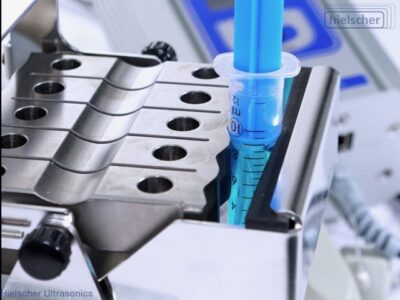
Sterile syringe agitation with sonication
Why Sterile Sonication Matters for Drug Suspensions
Many injectable drugs, depot formulations, contrast agents, nanoparticles, microparticles and diagnostic suspensions must be uniformly dispersed before use. If particles settle during storage, the active ingredient or functional component may be unevenly distributed. This can lead to inconsistent dosing, poor analytical reproducibility or unreliable diagnostic readouts.
Conventional preparation methods often rely on manual shaking, vortexing or repeated aspiration. These techniques can be practical, but they provide not sufficient dispersion energy for challenging suspensions. They are also difficult to reproduce between operators, laboratories and clinical settings.
Sterile ultrasonic homogenization uses high-frequency sound waves to generate intense shear forces inside the liquid volume. These forces help break up particle agglomerates, distribute solids evenly and maintain a more homogeneous suspension. Because the liquid container remains closed, the process is non-contact and contamination-free.
Two Sterile Workflow Options: Vial Sonication and In-Syringe Sonication
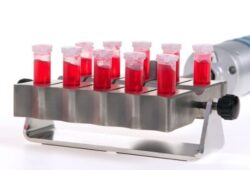 Sterile sonication can be implemented in two practical workflows.
In the first workflow option, the drug vial is sonicated before the suspension is drawn into the syringe. The vial containing the drug suspension is placed into the non-contact sonicator VialTweeter. Ultrasonic energy is transmitted through the vial wall into the liquid, where it disperses particles and improves suspension uniformity. After sonication, the homogeneous suspension is aspirated back into the syringe.
In the second workflow option, the filled syringe itself is sonicated. The syringe is closed with a sterile tip cap, for example a Luer-lock cap, and placed centrally into the VialPress. The sonicator is then set according to the required protocol. Sonication is applied directly through the closed syringe body, allowing sterile in-syringe mixing without opening the syringe or exposing the contents.
Both methods are designed to provide rapid, reproducible agitation while preserving a closed and sterile liquid path.
Non-Contact Sonication for Sterile, Contamination-Free Processing
A key advantage of VialTweeter and VialPress sonication is that no sonotrode or probe enters the drug suspension or biomedical liquid. Ultrasonic energy is coupled from the outside through the vial or syringe wall. This makes the process non-invasive and eliminates direct contact between the sonicator and the sterile liquid.
This design is highly relevant for sensitive applications, including:
- Injectable drug suspensions and depot formulations
- Microparticle and nanoparticle suspensions
- Biomedical and diagnostic liquids
- Blood-based or cell-based samples
- Point-of-care sample preparation
- Sterile in-syringe mixing before administration or analysis
- Dispersive liquid-liquid and liquid-solid microextraction in syringes
Because the container remains closed, the risk of contamination is reduced. At the same time, the ultrasound provides significantly stronger and more reproducible dispersion than manual shaking.
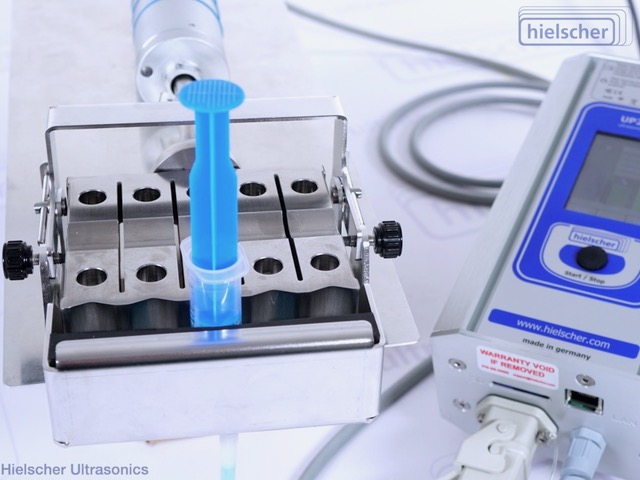
Steril Sonikatioun vun Spritzen mat dem VialTweeter + VialPress
Verglach tëscht manuellem Schëddelen an steriler Sprëtzsonikatioun
| Kriterium | Manuell Schëddelen | sterile sonication |
|---|---|---|
| Mëschungsprinzip | Operateur-ënnerstëtzte Handbewegung generéiert variabel Rësslechen. | Definéiert ultraschall Wellen schafen reproduzéierbar mechanesch Scherkräfte am zouenen Sprëtz oder Fläschchen. |
| reproducibility | Ofhängeg vun der Schëddelkraaft, Daueren an der Technik vum Operateur. | Sonikatiounszäit, Intensitéit an Pulsmodus kënnen standardiséiert ginn fir reproduzéierbar Virbereedung. |
| Homogenitéit vun der Suspension | Kann eventuell net genuch sinn fir séier sech ofsetzend Partikelen, déns Mikropartikelen oder aggloërte Suspensiounen ze behandelen. | Fërdert zouverlässeg Redispersioun vun de Partikelen an eng méi eenheetlech Verdeelung virun der Sprëtzung oder Analyse. |
| Sterilitéit | Sterilitéit kann erhalen ginn, wann de Behälter zoubleiwt, awer widderholl Handhabung kann d'Variabilitéit erhéijen. | Zoubehälterveraarbechtung hält d'Sprëtz oder d'Fläsch versiegelt während der Agitéierung, wat d'Kontaminatiounsrisiko reduzéiert. |
| Kontakt mat Flëssegkeet | Kee weidere Tool gelangt an d'Flëssegkeet, awer d'Mëschenergie ass limitéiert. | Kee Sond kontaktéiert d'Flëssegkeet; Ultraschall gëtt invasivfräi duerch d'Mauere vun der Sprëtz oder Fläsch iwwerdroen. |
| Veraarbechtungsintensitéit | Begrenzt duerch manuell Kraaft an ergonomesch Restriktiounen. | Héich-Intensitéit Ultrasonic Agitéierung bitt méi staark Dispersiounskraaft fir erausfuerderend Suspensiounen. |
| Protokollkontroll | Difficult to document and validate precisely. | Parameters can be defined and repeated, supporting protocol development and standardized workflows. |
| Point-of-care suitability | Simple but inconsistent, especially when different users prepare the same suspension. | Compact, fast and reproducible, making it suitable for decentralized medical and diagnostic applications. |
| Typesch Uwendungen | Simple liquids and easy-to-redisperse suspensions. | Injectable drug suspensions, microparticles, nanoparticles, biomedical liquids, diagnostic samples and in-syringe microextraction. |
More Reliable Homogeneity Than Manual Shaking
Manual shaking is easy, but it is not a controlled process. The result depends on the operator, shaking force, duration, vial or syringe geometry, fill volume and sedimentation behavior of the suspension. In clinical and laboratory workflows, this variability can become a serious limitation.
Sterile ultrasonic agitation improves reproducibility because sonication parameters can be defined, repeated and documented. Amplitude, sonication time, pulse mode and cooling conditions can be adjusted to the formulation or sample type. This helps users establish a validated protocol for reliable redispersion.
- For injectable suspensions, better homogeneity can support more consistent dosing.
- For analytical and diagnostic samples, better dispersion can improve subsampling accuracy and measurement reproducibility.
- For research applications, standardized ultrasonic agitation helps reduce experimental variability.
Ultrasonic Shear Forces for Dispersion and Emulsification
The effect of sterile syringe sonication is based on the mechanical action of intense ultrasonic waves. When ultrasound propagates through the liquid, it produces high-frequency agitation and shear forces. These forces help disperse solid particles, break soft agglomerates and distribute suspended material throughout the liquid volume.
Depending on the formulation, ultrasonic agitation can support:
- Redispersion of settled microparticles
- Homogeniséierung vu Nanopartikel-Dispersiounen
- Virbereedung vun Emulsiounen
- Dispersioun vun schlecht waasserduechtege Feststoffer
- Flësseg-flësseg Mikroextraktioun
- Flësseg-Feststoff Mikroextraktioun
Benotzt Hielscher sterile Sprëtz a Fläsch Sonikatioun fir injizéierbar Medikamenter, diagnostesch Flëssegkeeten a biomedizinesch Proben reproduzéierbar ze disperséieren – ouni den Dëppl ze öffnen. Sot eis Äre Sprëtz- oder Fläschformat, Probenvolumen a Suspensiounstyp, an mir recommandéieren déi passend Sonikatiouns-Setzung.
Mëschung vu diagnostesche Reagenzien a biomedizinesche Flëssegkeeten
A sterile sonication pathway is especially valuable when uniform particle distribution is required but the liquid cannot be opened, touched or mechanically stirred with an internal tool.
Relevanz fir Wëssenschaft a biomedizinesch Fuerschung
In scientific laboratories, reproducible sample preparation is often the foundation for reliable results. A poorly dispersed suspension can compromise downstream analysis, whether the application involves particle sizing, microscopy, chromatography, spectroscopy, cell assays or diagnostic readouts.
Sterile non-contact sonication is relevant for research groups working with drug delivery systems, nanoformulations, extracellular vesicles, cell suspensions, blood-derived samples, diagnostic reagents and biomedical microextraction. It enables researchers to prepare small-volume samples under controlled conditions without introducing a probe into the sample.
For laboratories handling precious or contamination-sensitive materials, this is a practical advantage. Samples remain closed. Cross-contamination is minimized. Cleaning of wetted ultrasonic tools is avoided. At the same time, the agitation intensity is much higher and more reproducible than manual handling.
Relevance for Point-of-Care Medical Applications
Point-of-care medicine increasingly depends on rapid, reliable and compact sample preparation. Diagnostic workflows often require small-volume liquid handling, sterile conditions and fast preparation close to the patient. In these environments, manual variability can directly affect test reliability.
Sterile in-syringe sonication offers a simple approach for homogenizing suspensions or preparing diagnostic liquids directly in a closed syringe. The syringe can be sealed with a tip cap, placed into the VialPress and sonicated according to a defined protocol. This creates a closed, non-contact workflow that is well suited to decentralized medical applications.
Potential point-of-care benefits include faster preparation, reduced handling steps, improved suspension uniformity and lower contamination risk. For diagnostic liquids, blood-based samples or particle-containing biomedical formulations, ultrasonic agitation can help create more consistent sample conditions before testing or administration.
Steril In-Sprëtz Mëschung: Einfach Workflow
E typesche sterile In-Sprëtz Sonikatiouns-Workflow ass direkt. D'Sprëtz gëtt mat der Suspensioun oder Flëssegkeet gefëllt, déi veraarbecht soll ginn, an da mat engem sterile Spëtzekapp zougemaach, wéi e Luer-Lock-Kapp. D'ofgeschloss Sprëtz gëtt zentral an de VialPress gesat. Den Benotzer stellt d'ultrasonic Parameteren um Generator, abäigefüügt d'Sonikatiounszäit an d'Intensitéit. D'Sprëtz gëtt no dem definéierte Protokoll sonicéiert bis d'Partikelen gläichméisseg verdeelt sinn.
No der Sonikatioun kann d'Sprëtz fir de nächste Schrëtt am Prozess benotzt ginn, wéi Injektioun, Iwwerdroung, Analys oder Mikroextraktioun. Well d'Sprëtz wärend dem ganze Prozess zou bleift, ass de Flëssegkeetwee géint Ëmweltaussetzung geschützt.
Applications Beyond Injectable Suspensions
Although sterile syringe sonication is particularly attractive for injectable drug suspensions, the same principle can be used for many other biomedical and analytical liquids. In-syringe sonication can support dispersive liquid-liquid microextraction, liquid-solid microextraction and the preparation of particle-containing diagnostic samples.
For analytical chemistry, in-syringe sonication can intensify mass transfer and accelerate extraction steps. For biomedical laboratories, it offers controlled agitation of small liquid volumes without opening the sample vessel. For formulation development, it provides a repeatable method to evaluate redispersion behavior, particle suspension quality and emulsion stability.
Sterile Sonication as a Controlled Alternative to Shaking
The main value of sterile syringe sonication is process control. Instead of relying on manual shaking, users can apply defined ultrasonic energy to a closed syringe or vial. This improves repeatability and helps standardize suspension preparation across different users and settings.
For pharmaceutical, diagnostic and point-of-care applications, this can be a decisive advantage. A closed container, non-contact ultrasound transmission and reproducible shear forces combine sterility with effective dispersion. As drug delivery systems, particle-based diagnostics and decentralized medical testing continue to advance, sterile ultrasonic agitation provides a practical technology for preparing homogeneous liquids quickly and reliably.

Frequently Asked Questions: Sterile Syringe Sonication
What is sterile syringe sonication?
Sterile syringe sonication is the ultrasonic agitation of a sealed syringe to disperse particles, homogenize suspensions or emulsify liquids without opening the syringe. The syringe is closed with a sterile tip cap and placed into a sonication device such as the VialPress, where ultrasonic energy is transmitted through the syringe wall into the liquid.
Why is sonication useful for injectable drug suspensions?
Injectable drug suspensions often contain microparticles or nanoparticles that may settle during storage. Sonication helps redisperse these particles and create a more homogeneous suspension before use. This can improve dosing consistency and reduce the variability associated with manual shaking.
Is the liquid contacted by the ultrasonic probe?
No. In sterile syringe sonication and vial sonication, the ultrasonic tool does not enter the liquid. Ultrasonic energy is transmitted through the closed syringe or vial wall. This makes the process non-contact, sterile and contamination-free.
Can sonication replace manual shaking?
For many suspensions, sonication offers a more controlled and reproducible alternative to manual shaking. Manual shaking depends on operator technique, while sonication can be performed with defined parameters such as amplitude, time, temperature, and pulse mode.
Which samples can be processed by sterile syringe sonication?
Sterile syringe sonication is suitable for injectable drug suspensions, biomedical liquids, diagnostic reagents, nanoparticle samples, microparticle suspensions, blood-based samples, cell-based samples and microextraction workflows.
Why is sterile non-contact sonication relevant for point-of-care applications?
Point-of-care workflows require fast, reliable and contamination-controlled preparation close to the patient. Sterile in-syringe sonication allows liquids to be mixed or dispersed in a closed syringe, reducing handling steps and improving reproducibility.
Can sterile syringe sonication be used for microextraction?
Yes. In-syringe sonication can support dispersive liquid-liquid microextraction and liquid-solid microextraction by intensifying mixing and mass transfer inside the syringe. This can be useful in analytical chemistry, diagnostics and biomedical sample preparation.
How is a syringe prepared for sonication?
The syringe is filled with the liquid or suspension and closed with a sterile tip cap, such as a Luer-lock cap. It is then placed centrally into the VialPress. The ultrasonic generator is set according to the required protocol, and the syringe is sonicated until the desired dispersion or mixing result is achieved.
What are the main advantages of sterile syringe sonication?
The main advantages are sterile processing, non-contact ultrasound transmission, contamination-free handling, improved suspension homogeneity, reproducible redispersion, rapid preparation and better control compared with manual shaking.
Literatur / Referenzen
- FactSheet VialTweeter VT26dxx – Customized VialTweeter Sonicator for Single Test Tubes or Vials
- FactSheet VialTweeter – Sonicator for Simultaneous Sample Preparation
- Laughton, Stephanie; Laycock, Adam; von der Kammer, Frank; Hofmann, Thilo; Casman, Elizabeth; Rodrigues, Sónia; Lowry, Gregory (2019): Persistence of copper-based nanoparticle-containing foliar sprays in Lactuca sativa (lettuce) characterized by spICP-MS. Journal of Nanoparticle Research 21, 2019.
- Müller A., Eller J., Albrecht F., Prochnow P., Kuhlmann K., Bandow J. E., Slusarenko A. J., Leichert L.I.O. (2016): Allicin Induces Thiol Stress in Bacteria through S-Allylmercapto Modification of Protein Cysteines. Journal of Biological Chemistry, Vol. 291, No. 22, 2016. 11477-11490.
- Ciobanu, V., Braniste, T., Doroftei, F., Tiginyanu, I. (2025): PVP Modified ZnO and GaN Nanoparticles for Ceftriaxone Drug Delivery. In: Sontea, V., Tiginyanu, I., Railean, S. (eds) 7th International Conference on Nanotechnologies and Biomedical Engineering. ICNBME 2025. IFMBE Proceedings, vol 134. Springer, Cham.
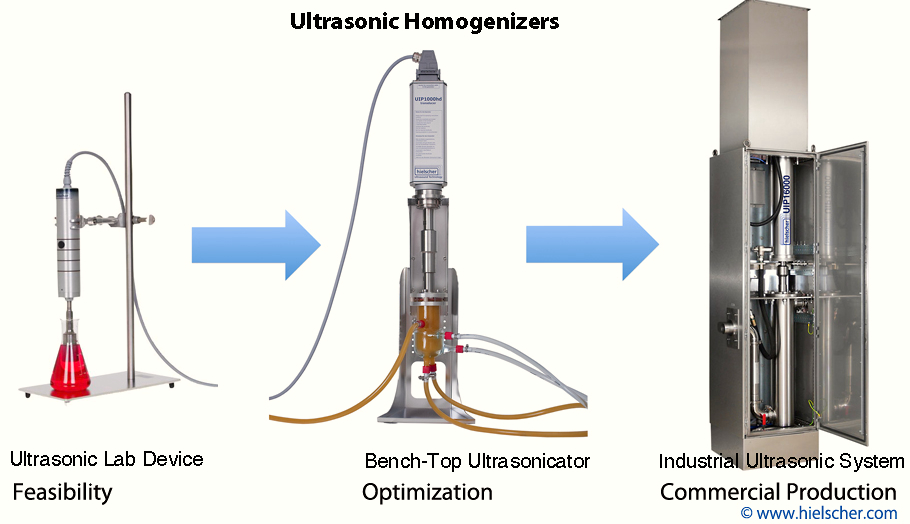
Hielscher Ultrasonics fabrizéiert High-Performance Ultrasonic Homogenisatoren aus Labo zu industriell Gréisst.