Sonokemisk reduktion af palladium nanopartikler
Palladium (Pd) er velkendt for sine katalytiske egenskaber og anvendes også i vid udstrækning inden for materialeforskning, elektronikproduktion, medicin, brintrensning og forskellige kemiske anvendelser. Ved hjælp af en sonokemisk metode kan størrelsen og morfologien af palladiumpartiklerne styres ved at justere PVP/Pd-forholdet. Dette muliggør ultralydssyntese af enten meget fine, monodisperse nanopartikler eller større palladiumaggregater, hvilket gør det muligt at tilpasse partikeldimensionerne for at opnå optimal katalytisk ydeevne.
Ultralydsproduktion af palladium nanopartikler
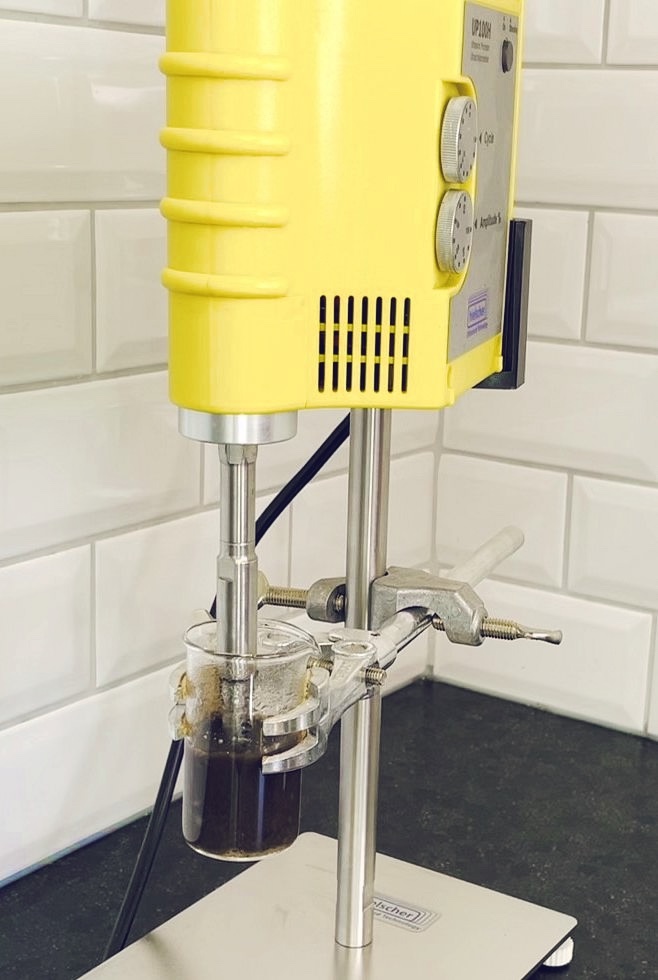 Reduktion af palladium-nanopartikler ved hjælp af ultralyd udgør en hurtig og reagensbesparende metode til fremstilling af Pd(0)-nanopartikler, idet man ved hjælp af akustisk kavitation skaber lokaliserede højenergiforhold og reducerer radikaler i opløsningen, hvilket gør det muligt at reducere palladiumioner uden brug af konventionel højtemperaturbehandling.
En af de vigtigste fordele er proceskontrol: sonikeringstiden og stabilisatorkoncentrationen, såsom PVP/Pd-forholdet, kan påvirke, om produktet dannes som veldisperse, afrundede nanopartikler på omkring 5 nm eller som større aggregater på omkring 20 nm, hvilket er industrielt relevant, da palladiums ydeevne i katalyse afhænger stærkt af partikelstørrelse, morfologi, dispersion og overfladeareal. Da palladium-nanopartikler er meget værdifulde som heterogene katalysatorer, elektrokatalysatorer og funktionelle materialer, er ultralydsreduktion en attraktiv metode til fremstilling af fint dispergerede Pd-katalysatorer under forholdsvis milde væskefasebetingelser, med potentielle fordele for kemisk syntese, miljøkatalyse, brændselscelleteknologier og andre processer, hvor høj katalytisk aktivitet og effektiv udnyttelse af ædelmetaller er økonomisk vigtige.

Industriel forarbejdning af nanopartikler med sonikatoren UIP2000hdT
Fremgangsmåde ved prøveforberedelse
Prøverne blev fremstillet som følger:
Til prøverne, blandinger af 30 ml EG og 5,10-6mol PVP blev fremstillet ved magnetomrøring i 15 minutter. Til de forskellige prøver blev der tilsat forskellige mængder Pd(NO₃)₂-opløsning, nemlig 1,5 mL og 2 mL. Prøveblandingerne blev fremstillet i forholdet 2·10-3mol Pd(NO₃)₂ i prøve (a) og 2,66·10-3mol Pd(NO₃)₂ i prøve (b). Begge blandinger blev behandlet med ultralyd i et 20 ml-hætteglas ved hjælp af en ultralydsenhed med sonde. Der blev udtaget prøver efter ultralydsbehandling i henholdsvis 30, 60, 90, 120, 150 og 180 minutter.
Analysen af forsøgsresultaterne viser, at:
- 1. Den sonokemiske reduktion af Pd (II) til Pd (0) afhænger af sonikeringstiden.
- 2. Det høje PVP/Pd(II) molforhold fører til dannelsen af monodispergerede palladiumpartikler med en afrundet form og en gennemsnitlig diameter på ca. 5nm.
- 3. Det lave PVP/Pd(II) molare forhold involverer imidlertid opnåelse af aggregater palladium nanopartikler med en stor størrelsesfordeling centreret ved 20nm.
Den sonokemiske vej til reduktion af palladium (II) ioner Pd(II) til palladiumatomer Pd(0) kan antages at være følgende:
- (1) Vandpyrolyse: H₂O → •OH + •H
- (2) Dannelse af radikaler: RH (reduktionsmiddel) + •OH(•H) → •R + H₂O(H₂)
- (3) Ionreduktion: Pd(II) + reducerende radikaler (•H, •R) → Pd(0) + R•CHO + H+
- 4) Partikeldannelse: NPd(0) → Pdn
Resultat: Afhængigt af PVP/Pd(II)-forholdet, spredt eller aggregeret PdN blev opnået.
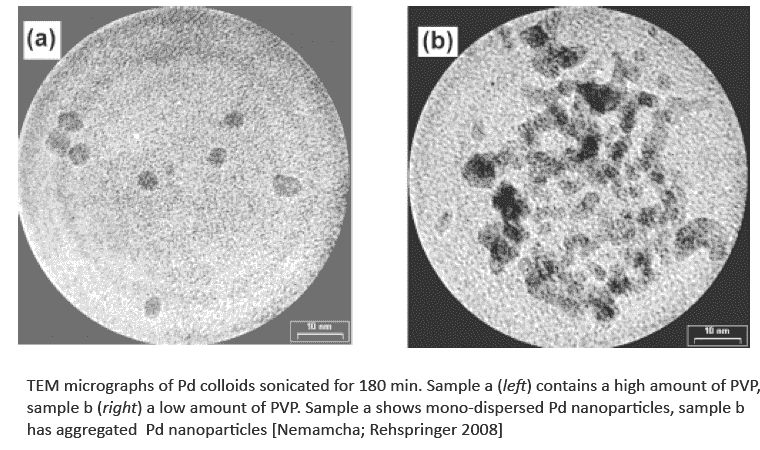
Sonokemisk reduktion af palladium: Prøve a (til venstre) indeholder en stor mængde PVP, prøve b (til højre) en lille mængde PVP. Ultralydsbehandlingstid med UP100H: 180 min. Prøve a viser monodisperse Pd-nanopartikler, prøve b aggregerede Pd-nanopartikler.
Billeder og undersøgelse: ©Nemamcha og Rehspringer, 2008
Analyse og resultater
De UV-synlige absorptionsanalyser bekræfter forholdet mellem den sonokemiske reduktion af palladium(II)-ioner til palladium(0)-atomer og retentionstiden i ultralydsfeltet. Reduktionen af palladium (II) ioner til palladium (0) atomer skrider frem og kan opnås fuldstændigt med stigende sonikeringstid. Mikrograferne af transmissionselektronmikroskopi (TEM) viser, at:
- Når der tilsættes en stor mængde PVP, fører den sonokemiske reduktion af palladiumioner til dannelsen af monodisperse palladiumpartikler med sfærisk form og en gennemsnitlig diameter på ca. 5 nm.
- Anvendelsen af en lille mængde PVP medfører dannelsen af aggregater af palladium-nanopartikler. Målinger ved hjælp af dynamisk lysspredning (DLS) viser, at aggregaterne af palladium-nanopartikler har en bred størrelsesfordeling med et centrum på 20 nm.

Laboratorie-ultralydsapparatet UP100H er blevet anvendt til fremstilling af palladium-nanopartikler.

Palladium (Pd) nanopartikler kan fremstilles ved sonikering
Design, produktion og rådgivning – Kvalitet fremstillet i Tyskland
Hielscher ultralydapparater er kendt for deres højeste kvalitet og designstandarder. Robusthed og nem betjening muliggør en jævn integration af vores ultralydapparater i industrielle faciliteter. Hårde forhold og krævende miljøer håndteres let af Hielscher ultralydsapparater.
Hielscher Ultrasonics er et ISO-certificeret firma og lægger særlig vægt på højtydende ultralydapparater med avanceret teknologi og brugervenlighed. Selvfølgelig er Hielscher ultralydapparater CE-kompatible og opfylder kravene i UL, CSA og RoHs.
Litteratur/Referencer
- Nemamcha, A.; Rehspringer, J. L. (2008): Morphology of dispersed and aggregated PVV-Pd nanoparticles prepared by ultrasonic irradiation of Pd(NO₃)₂ solution in ethylene glycol. Rev. Adv. Mater. Sci. 18;2008. 685-688.
- Prekob, Á., Muránszky, G., Kocserha, I. et al. (2020): Sonochemical Deposition of Palladium Nanoparticles Onto the Surface of N-Doped Carbon Nanotubes: A Simplified One-Step Catalyst Production Method. Catalysis Letters 150, 2020. 505–513.
- Haitao Zheng, Mphoma S. Matseke, Tshimangadzo S. Munonde (2019): The unique Pd@Pt/C core-shell nanoparticles as methanol-tolerant catalysts using sonochemical synthesis. Ultrasonics Sonochemistry, Volume 57, 2019. 166-171.
Fakta, der er værd at vide
Hvad er palladium?
Palladium er et sjældent, sølvhvidt ædelmetal med det kemiske symbol Pd og atomnummer 46. Det tilhører platinmetaller og er værdsat, fordi det er kemisk stabilt, leder elektricitet, absorberer brint og fungerer som en fremragende katalysator. Fint opdelt palladium er særligt effektivt til hydrogenerings- og dehydrogeneringsreaktioner, og opvarmet palladium kan lade hydrogen diffundere igennem sig, hvilket gør det anvendeligt til adskillelse og rensning af hydrogen.
Hvad bruges palladiumnanopartikler til?
Palladium-nanopartikler anvendes hovedsageligt som katalysatorer med stort overfladeareal. Da nanopartikler udgør et langt større aktivt overfladeareal end palladium i fast form, kan de forbedre katalysatorens effektivitet og reducere mængden af det dyre ædelmetal, der kræves. Typiske anvendelsesområder omfatter kemisk syntese, hydrogeneringsreaktioner, kulstof-kulstof-koblingsreaktioner, elektrokatalyse, brændselscelleforskning, hydrogenmåling og -lagring, miljøkatalyse samt visse biomedicinske forskningsområder, såsom antimikrobielle, fototermiske og kræftbekæmpende systemer. Palladiums katalytiske egenskaber afhænger i høj grad af partikelstørrelse, morfologi og dispersion.
Palladium-nanopartikler anvendes også til at dotere andre partikler med henblik på at opnå katalytiske egenskaber. Læs mere om den ultralydsbaserede metode til syntese af Pd/N-BCNT som Fischer-Tropsch-katalysator!
Er palladium giftigt?
Rent metallisk palladium anses generelt for at have lav toksicitet og ingen kendt biologisk funktion, men palladiumforbindelser, salte, støv og former i nanostørrelse bør håndteres med forsigtighed. Eksponering på arbejdspladsen eller i laboratoriet kan forårsage irritation eller overfølsomhed afhængigt af forbindelsen og eksponeringsvejen, og palladiumchloridopløsninger kan for eksempel irritere slimhinderne. Ved industriel håndtering er det praktiske svar: metallisk palladium i bulk udgør en relativt lav risiko, men palladiumpulver, opløselige palladiumsalte og palladiumnanopartikler bør behandles som potentielt farlige stoffer, hvilket kræver støvkontrol, ventilation, handsker, øjenbeskyttelse og korrekt affaldshåndtering.