Ultrasoon versterkt vast bed reactoren
Ultrasone behandeling kan katalytische reacties in reactoren met een vast bed verbeteren, voornamelijk door de massaoverdracht rondom en binnenin het gepakte katalysatorbed te intensiveren. Bovendien verwijdert ultrasone behandeling passiverings- en vervuilingslagen van het katalysatoroppervlak, waardoor de katalysator continu wordt geregenereerd.
Hoe ultrasone behandeling de katalyse in een vast bed verbetert
In een reactor met vast bed blijven de katalysatordeeltjes stil liggen, terwijl vloeibare, gasvormige of meerfasige reactanten door het bed stromen. De reactieprestaties worden vaak beperkt door externe massaoverdracht, diffusie door poriën, kanalisatie, vervuiling en warmteoverdrachtsgradiënten. Ultrasoon geluid kan een aantal van deze beperkingen verminderen door akoestische cavitatie, microstreaming, afschuifkrachten en drukschommelingen te genereren.

Sonicator UIP2000hdT geïntegreerd in een reactor met vast bed
Belangrijkste effecten van ultrasoon versterkte reacties in een vast bed
- Verbeterde externe massaoverdracht: Ultrasone microstreaming vermindert de stilstaande grenslaag rond katalysatordeeltjes, waardoor reactanten de actieve plaatsen efficiënter kunnen bereiken.
- Verbeterde toegankelijkheid van de poriën: Door cavitatie veroorzaakte drukschommelingen en vloeistofbewegingen kunnen de penetratie van reactanten in de poriën van de katalysator en de afvoer van producten uit de poriën bevorderen.
- Vermindering van aangroei en passivering: Met behulp van ultrasone behandeling kunnen afzettingen, polymeerfilms, cokesvoorlopers of andere passiverende lagen van katalysatoroppervlakken worden verwijderd, waardoor de katalytische activiteit langer behouden blijft.
- Verminderde kanaalvorming in gepakte bedden: Uit onderzoek naar microverpakte bedden is gebleken dat ultrasone golven het stromingsgedrag beïnvloeden en de dispersie verminderen, waardoor de reactor dichter bij een idealer plug-flow-gedrag komt.
- Verbeterde warmteoverdracht: Akoestische stroming en turbulentie zorgen voor een betere lokale warmteafvoer, waardoor hotspots of koude zones in het katalysatorbed worden verminderd.
- Hogere conversie en opbrengst: Door de massaoverdracht en de toegankelijkheid van de katalysator te verbeteren, kan ultrasone behandeling de reactiesnelheid, de omzetting en de productopbrengst verhogen, met name wanneer de reactie transportbeperkt is in plaats van puur kinetisch beperkt.
Verbeterd contact tussen vloeistof en vaste stof: Ultrasoonbehandeling zorgt voor een betere bevochtiging van katalysatordeeltjes, wat met name nuttig is in druppelbed-, slurry- of vloeistoffase-systemen met een vast bed.
Hoe draagt ultrasone behandeling bij aan de verbetering van katalyse in een vast bed?
Het belangrijkste mechanisme is akoestische cavitatie: ultrasone golven zorgen voor microscopisch kleine belletjes die groeien en vervolgens met grote kracht uiteenspatten. Door het uiteenspatten ontstaan lokale schuifkrachten, microstralen, schokgolven en intensieve vermenging. In de nabijheid van katalysatoroppervlakken kunnen deze effecten het grensvlak tussen vaste stof en vloeistof reinigen, activeren en vernieuwen. In overzichtsartikelen over sonocatalyse wordt dit beschreven als een synergie tussen ultrasone golven en vaste katalysatoren, waarbij sprake is van verbeterde warmteoverdracht, massaoverdracht en plaatselijke effecten op katalytische oppervlakken.
Ultrasone behandeling is het meest effectief wanneer de reactie in een vast bed te kampen heeft met:
- langzame diffusie in de poriën van de katalysator,
- slechte bevochtiging van de katalysatordeeltjes,
- productophoping in de poriën,
- aangroei of passivering van het oppervlak,
- kinetiek die wordt beperkt door massaoverdracht,
- ongelijkmatige verdeling in een meerfasestroming,
- door het gepakte bed.
Katalysatoren met vast bed
Vaste bedden (soms ook wel gepakte bedden genoemd) worden meestal geladen met katalysatorpellets, wat meestal korrels zijn met een diameter van 1-5 mm. Ze kunnen in de reactor worden geladen in de vorm van een enkel bed, als afzonderlijke schalen of in buizen. De katalysatoren zijn meestal gebaseerd op metalen zoals nikkel, koper, osmium, platina en rhodium.
De effecten van krachtige ultrasone trillingen op heterogene chemische reacties zijn algemeen bekend en worden op grote schaal toegepast in industriële katalytische processen. Ook katalytische reacties in een reactor met vast bed profiteren van een ultrasone behandeling. Ultrasone bestraling van de vaste-bedkatalysator zorgt voor zeer reactieve oppervlakken, verhoogt het massatransport tussen de vloeibare fase (reactanten) en de katalysator, en verwijdert passiverende coatings (bijv. oxidelagen) van het oppervlak.
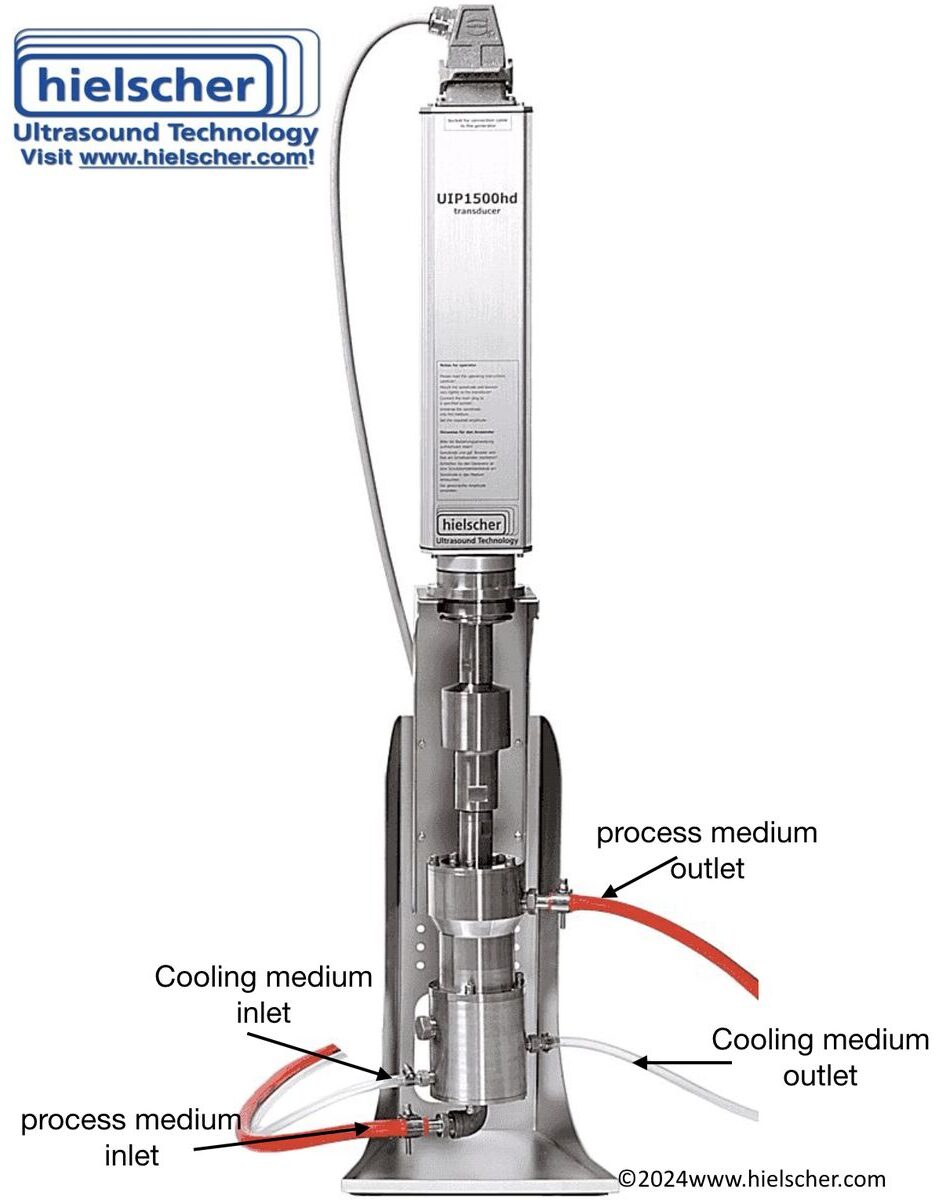
Sonicator UIP1500hdT met doorstroomcel voor het reactiveren en recyclen van gebruikte katalysatoren
- Verbeterde efficiëntie
- Verhoogde reactiviteit
- Verhoogde conversie
- Hogere opbrengst
- Recycling van katalysator
Ultrasone intensivering van katalytische reacties
Ultrasoon mengen en agiteren verbetert het contact tussen de reactant en katalysatordeeltjes, creëert zeer reactieve oppervlakken en initieert en/of versterkt de chemische reactie.
Ultrasone katalysatorvoorbereiding kan veranderingen veroorzaken in kristallisatiegedrag, dispersie / deagglomeratie en oppervlakte-eigenschappen. Bovendien kunnen de eigenschappen van voorgevormde katalysatoren worden beïnvloed door passiverende oppervlaktelagen te verwijderen, de dispersie te verbeteren en de massaoverdracht te verhogen.
Voorbeelden van reacties die door ultrasone behandeling zijn verbeterd
- Ultrasone voorbehandeling van nikkelkatalysatoren voor hydrogeneringsreacties
- Sonische Raney Ni katalysator met wijnsteenzuur resulteert in een zeer hoge enantioselectiviteit
- Met behulp van ultrasone synthese vervaardigde Fischer-Tropsch-katalysatoren
- Sonochemisch behandelde amorfe poederkatalysatoren voor verhoogde reactiviteit
- Sonosynthese van amorfe metaalpoeders
Ultrasoon katalysatorherstel
Vaste katalysatoren in reactoren met een vast bed worden doorgaans gebruikt in de vorm van bolvormige korrels, pellets, extrudaten of cilindrische deeltjes. Tijdens chemische reacties kan het oppervlak van de katalysator worden gepassiveerd door een afzettingslaag, wat na verloop van tijd leidt tot een geleidelijk verlies van katalytische activiteit en/of selectiviteit.
De tijdschaal van katalysatordeactivering varieert aanzienlijk. Zo kan de deactivering van een kraakkatalysator al binnen enkele seconden plaatsvinden, terwijl een ijzerkatalysator die bij de ammoniaksynthese wordt gebruikt, 5–10 jaar actief kan blijven. Niettemin wordt katalysatordeactivering bij vrijwel alle katalytische processen waargenomen. Hoewel er verschillende deactiveringsmechanismen kunnen optreden – waaronder chemische, mechanische en thermische afbraak – Aanslag is een van de meest voorkomende oorzaken van katalysatorafbraak.
Verontreiniging verwijst naar de fysieke afzetting van stoffen uit de vloeistoffase op het oppervlak van de katalysator en in de poriën ervan. Deze afzettingen blokkeren reactieve plaatsen, beperken de toegankelijkheid van de poriën en verminderen het contact tussen de reactanten en het actieve oppervlak van de katalysator. Vervuiling van de katalysator door cokes of koolstofhoudende afzettingen is vaak een snel proces; in veel gevallen kan dit echter gedeeltelijk of volledig worden teruggedraaid door middel van ultrasone regeneratie.
Ultrasone cavitatie is een effectieve methode om passiverende aangroei-lagen van katalysatoroppervlakken te verwijderen. Tijdens ultrasone behandeling genereert hoogintensieve ultrasone golven cavitatiebellen in een vloeibaar medium. Het instorten daarvan veroorzaakt plaatselijke schuifkrachten, microstralen, schokgolven en intense micromenging. Deze effecten helpen bij het losmaken van vervuilingsresten van het katalysatoroppervlak, het weer openen van verstopte poriën en het herstellen van de toegang tot actieve plaatsen.
Het terugwinnen van katalysatoren met behulp van ultrasone trillingen gebeurt doorgaans door de katalysatordeeltjes te dispergeren in een vloeistof, zoals gedeïoniseerd water of een geschikt oplosmiddel, en de suspensie bloot te stellen aan een gecontroleerde ultrasone behandeling. Dit proces kan vervuilingsresten verwijderen van diverse katalysatormaterialen, waaronder platina/silicavezelkatalysatoren, nikkelkatalysatoren en andere katalysatoren op metaaldrager. Daardoor kan ultrasone behandeling bijdragen aan de regeneratie van de katalysator, een langere levensduur van de katalysator en een verbeterde duurzaamheid van het proces.
Klik hier voor meer informatie over de ultrasone regeneratie van gebruikte katalysatoren!
Ultrasone apparaten voor integratie in chemische reactoren
 Hielscher Ultrasonics biedt verschillende ultrasone processors en variaties voor de integratie van power ultrasound in reactoren met vast bed. Er zijn verschillende ultrasone systemen beschikbaar voor installatie in reactoren met vast bed. Voor complexere reactortypes bieden we aangepaste ultrasone oplossingen.
Ontdek hoe ultrasone trillingen chemische reacties in verschillende reactorontwerpen verbeteren!
Om de effecten van ultrasone behandeling op uw chemische reactie te testen, bent u van harte welkom in ons ultrasoonproceslaboratorium en technisch centrum in Teltow!
Neem vandaag nog contact met ons op! We bespreken graag de ultrasone intensivering van uw chemische proces met u!
De onderstaande tabel geeft een indicatie van de verwerkingscapaciteit van Hielscher sonicators bij benadering:

Ultrasoon stromingssysteem
- hydrogenering
- Alcylatie
- Cyanatie
- ethervorming
- verestering
- polymerisatie
- Allylatie
- Bromering
(bijv. Ziegler-Natta katalysatoren, metallocens)
Literatuur / Referenties
- Francisco J. Navarro-Brull; Andrew R. Teixeira; Jisong Zhang; Roberto Gómez; Klavs F. Jensen (2018): Reduction of Dispersion in Ultrasonically-Enhanced Micropacked Beds. Industrial & Engineering Chemistry Research 57, 1; 2018. 122–128.
- Yasuo Tanaka (2002): A dual purpose packed-bed reactor for biogas scrubbing and methane-dependent water quality improvement applying to a wastewater treatment system consisting of UASB reactor and trickling filter. Bioresource Technology, Volume 84, Issue 1, 2002. 21-28.
- Argyle, M.D.; Bartholomew, C.H. (2015): Heterogeneous Catalyst Deactivation and Regeneration: A Review. Catalysts 2015, 5, 145-269.
- Oza, R.; Patel, S. (2012): Recovery of Nickel from Spent Ni/Al2O3 Catalysts using Acid Leaching, Chelation and Ultrasonication. Research Journal of Recent Sciences Vol. 1; 2012. 434-443.
- Sana, S.; Rajanna, K.Ch.; Reddy, K.R.; Bhooshan, M.; Venkateswarlu, M.; Kumar, M.S.; Uppalaiah, K. (2012): Ultrasonically Assisted Regioselective Nitration of Aromatic Compounds in Presence of Certain Group V and VI Metal Salts. Green and Sustainable Chemistry, 2012, 2, 97-111.
- Suslick, K. S.; Skrabalak, S. E. (2008): “Sonocatalysis” In: Handbook of Heterogeneous Catalysis, vol. 4; Ertl, G.; Knözinger, H.; Schüth, F.; Weitkamp, J., (Eds.). Wiley-VCH: Weinheim, 2008. 2006-2017.
Wetenswaardigheden
Wat is ultrasone cavitatie?
Ultrasone cavitatie is het ontstaan, de groei en het heftige instorten van microscopisch kleine damp- of gasbellen in een vloeistof die wordt blootgesteld aan ultrasone golven met hoge intensiteit. Tijdens het instorten van de bellen kunnen gedurende zeer korte tijd extreme lokale omstandigheden optreden, waaronder hoge temperaturen, hoge druk, schokgolven, microstralen en intense schuifkrachten.
Wat is Sonochemie?
Sonochemie is het gebruik van deze ultrasone cavitatie-effecten om chemische en fysisch-chemische processen op gang te brengen, te versnellen of te beïnvloeden. Het is met name van belang in systemen in vloeibare fase, omdat cavitatie het mengen, de massaoverdracht, de emulgering, de deeltjesdispersie, de reiniging van katalysatoroppervlakken en, in sommige gevallen, de vorming van radicalen bevordert. Daarom wordt sonochemie gebruikt om reacties zoals heterogene katalyse, oxidatie, extractie, polymerisatie, kristallisatie en de synthese van nanomaterialen te intensiveren.
Wat is een heterogene katalytische reactie?
In de chemie verwijst heterogene katalyse naar het type katalytische reactie waarbij de fasen van de katalysator en de reactanten van elkaar verschillen. In de context van heterogene chemie wordt fase niet alleen gebruikt om onderscheid te maken tussen vast, vloeibaar en gas, maar het verwijst ook naar niet-mengbare vloeistoffen, zoals olie en water.
Tijdens een heterogene reactie ondergaan een of meer reactanten een chemische verandering op een grensvlak, bijvoorbeeld op het oppervlak van een vaste katalysator.
De reactiesnelheid is afhankelijk van de concentratie van de reactanten, de deeltjesgrootte, de temperatuur, de katalysator en andere factoren.
Concentratie van de reactant: Over het algemeen verhoogt een verhoging van de concentratie van een reactant de reactiesnelheid door het grotere grensvlak en daardoor een grotere faseoverdracht tussen de reactordeeltjes.
Deeltjesgrootte: Als een van de reactanten een vast deeltje is, dan kan dit niet worden weergegeven in de snelheidsvergelijking, omdat de snelheidsvergelijking alleen concentraties weergeeft en vaste stoffen geen concentratie kunnen hebben omdat ze in een andere fase zitten. De deeltjesgrootte van de vaste stof beïnvloedt echter de reactiesnelheid vanwege het beschikbare oppervlak voor faseoverdracht.
Reactietemperatuur: Temperatuur is gerelateerd aan de snelheidsconstante via de vergelijking van Arrhenius: k = Ae-Ea/RT
Waarbij Ea de activeringsenergie is, R de universele gasconstante en T de absolute temperatuur in Kelvin. A is de Arrhenius (frequentie)factor. e-Ea/RT geeft het aantal deeltjes onder de curve die een energie hebben die groter is dan de activeringsenergie, Ea.
Katalysator: In de meeste gevallen verlopen reacties sneller met een katalysator omdat er minder activeringsenergie nodig is. Heterogene katalysatoren bieden een sjabloonoppervlak waarop de reactie plaatsvindt, terwijl homogene katalysatoren tussenproducten vormen die de katalysator vrijmaken tijdens een volgende stap van het mechanisme.
Andere factoren: Andere factoren zoals licht kunnen bepaalde reacties beïnvloeden (fotochemie).
Welke soorten deactivering van katalysatoren zijn er?
- Katalysatorvergiftiging is de term voor de sterke chemisorptie van stoffen op katalytische sites die sites voor katalytische reactie blokkeren. Vergiftiging kan reversibel of irreversibel zijn.
- Fouling verwijst naar een mechanische degradatie van de katalysator, waarbij soorten uit de vloeistoffase neerslaan op het katalytische oppervlak en in katalysatorporiën.
- Thermische degradatie en sinteren resulteert in het verlies van katalytisch oppervlak, ondersteuningsgebied en actieve fase-ondersteuningsreacties.
- Dampvorming betekent een chemische afbraakvorm waarbij de gasfase reageert met de katalysatorfase om vluchtige verbindingen te produceren.
- Damp-vaste en vaste stof-vaste reacties resulteren in de chemische deactivering van de katalysator. Damp, drager of promotor reageert met de katalysator zodat er een inactieve fase ontstaat.
- Attrutie of pletten van de katalysatordeeltjes resulteert in het verlies van katalytisch materiaal door mechanische slijtage. Het interne oppervlak van de katalysator gaat verloren door het mechanisch pletten van de katalysatordeeltjes.
Lees meer over hoe ultrasone trillingen gebruikte katalysatoren weer actief kunnen maken!
Wat is nucleofiele substitutie?
Nucleofiele substitutie is een fundamentele reactieklasse in de organische (en anorganische) scheikunde, waarbij een nucleofiel selectief een binding aangaat in de vorm van een Lewis-base (als donor van een elektronenpaar) met een organisch complex, of de positieve of gedeeltelijk positieve (+) lading van een atoom of een groep atomen om een vertrekkende groep te vervangen. Het positief of gedeeltelijk positief geladen atoom, dat de elektronenpaaracceptor is, wordt een elektrofiel genoemd. Het gehele moleculaire geheel van het elektrofiel en de vertrekkende groep wordt gewoonlijk het substraat genoemd.
De nucleofiele substitutie kan worden waargenomen als twee verschillende routes – de SN1 en SN2 reactie. Welke vorm van reactiemechanisme – sN1 of SN2 – plaatsvindt, is afhankelijk van de structuur van de chemische verbindingen, het type nucleofiel en het oplosmiddel.