Practical Cavitation Erosion Testing of Marine Bronze Coatings
Cavitation erosion testing is most useful when it connects a controlled laboratory exposure to a real engineering problem. A practical example is the evaluation of cavitation-resistant bronze coatings for maritime components such as ship rudders and propellers. These parts operate in zones where local pressure fluctuations can generate vapor bubbles that collapse near the surface, creating repeated high-intensity impact loads. Over time, this produces pitting, fatigue damage, coating failure, and material loss.
Cavitation Erosion Test of Bronze Coatings
In the study by Hauer et al., bronze coatings produced by cold spraying, warm spraying, HVOF spraying, and arc spraying were compared against cast nickel aluminum bronze and shipbuilding steel. The central question was simple: which coating process can produce a bronze surface that survives cavitation exposure long enough for marine service? To answer it, the researchers used a cavitation erosion test based on ASTM G32-16 with a vibratory apparatus, including a Hielscher UIP1000hdT ultrasonic vibratory system as test system.

Sonicator UIP1000hdT (1000W, 20kHz) Cavitation Erosion Test Setup
Precise Control of Test Conditions and Automated Data Recording
The sonicator UIP1000hdT is well suited for this type of test because it delivers high-intensity, low-frequency ultrasound in the range used for cavitation erosion testing. The cavitation erosion test setup using the 1000-watt sonicator operates at 20 kHz, and allows for precise process monitoring, amplitude control, temperature measurement, and automatic protocoling of test data. These functions are important because cavitation intensity depends strongly on amplitude, liquid temperature, liquid pressure, sonotrode geometry, and the distance between the sonotrode and specimen.
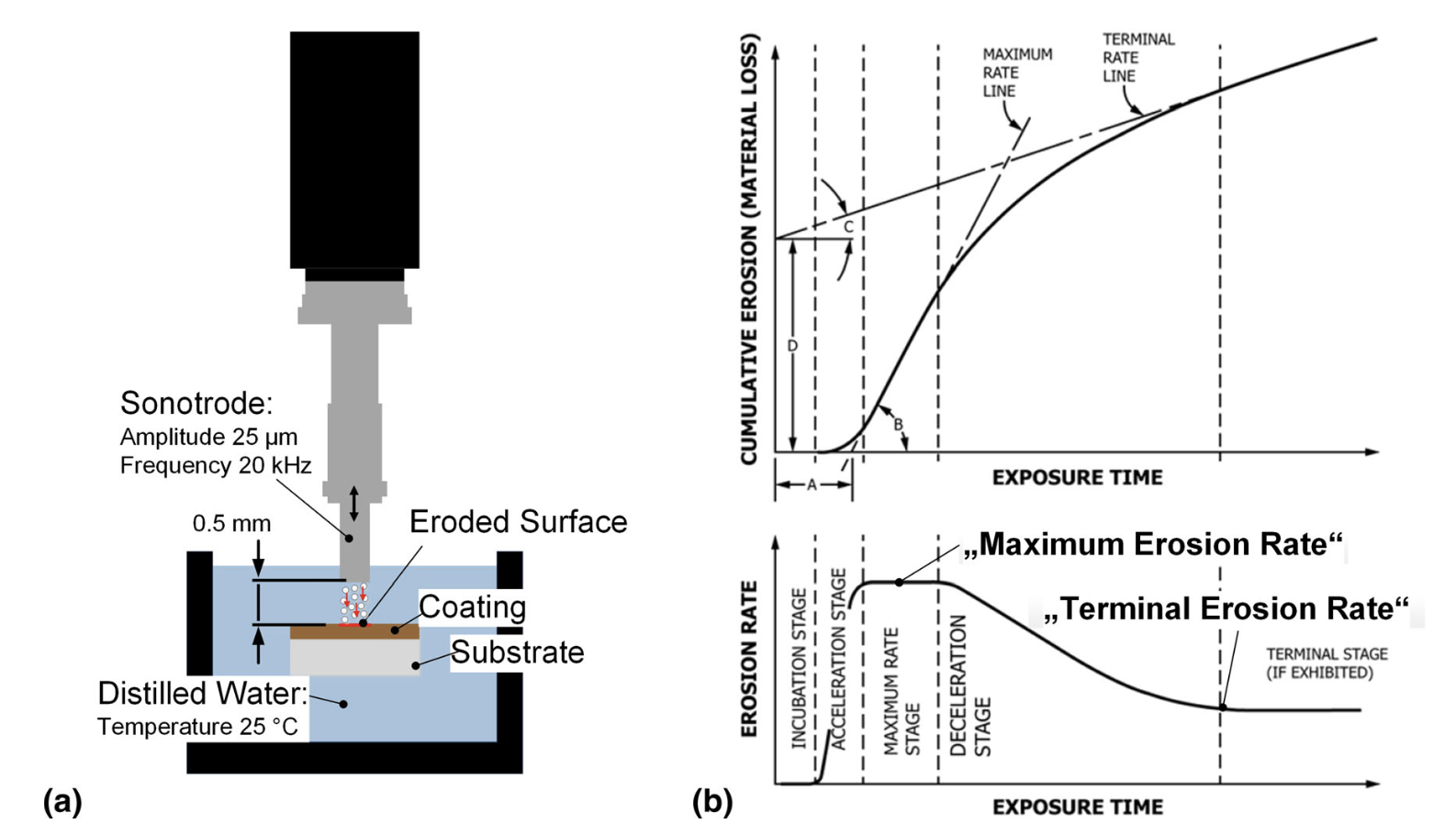
(a) Kavitatioun Erosiounstest no ASTM G32-16 mat Sonicator UIP1000hd (indirekt Method). All Testparametere sinn nominal Wäerter; d'Toleranzen sinn an der Norm opgelëscht.
(b) Schematesch Phasen an der Erosioun-Zäit Kurve an charakteristesch Parameter am Testprozedur.
Grafiken a Studie: ©Hauer et al., 2021.
Ultraschall Kavitatioun Erosiounstest vu Bronze Beschichtungen
Fir d'Marine Bronze Beschichtung Beispill gouf den Test an der indirekter ASTM G32 Arrangement gemaach. An dëser Konfiguratioun ass d'Exemplar net un de vibréierende Horn befestegt. Amplaz generéiert d'Ultraschall Sonotrode Kavitatioun am destilléiertem Waasser, an de Beschichtete Exemplar ass ënner der Sonotrode bei engem definéierte Spalt fixéiert. Hauer et al. benotzt eng 0,5 mm Distanz tëscht Probe a Sonotrode, eng Frequenz vun 20 kHz, an eng Peak-to-Peak Amplitude vun 50 µm. D'Testflëssegkeet war destilléiert Waasser, gehal bei ongeféier Raumtemperatur, ongeféier 25 ° C.
Specimen preparation is a critical step. Before cavitation exposure, the coated surfaces were stepwise ground and polished down to a fine diamond abrasive below 4 µm. This reduces the influence of loosely attached particles or surface irregularities that could otherwise detach immediately and distort the erosion curve. The goal is not to make the coating look good, but to create a reproducible starting condition so that measured mass loss reflects cavitation resistance rather than poor surface preparation.

Héicht justierbar Testzelle fir Kavitatiounserosiounstest (ASTM G32-16)
The Procedure of Ultrasonic Cavitation Erosion Testing and its Results
Déi praktesch Testprozedur ass einfach. Als éischt gëtt all Exemplar gebotzt, gedréchent a gewien op enger Präzisiounsbalance. Et gëtt dann an der Testzelle ënner der Sonotrode BS4d22 vum Sonicator UIP1000hdT montéiert mat der 0,5 mm Spalt suergfälteg a widderholl. De Sonicator gëtt mat der definéierter Amplitude a Frequenz operéiert, während d'Flëssegkeetstemperatur kontrolléiert gëtt fir d'Heizung vun der Kavitatiounsintensitéit z'änneren. No engem definéierte Beliichtungsintervall gëtt d'Prouf ewechgeholl, gebotzt, gedréchent an erëm gewien. Dës Sequenz gëtt iwwer ëmmer méi, materiell ofhängeg Beliichtungsintervaller widderholl bis eng komplett Erosiounskurve kritt gëtt.
The raw measurement is mass loss. For engineering comparison, this mass loss is converted into volume loss using the material density. The volume loss is then divided by the exposed surface area to determine mean erosion depth. From the erosion-depth curve, the researcher can calculate characteristic erosion parameters such as maximum erosion rate, terminal erosion rate, and mean depth of erosion. Hielscher also notes that erosion can be reported as mass, volume, or penetration depth per time or per delivered ultrasonic energy, depending on the chosen protocol.
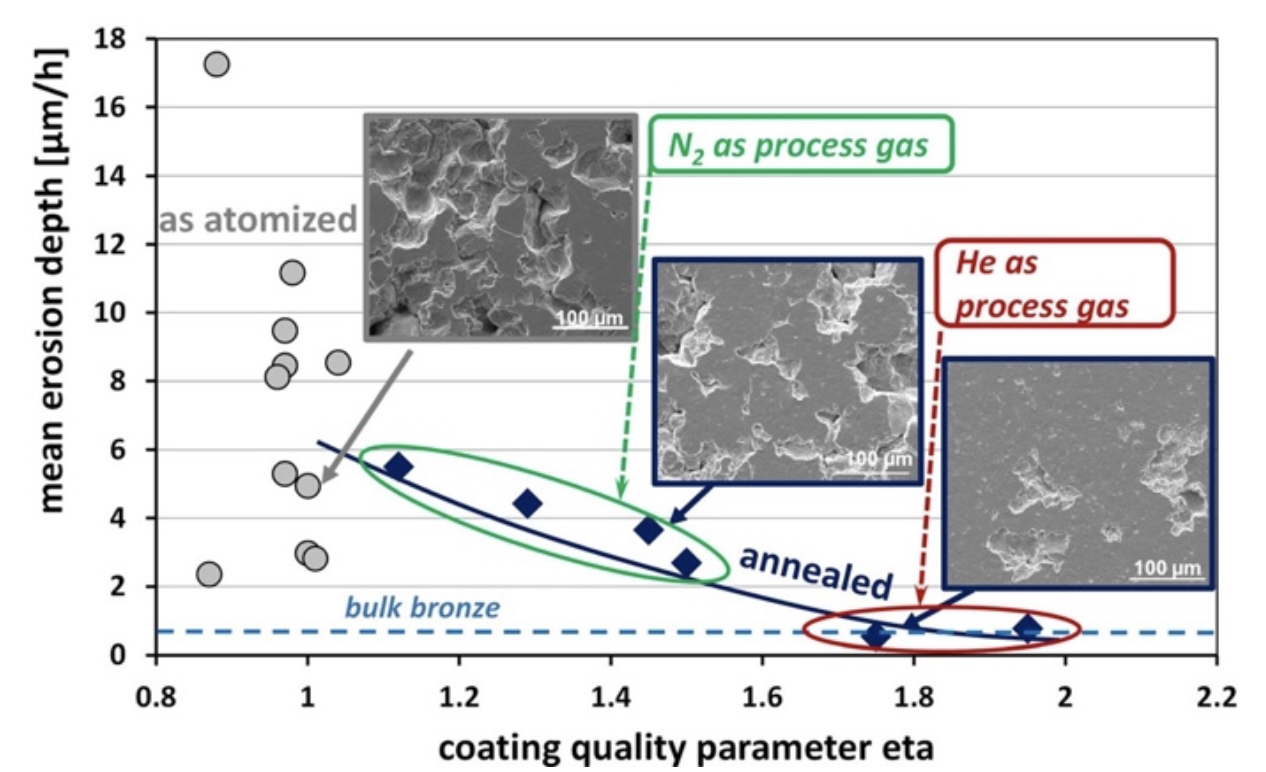
Moyenne Erosiounsdéiften als Funktioun vun ugepasste Beschichtungsqualitéitsparameter n. Pulverglühung an domat reduzéierter Pulverstäerkt erméiglecht et héich Beschichtungsqualitéiten z'erreechen. D'Inserts weisen den Uewerflächeschued kritt no enger Kavitatiounstestzäit vun 100min.
Grafiken a Studien: ©Hauer et al., 2021.
Eng wichteg Lektioun aus der Hauer Etude ass datt fréi Erosiounsraten täuschend kënne sinn. Thermesch a kinetesch gesprëtzt Beschichtungen hunn dacks héich initial Materialverloscht gewisen, gefollegt vun enger méi niddereger, méi stabiler Erosiounsquote. Aus dësem Grond, Hauer et al. benotzt terminal Erosiounsquote als méi representativ Indikator fir laangfristeg Beschichtungsleistung. An hirem 120-Minute Verglach gouf d'Terminal Erosiounsquote haaptsächlech vun der zweeter Halschent vum Test evaluéiert, iwwer 60 Minuten, fir dat stabiliséiert Verhalen besser z'erfaassen.
The test results show why a controlled vibratory cavitation apparatus is valuable. Cast nickel aluminum bronze achieved a terminal erosion rate of about 0.40 µm/h. Optimized warm-sprayed bronze reached 0.57 µm/h, close to the cast reference. An optimized arc-sprayed coating on shipbuilding steel reached about 1.02 µm/h, while an optimized HVOF coating reached about 1.74 µm/h. Even when these coatings did not fully match cast propeller bronze, they dramatically outperformed shipbuilding steel; the study reports that arc-sprayed and HVOF-sprayed coatings achieved about 26 times and 16 times better cavitation resistance, respectively, than VL-A steel.

Ersatzbar Tipp fir ASTM G32 – Kavitatioun Erosioun Test
Use a Sonicator as Vibratory Apparatus for Your Cavitation Erosion Tests
 The practical conclusion is that cavitation erosion testing with the UIP1000hdT sonicator as vibratory apparatus can do more than rank materials. It reveals how coating process, microstructure, oxide content, porosity, interface bonding, and post-treatment affect real erosion behavior. Hauer et al. concluded that HVOF and arc spraying can offer a strong performance-cost compromise for improving steel rudder surfaces, while cold and warm spraying are preferred when cavitation resistance close to bulk nickel aluminum bronze is required.
For laboratories and coating developers, the key to reproducible results is strict control of the test parameters: sonotrode amplitude, frequency, sonotrode-to-sample distance, liquid temperature, liquid chemistry, specimen preparation, weighing intervals, and erosion-rate calculation. With these conditions defined, the Hielscher UIP1000hdT provides a practical and repeatable way to translate ultrasonic cavitation into quantitative coating-performance data.

Beispill Worksheet fir Kavitatioun Erosioun Testen
You can find instructions for Cavitation Erosion Tests here!
ASTM G32 Cavitation Erosion Test Setup
The sonicators UIP500hdT, UIP1000hdT, UIP15000hdT and UIP2000hdT are suitable for ASTM G32 testing. We can supply each of these units with an accurate Amplitudenmessprotokoll of the mechanical amplitude at the sonotrode tip. We recommend using either of these devices with a sonotrode BS4d22 (22mm diameter) and a stand ST2.
| sonicator | Ultrasound Power | Frequenz |
|---|---|---|
| UIP500hdT | 500 Watt | 20 kHz |
| UIP1000hdT | 1000W | 20 kHz |
| UIP1500hdT | 1500 Watt | 20 kHz |
| UIP2000hdT | 2000W | 20 kHz |

ASTM G32 -16 15.9mm Sonotrode mat ersatbare Tipp
Design, Fabrikatioun a Berodung – Qualitéit Made in Germany
Hielscher Ultraschaller si bekannt fir hir héchst Qualitéit an Designnormen. Robustheet an einfach Operatioun erlaben déi glat Integratioun vun eisen Ultraschaller an industriellen Ariichtungen. Rau Konditiounen an erfuerderlech Ëmfeld ginn einfach vun Hielscher Ultraschaller gehandhabt.
Hielscher Ultrasonics ass eng ISO zertifizéiert Firma a setzt spezielle Wäert op High-Performance Ultrasonicatoren mat modernste Technologie a Benotzerfrëndlechkeet. Natierlech sinn Hielscher Ultraschaller CE konform an entspriechen d'Ufuerderunge vun UL, CSA a RoHs.

Kavitatioun Erosioun Op Titan Uewerfläch
Oft gestallten Froen
What is ASTM G32-16?
ASTM G32-16 ass eng ASTM International Standardtestmethod fir d'Moossnam vu Kavitéierungserosioun mat engem vibratoreschen Apparat. An der referenzéierter Etude gouf et an enger indirekter Anordnung mat engem 20 kHz Sonotrode, 50 µm Peak-to-Peak-Amplitude an enger 0,5 mm Probezum-Sonotrode-Distanz ugewannt.
Wat sinn Bronze Beschichtungen?
Bronzebeschichtungen sinn Kupfer-baséiert Legierungs-Uewerflächeschichten, wéi Ni-Al-Bronze oder Mn-Al-Bronze, déi op e Substrat duerch Prozesser wéi Kältesprayen, Waarmsprayen, HVOF-Sprayen oder Bogenprayen applizéiert ginn. Si ginn benotzt fir d'Widderstandsfäegkeet géint Uewerflächswäertung, Korrosioun an Kavitéierungserosioun ze verbesseren, besonnesch op maritime Komponente.
Fir wat gëtt Kavitéierungserosiounstest benotzt?
Cavitation erosion testing is used to quantify how resistant a material or coating is to damage caused by the collapse of cavitation bubbles. It measures material loss over time, converts it into erosion depth, and evaluates parameters such as maximum erosion rate and terminal erosion rate for material comparison and process selection.
Are Ultrasonic Vibratory Apparatuses used for Other Test Methods?
Yes. Beyond ASTM G32-16, ultrasonic vibratory apparatuses (sonicators) can support comparative studies of cavitation–corrosion or coating durability.
Discover how cavitation erosion testing is used for marine bronze coatings!
Furthermore, ultrasonic vibration is used for axial fatigue testing, particularly in the very-high-cycle fatigue regime. A specimen tuned to longitudinal resonance – typically near 20 kHz–is subjected to cyclic tension – compression.
Discover how ultrasonic vibrations are used for axial fatigue testing of specimens!
Literatur / Referenzen
- Hielscher Cavitation Erosion Test Protocol – ASTM G32
- Hauer, Michél; Gärtner, Frank; Krebs, Sebastian; Klassen, Thomas; Watanabe, Makoto; Kuroda, Seiji; Krömmer, Werner; Henkel, Knuth-Michael (2021): Process Selection for the Fabrication of Cavitation Erosion-Resistant Bronze Coatings by Thermal and Kinetic Spraying in Maritime Applications. Journal of Thermal Spray Technology 30, 2021.
- Bolewski, Łukasz; Szkodo, Marek; Kmieć, Mateusz (2017): Cavitation erosion degradation of Belzona® coatings. Advances in Materials Science. 17, 2017.
- Kmieć, Mateusz; Karpiński, Bartłomiej; Szkodo, Marek (2016): Cavitation Erosion of P110 Steel in Different Drilling Muds. Advances in Materials Science. 16, 2016.
- Müller, Saskia; Fischper, Maurice; Mottyll, Stephan; Skoda, Romuald; Hussong, Jeanette (2014): Analysis of the cavitating flow induced by an ultrasonic horn – Experimental investigation on the influence of actuation phase, amplitude and geometrical boundary conditions. EPJ Web of Conferences 67, 2014.
- héich Effizienz
- Staat-vun-der-Konscht Technologie
- Zouverlässegkeet & Robustheet
- justierbar, präzis Prozess Kontroll
- batch & an der Schlaang
- fir all Volumen
- intelligent Software
- Smart Features (zB programmierbar, Datenprotokoll, Fernbedienung)
- einfach a sécher ze bedreiwen
- niddereg Ënnerhalt
- CIP (clean-in-place)
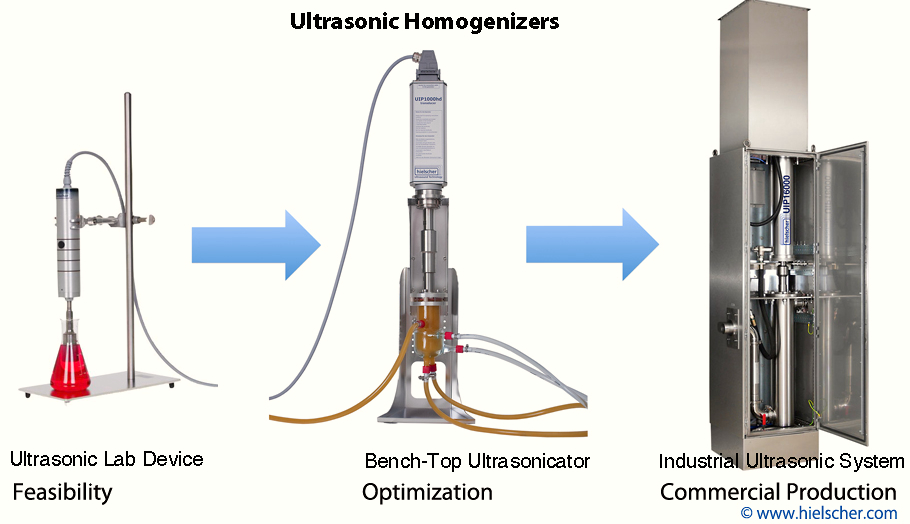
Hielscher Ultrasonics fabrizéiert High-Performance Ultrasonic Homogenisatoren aus Labo zu industriell Gréisst.