Redução sonoquímica de nanopartículas de paládio
O paládio (Pd) é bem conhecido pelas suas propriedades catalíticas e é também amplamente utilizado na investigação de materiais, no fabrico de produtos eletrónicos, na medicina, na purificação de hidrogénio e em várias aplicações químicas. Através de um processo sonoquímico, é possível controlar o tamanho e a morfologia das partículas de paládio ajustando a proporção PVP/Pd. Isto permite a síntese por ultrassons tanto de nanopartículas muito finas e monodispersas como de agregados de paládio de maiores dimensões, permitindo adaptar as dimensões das partículas para obter um desempenho catalítico ideal.
Produção ultra-sónica de nanopartículas de paládio
 A redução ultrassónica de nanopartículas de paládio oferece uma via rápida e eficiente em termos de reagentes para a obtenção de nanopartículas de Pd(0), recorrendo à cavitação acústica para gerar condições localizadas de alta energia e à redução de radicais em solução, permitindo que os iões de paládio sejam reduzidos sem o recurso a processos convencionais a altas temperaturas.
Uma vantagem fundamental é o controlo do processo: o tempo de sonicação e a concentração do estabilizador, tal como a relação PVP/Pd, podem influenciar se o produto se forma como nanopartículas bem dispersas e arredondadas com cerca de 5 nm ou como agregados maiores com cerca de 20 nm, o que é relevante do ponto de vista industrial, uma vez que o desempenho do paládio na catálise depende fortemente do tamanho das partículas, da morfologia, da dispersão e da área superficial. Uma vez que as nanopartículas de paládio são amplamente valorizadas como catalisadores heterogéneos, eletrocatalisadores e materiais funcionais, a redução por ultrassons é uma opção atraente para a produção de catalisadores de Pd finamente dispersos em condições relativamente suaves de fase líquida, com potenciais benefícios para a síntese química, a catálise ambiental, as tecnologias de células de combustível e outros processos em que uma elevada atividade catalítica e a utilização eficiente de metais nobres são economicamente importantes.

Processamento industrial de nanopartículas com o sonicador UIP2000hdT
Procedimento de preparação de amostras
As amostras foram preparadas da seguinte forma:
Para as amostras, misturas de 30mL de EG e 5-10-6Foram preparadas mol de PVP por agitação magnética durante 15 min. Para as diferentes amostras, foram adicionadas quantidades diferentes de solução de Pd(NO₃)₂, nomeadamente 1,5 mL e 2 mL. As misturas das amostras foram preparadas na proporção de 2·10-3mol de Pd(NO₃)₂ na amostra (a) e 2,66·10-3mol de Pd(NO₃)₂ na amostra (b). Ambas as misturas foram submetidas a sonicação num frasco de 20 mL, utilizando um ultrassonificador do tipo sonda. Foram recolhidas amostras após tempos de sonicação de 30, 60, 90, 120, 150 e 180 min.
A análise dos resultados experimentais mostra que:
- 1. A redução sonoquímica de Pd(II) em Pd(0) depende do tempo de sonicação.
- 2. A elevada razão molar PVP/Pd(II) leva à formação de partículas de paládio monodispersas com uma forma arredondada e um diâmetro médio de cerca de 5nm.
- 3. No entanto, a baixa razão molar PVP/Pd(II) implica a obtenção de agregados de nanopartículas de paládio com uma grande distribuição de tamanho centrada em 20nm.
A via sonoquímica de redução de iões paládio (II) Pd(II) para átomos de paládio Pd(0) pode ser assumido como sendo o seguinte:
- (1) Pirólise da água: H₂O → •OH + •H
- (2) Formação de radicais: RH (agente redutor) + •OH(•H) → •R + H₂O(H₂)
- (3) Redução dos iões: Pd(II) + radicais redutores (-H, -R) → Pd(0) + R-CHO + H+
- (4) Formação de partículas: NPd(0) → Pdn
Resultados: Dependendo do rácio PVP/Pd(II), o PdN foram obtidos.
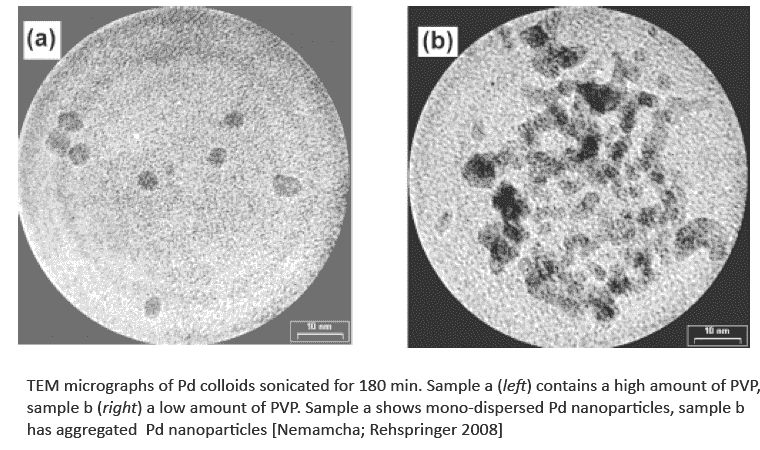
Redução sonoquímica do paládio: a amostra a (à esquerda) contém uma elevada quantidade de PVP, enquanto a amostra b (à direita) contém uma quantidade reduzida de PVP. Tempo de sonicação com o UP100H: 180 min. A amostra a apresenta nanopartículas de Pd monodispersas, enquanto a amostra b apresenta nanopartículas de Pd agregadas.
Imagens e estudo: ©Nemamcha e Rehspringer, 2008
Análise e resultados
As análises de absorção UV-visível confirmam a relação entre a redução sonoquímica de iões de paládio (II) a átomos de paládio (0) e o tempo de retenção no campo ultrassónico. A redução de iões de paládio (II) a átomos de paládio (0) progride e pode ser completamente alcançada com o aumento do tempo de sonicação. As micrografias de microscopia eletrónica de transmissão (TEM) mostram que:
- Quando se adiciona uma quantidade elevada de PVP, a redução sonoquímica dos iões de paládio conduz à formação de partículas de paládio monodispersas, de forma esférica e com um diâmetro médio de aproximadamente 5 nm.
- A utilização de uma pequena quantidade de PVP permite a obtenção de agregados de nanopartículas de paládio. As medições por espalhamento dinâmico de luz (DLS) revelam que os agregados de nanopartículas de paládio apresentam uma ampla distribuição de tamanhos, centrada nos 20 nm.

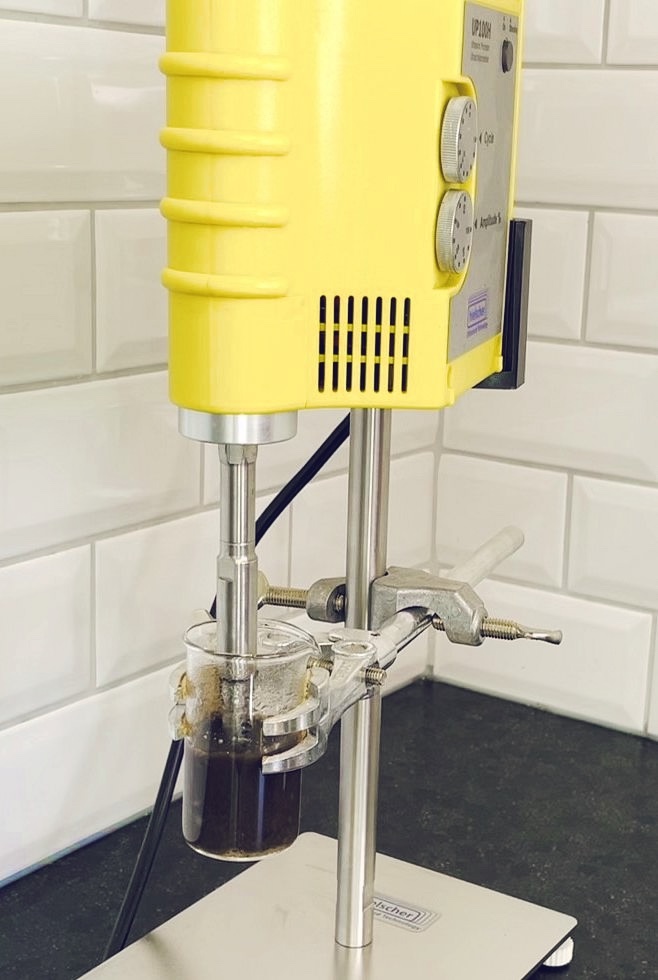
O sonicador de laboratório UP100H tem sido utilizado na preparação de nanopartículas de paládio.

As nanopartículas de paládio (Pd) podem ser preparadas por sonicação
Conceção, fabrico e consultoria – Qualidade fabricada na Alemanha
Os ultrassons Hielscher são conhecidos pelos seus elevados padrões de qualidade e design. A robustez e a facilidade de operação permitem a integração harmoniosa dos nossos ultrassons nas instalações industriais. As condições difíceis e os ambientes exigentes são facilmente controlados pelos ultrassons Hielscher.
A Hielscher Ultrasonics é uma empresa certificada pela ISO e dá especial ênfase aos ultrassons de alto desempenho com tecnologia de ponta e facilidade de utilização. Naturalmente, os ultrassons da Hielscher estão em conformidade com a CE e cumprem os requisitos da UL, CSA e RoHs.
Literatura/Referências
- Nemamcha, A.; Rehspringer, J. L. (2008): Morphology of dispersed and aggregated PVV-Pd nanoparticles prepared by ultrasonic irradiation of Pd(NO₃)₂ solution in ethylene glycol. Rev. Adv. Mater. Sci. 18;2008. 685-688.
- Prekob, Á., Muránszky, G., Kocserha, I. et al. (2020): Sonochemical Deposition of Palladium Nanoparticles Onto the Surface of N-Doped Carbon Nanotubes: A Simplified One-Step Catalyst Production Method. Catalysis Letters 150, 2020. 505–513.
- Haitao Zheng, Mphoma S. Matseke, Tshimangadzo S. Munonde (2019): The unique Pd@Pt/C core-shell nanoparticles as methanol-tolerant catalysts using sonochemical synthesis. Ultrasonics Sonochemistry, Volume 57, 2019. 166-171.
Fatos, vale a pena conhecer
O que é o paládio?
O paládio é um metal precioso raro, de cor branco-prateada, com o símbolo químico Pd e o número atómico 46. Pertence aos metais do grupo da platina e é valorizado pela sua estabilidade química, pela sua capacidade de conduzir eletricidade, pela sua capacidade de absorver hidrogénio e por ser um excelente catalisador. O paládio finamente dividido é especialmente eficaz em reações de hidrogenação e desidrogenação, e, quando aquecido, permite que o hidrogénio se difunda através dele, o que o torna útil para a separação e purificação do hidrogénio.
Para que servem as nanopartículas de paládio?
As nanopartículas de paládio são utilizadas principalmente como catalisadores de grande área superficial. Uma vez que as nanopartículas apresentam uma área superficial ativa muito superior à do paládio em massa, podem melhorar a eficiência do catalisador e reduzir a quantidade de metal nobre dispendioso necessária. As aplicações típicas incluem a síntese química, reações de hidrogenação, reações de acoplamento carbono-carbono, eletrocatálise, investigação sobre células de combustível, deteção e armazenamento de hidrogénio, catálise ambiental e algumas áreas de investigação biomédica, tais como sistemas antimicrobianos, fototérmicos e anticancerígenos. O comportamento catalítico do paládio depende fortemente do tamanho das partículas, da morfologia e da dispersão.
As nanopartículas de paládio também são utilizadas para dopar outras partículas, com o objetivo de obter funcionalidades catalíticas. Saiba mais sobre o método ultrassónico para sintetizar Pd/N-BCNT como catalisador de Fischer-Tropsch!
O paládio é tóxico?
Considera-se geralmente que o paládio metálico elementar tem baixa toxicidade e não desempenha qualquer função biológica conhecida; no entanto, os compostos, sais, poeiras e formas à escala nanométrica do paládio devem ser manuseados com cuidado. A exposição no local de trabalho ou em laboratório pode causar irritação ou sensibilização, dependendo do composto e da via de exposição; as soluções de cloreto de paládio, por exemplo, podem irritar as membranas mucosas. No que diz respeito ao manuseamento industrial, a resposta prática é a seguinte: o paládio metálico a granel apresenta um risco relativamente baixo, mas os pós de paládio, os sais solúveis de paládio e as nanopartículas de paládio devem ser tratados como materiais potencialmente perigosos, com medidas de controlo de poeiras, ventilação, uso de luvas, proteção ocular e gestão adequada de resíduos.