Ultrasonic Peptide Synthesis Using the TAGGING Technique
Peptidsynthese ass e Grondsteen vun pharmazeuteschen R+D, awer konventionell Methoden – solid-phase peptide synthesis (SPPS) and classical solution-phase coupling – bleiwen Aarbechtsintensiv, reagens-verschwendung, a schwéier ze Skala. Eng méi effizient Alternativ ass entstanen an der Kombinatioun vun zwee orthogonalen Strategien: d'TAGGING (temporär Verankerungsgrupp) Technik fir Léisungsphase Peptidversammlung an Ultraschall (sonochemesch) Veraarbechtung fir d'Kupplung, d'Entschutz an d'Aarbechtsschrëtt ze beschleunegen. Zesummen erméiglechen se Gramm- bis Bulk-Skala Produktioun vun therapeutesche Peptiden – wéi den Antibiotikum / Antikriibs Lipopeptid Lipobactin – mat héijer Rengheet, reduzéierter Reinigungslaascht, an dramatesch manner manuell Operatiounen.
Wéi eng Virdeeler kommen mat der Ultraschall-Peptidsynthese?
- Léisungsphase Wirtschaft: Reaktiounen lafen a Léisung mat wesentlech méi nidderegen Aminosaierverbrauch wéi zolidd Phase Peptidsynthese
- Filtratioun-baséiert Reinigung: The TAG-bound peptide precipitates in polar solvents, so intermediates are isolated by simple filtration – no column chromatography or per-step characterization needed.
- Massive labor savings: Eliminating intermediate purifications and spectral checks saves substantial human hours across a full synthesis campaign.
- Sonochemical acceleration: Sonication shortens every critical step – Fmoc deprotection, side-chain coupling, cyclization, and global deprotection – without compromising selectivity.
- High yields, high purity: Each fragment coupling and the final lipobactin assembly proceed in high yield; the global deprotection gives the target in ~83 % yield.
- Bulk-scale readiness: The TAGGING technique is explicitly described as enabling bulk-scale preparation of peptides with utmost purity, making it a practical route to gram and kilogram quantities of therapeutically important lipopeptides.
- Full method compatibility: The approach is fully compatible with conventional SPPS and solution-phase chemistry, so existing protecting-group strategies (Fmoc, Alloc, Pbf, tBu) and coupling agents (T3P, HATU, COMU, DIC/DMAP) carry over unchanged.
Tell us about the challenges in your peptide synthesis process. Our sonication experts recommend you the ideal sonicator configuration for your peptide production targets!

Industriell Sonicator UIP2000hdT with pharma-batch reactor for enhanced peptide synthesis
What is the TAGGING technique?
In the TAG approach, a peptide fragment is covalently anchored to a removable, resin-like anchor (TAG) group that remains in solution. This lets the growing chain be handled like a solid-phase peptide, but in the liquid phase:
- After each coupling or deprotection, the TAG-bound peptide is recovered as a solid by simple filtration or precipitation in polar/anti-solvent media, while soluble impurities and by-products are washed away.
- Because the peptide stays attached to the linker, column chromatography and full characterization of every intermediate are largely eliminated, saving significant time and human effort.
- Reactions can be run in solution phase, using far less amino acid than SPPS, and the final product is released by cleavage of the TAG group near the end of the synthesis.
For lipobactin, the retro-synthesis used three fragments – Fmoc-Ala-Arg-TAG, Alloc-Thr(Ile-Fmoc)-OH, and the lipid fragment C₁₁H₂₃CONH-Ile-Ser(OᵗBu)-OH – coupled by a fragment-condensation strategy to achieve the long peptide in very high yields. (cf. Ramya et al., 2025)
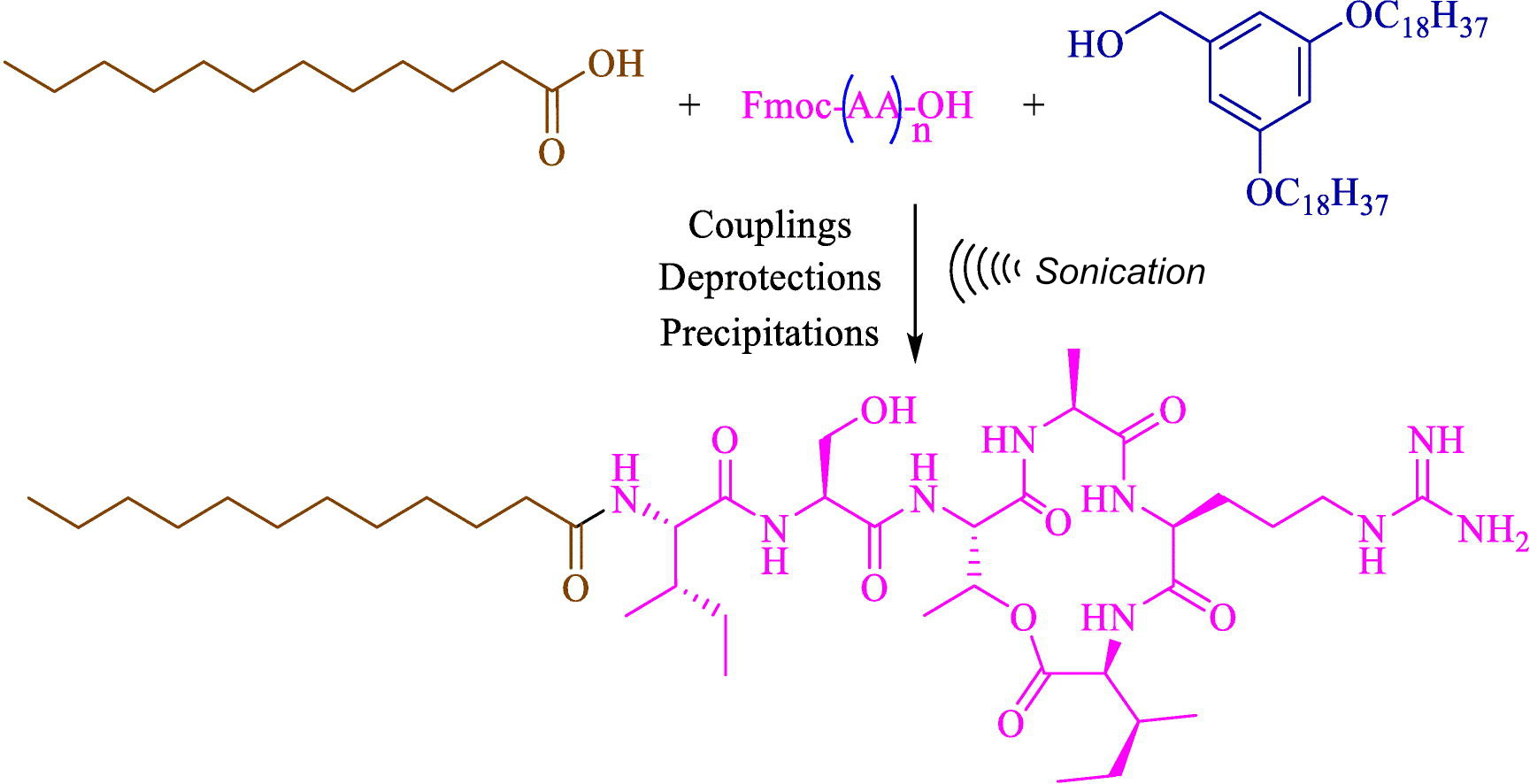
TAG-assisted complete synthesis of the peptide lipobactin is accelerated by sonication.
(Study: Ramya et al., 2025)
How Sonication Improves Solution Phase Synthesis of Peptides
Ultrasonication is used to intensify and shorten the key solution-phase steps. In the lipobactin synthesis as decribes by Ramya et al. (2025), sonication is applied to:
Because TAG chemistry already delivers intermediates as filterable solids, ultrasonication and TAGGING are complementary: ultrasound speeds mass transfer, mixing, and reaction kinetics, while the anchor keeps the peptide as a recoverable solid for a clean, chromatography-light workflow.

Sonicator UP200St: Ultrasonically agitated reactor for accelerated peptide synthesis.
Facile Scale-up of High-Purity Peptides with Sonication
A frequent challenge in moving peptide and peptide-drug processes from the bench to production is preserving the sonochemical effect at larger volumes and continuous flow. Hielscher addresses this with a continuous range of ultrasonic processors from laboratory to full industrial scale, delivering validated, reproducible power and documented process control.
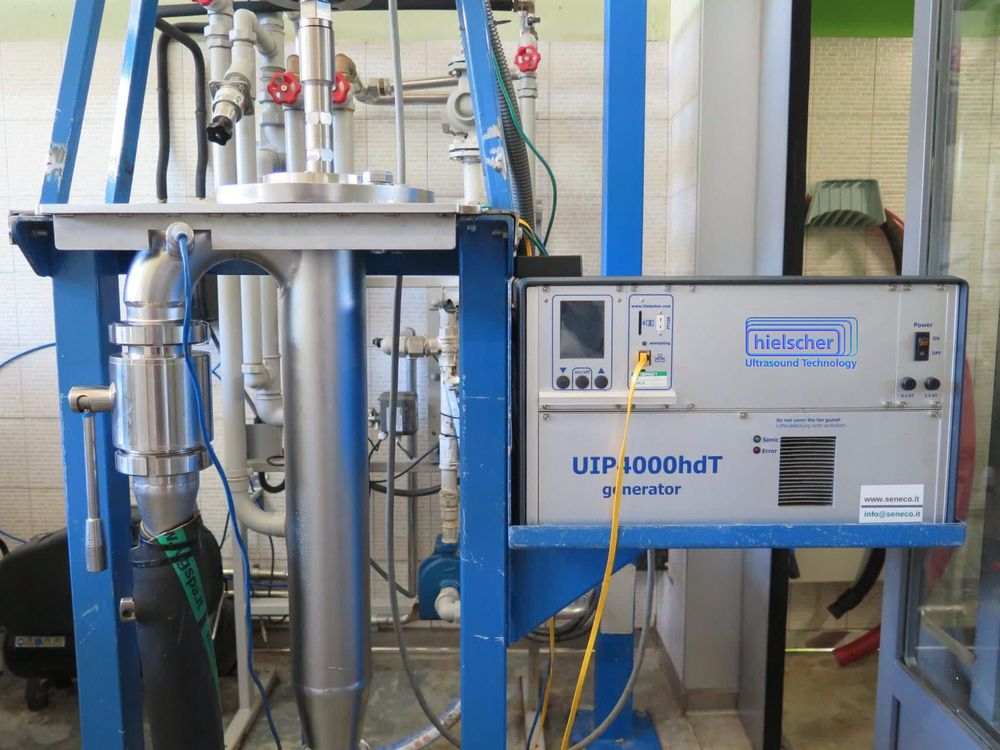
Industrial sonicator UIP4000hdT (4000W, 20kHz) for ultrasonically-enhanced peptide synthesis
Frequently Asked Questions about Sonication-Assisted TAG Peptide Synthesis
What is liquid-phase peptide synthesis (LPPS)?
Liquid-phase peptide synthesis (LPPS) is a method for building peptides step-by-step in solution using classic organic chemistry tools. It is one of the four main methods for creating peptides and is known for being cost-effective, scalable, and the most environmentally friendly among peptide synthesis approaches. It is particularly well-suited for shorter peptides, though it can encounter difficulties with longer sequences due to challenges in maintaining consistent reactions, solubility, and removing unwanted byproducts.
How does ultrasound enhance liquid-phase peptide synthesis?
Ultrasound (sonication) enhances LPPS by accelerating both coupling and deprotection steps. The ultrasonic waves improve mass transfer and reaction kinetics, leading to:
- Reduced reaction times: Koppelen- a Deprotektiounszyklë kënnen wesentlech verkierzt ginn
- Héichere Rendementen: méi komplett Konversioun bei all Schrëtt
- Verbessert Gereinigtheet vum roude Produkt: wénger onkomplett Koppel-Nebenprodukter
- Niddereg Reagenzverbrauch: wéineg Äquivalenter vun Koppelreagenzen an Aminosaieren si wéinst méi séiere, méi effizienten Reaktiounen néideg
Wat ass TAG-ënnerstëtzt Peptidsynthese (TAPS)?
Tag-Assisted Peptide Synthesis (TAPS) is a special case of liquid-phase peptide synthesis in which peptides are built step-by-step in solution using soluble organic tags instead of a solid support. These tags, analogous to the solid supports in SPPS, simplify isolation after each synthesis step by enabling separation through precipitation, filtration, or extraction. The tags must dissolve in organic solvents while remaining distinct from other materials.
How does ultrasound enhance the TAGGING process?
When ultrasonication is combined with TAG-assisted synthesis, the benefits include:
- Faster coupling and deprotection cycles – ultrasound accelerates the solution-phase reactions, reducing the time per step
- Improved solubility and mass transfer – ultrasonic cavitation helps maintain homogeneity of the tagged peptide in solution, which is critical since solubility is a key advantage of TAPS over SPPS
- Reduced reagent loading – higher reaction efficiency means fewer equivalents of amino acids and coupling reagents are needed
- More complete reactions – reduced incomplete coupling by-products, leading to higher crude purity and simplified downstream purification
A notable example is the TAG-assisted and ultrasonication-mediated total synthesis of lipobactin, which demonstrated that the TAGGING technique is fully compatible with solution-phase methods and that ultrasonication mediates high yields throughout each step. (cf. Ramya et al., 2025)
What peptide lengths are accessible with ultrasonic-assisted TAPS?
Short to medium peptides (~5–20 residues) are the sweet spot, where TAPS delivers high purity and reliable results.
Longer peptides can be accessed via a fragment condensation strategy: smaller fragments (6–10-mers) are synthesized on tag, then coupled together to build the full-length target.
For very long or complex targets, a hybrid SPPS/TAPS approach can be employed.
Discover how sonication improved Solid-Phase Peptide Synthesis (SPPS)!
Can ultrasonic-assisted liquid-phase peptide synthesis scaled to industrial production?
Yes, industrial sonicators – such as the Hielscher models UIP2000hdT or UIP4000hdT – can be integrated into batch reactors and flow-cells allowing for large scale peptide production. Retro-fitting into existing reactors allow to improve established peptide synthesis processing.
What are the main advantages of ultrasonic LPPS over conventional LPPS?
- Geschwindegkeet: reaction times are dramatically reduced at each coupling and deprotection step.
- Effizienz: higher per-step yields lead to higher overall yield for multi-residue peptides.
- Nohaltegkeet: fewer reagent equivalents and potentially less solvent due to faster reactions.
- Accessibility: requires only a standard ultrasonic bath, no specialized instrumentation.
- Compatibility: works with standard coupling reagents (DIC, HATU, TBTU, Oxyma, etc.) and protecting group strategies (Boc, Fmoc).
Literatur / Referenzen
- M. Ramya, Veeranjaneyulu Avula, S. Nandeesh, B. Kirankumar, G. Nagendra (2025): TAG assisted and ultrasonication mediated total synthesis of lipobactin. Results in Chemistry, Volume 18, 2025, 102842.
- Andrew M. Bray; Liana M. Lagniton; Robert M. Valerio; N.Joe Maeji (1994): Sonication-assisted cleavage of hydrophobic peptides. Application in multipin peptide synthesis. Tetrahedron Letters 35(48), 1994. 9079–9082.
- Raheem, Shvan J; Schmidt, Benjamin W; Solomon, Viswas Raja; Salih, Akam K; Price, Eric W (2020): Ultrasonic-Assisted Solid-Phase Peptide Synthesis of DOTA-TATE and DOTA-linker-TATE Derivatives as a Simple and Low-Cost Method for the Facile Synthesis of Chelator-Peptide Conjugates. ACS Bioconjugate Chemistry, 2020.
- M.V. Anuradha, B. Ravindranath (1995): Ultrasound in peptide synthesis. 4: Rapid cleavage of polymer-bound protected peptides by alkali and alkanolamines. Tetrahedron Volume 51, Issue 19, 1995. 5675-5680.

Ultraschall CupHorn fir d'intensiv Sonikatioun vu zouenen Tuben a Fläschen fir steril Peptidsonikatioun.
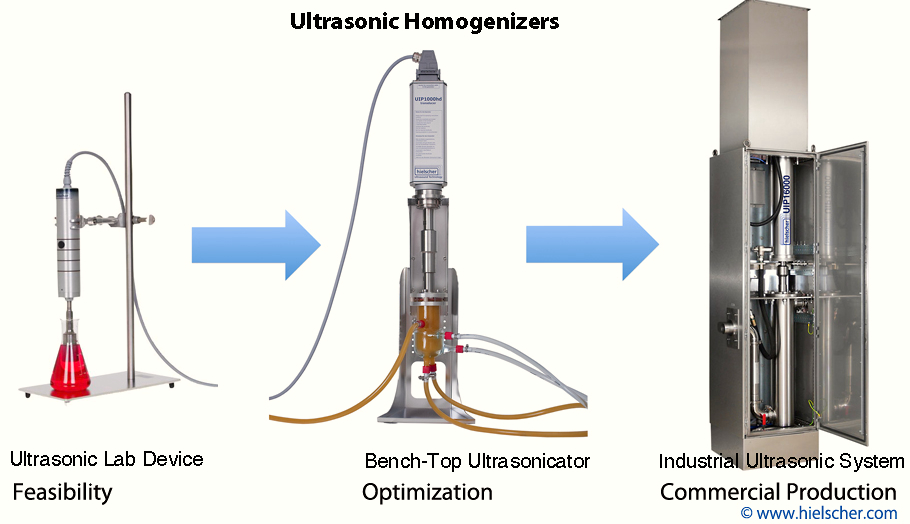
Hielscher Ultrasonics fabrizéiert High-Performance Ultrasonic Homogenisatoren aus Labo zu industriell Gréisst.