Scale-Up Agrochemical Formulation with Industrial Sonicators
Agrochemical formulation requires dispersing, dissolving, emulsifying, and homogenizing compounds. Sonication is an effective method for creating high-quality chemical suspensions. It allows for the high-speed production of high-load formulations and facilitates the preparation of active ingredients like nanoparticles and polymers for highly functional agrochemicals.
Ultrasonic Manufacturing of Agricultural Chemicals
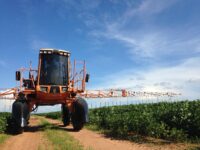 D'Produktioun vun Agrochemeschen – inklusiv Dünger (z.B. Stickstoff- a Phosphor-baséiert Verbindungen) an Planzeschutzmittel (z.B. Herbizider, Insektizider, Fungizider a Rodentizider) – erfuerdert präzis Verdeelen, Léisung an Emulgatioun vun hiren Deeler. Kraaft-Ultraschall adresséiert dës Veraarbechtungsbedierfnesser duerch d'Generéiere vu Cavitatioun-induzéierte héich Schéierkräfte, déi eng konsequent Mëschung, Homogeniséierung an Blendung duerch d'Formulatioun sécheren.
Vu stabilen Suspensiounen bis zu Nano-Dispersiounen, liwwert d'ultrasonic Veraarbechtung iwwerleeë Konsistenz an héich Durchsatz. Loosst eis Ingenieuren Äre momentanen Workflow analyséieren an eng skalierbar Léisung recommandéieren fir Energieverbrauch ze reduzéieren an d'Produkter Effektivitéit ze verbesseren.
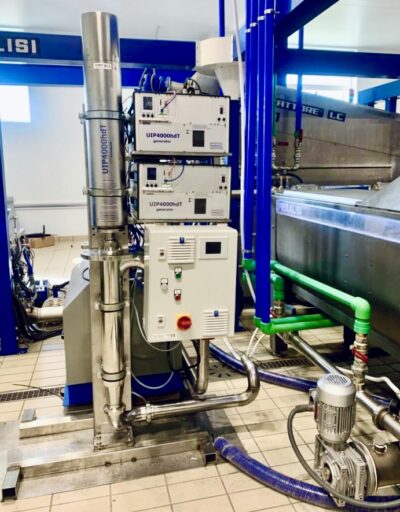
Industrie-Sonikator UIP4000hdT with flow cells for continuous inline processing of agrochemicals
Improve Crop Protection Products and Fertilizers with Sonication
How Crop Protection Products Benefit from Ultrasonics
- Suspension Concentrates (SCs): Milling active ingredients to sub-micron sizes to prevent settling and maximize field efficacy.
- Emulsifiable Concentrates (ECs): Producing stable, fine-mist oil-in-water emulsions to prevent phase separation.
- Wettable Powders: Deagglomerating dry powders to ensure rapid and complete wetting upon contact with water.
- Encapsulated Formulations: Uniformly dispersing polymer coatings to create controlled-release and UV-protective barriers.
How Fertilizers Benefit from Ultrasonics
- Liquid Fertilizers: Ensuring micronutrients don’t settle out (stabilizing suspensions).
- NPK Solutions: Preventing crystallization in high-concentration liquid fertilizers.
- Coated Urea: Improving the dispersion of polymers used in slow-release fertilizers.
The quality and effectiveness of agrochemicals is highly depending on the concentration, size and shape of active substances and additives as well as their interaction. This means that the dispersion, emulsion or suspension of the additives and active substances influences the expression of the desired features of a fertilizer or pesticide substantially. To produce high quality specialty chemicals such as agrochemicals, the liquid or solid particles must reliably processed: Ultrasonic particle size reduction, dispersion, emulsion and homogenization results in stable formulations and finally in high-quality chemical product.
Hielscher's Palette vun Ultraschall-Disperger an Homogeniséierer bitt déi passend “Aarbechtspäerd” fir Är Demande!
Improved Agrochemical Formulations – Méi héich Effizienz
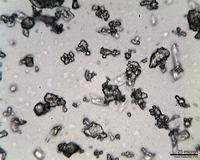 Agrochemical formulations typically combine one or more active ingredients with specialized additives to deliver the desired field performance. Depending on the application, these products are engineered as dispersions, emulsions, suspensions, microemulsions, or controlled-release systems. Achieving long-term stability requires precise control over the interaction forces between particles and droplets–a critical factor that directly impacts shelf life, efficacy, and regulatory compliance.
Ultrasonic processing addresses these formulation challenges by generating intense, localized shear forces through acoustic cavitation.
This technology reliably:
- Disperses solid powders uniformly into the liquid phase
- Emulgéiert Ueleger a Wachs a stabil, feinst Mist-Mëschungen
- Millt Partikelen op präzis Sub-Mikron- oder Nano-Gréissten
- Beschleunegt d'Léisung vun Salz a Elektrolyten
- Mëscht final Formulatiounen a héich homogeneous Produkter
Iwwer mechanesch Veraarbechtung eraus ënnerstëtzt Ultraschall aktiv fortgeschratt chemesch Transformationen. Et verbessert Reaktiounskinetik a erméiglecht spezialiséiert Prozesser wéi chemesch Synthese, sonochemesch Katalyse, Phase-Transfer-Katalyse (PTC), Polymerisatioun, an d'iwwerstëmmend Synthese oder Uewerflächfunktioun vun Nanopartikelen. Dës Villsäitegkeet mécht ultraschallveraarbechtung zu engem wäertvollen Asaz fir souwuel routinéiert Formuléierungs-Worfleows wéi och Next-Generation Agrochemikalien-Entwécklung.
Agrochemesch Ingredienten, déi mat Sonikatioun veraarbecht ginn, enthalen:
- Wettable Pudder (WP)
- Waasser dispersibel Granulat (WDG)
- Dry Flowables (DF)
- Flowables oder Suspension Concentrates (SC)
- Emulsifiéierbar Konzentrat (EC)
- Soluble Liquid Concentrates (SLC)
- Waasserléislech Granulat (WSG)
Advantages of Ultrasonic AgroChemical Processing:
- Héich Qualitéit Produiten
- Zuverlässeg Ultraschall
- präzis kontrolléierbar Prozessbedéngungen
- vum R&D zu Produktioun mat Hielscher d' Labo homogenizers, Bench-Top Apparater an industriell Systemer
- Fine chemicals manufacturing from kg to multi-ton batches
- Batch an Inline Veraarbechtung
- Einfach a sécher Operatioun
- Gréng, ëmweltfrëndlech Technik
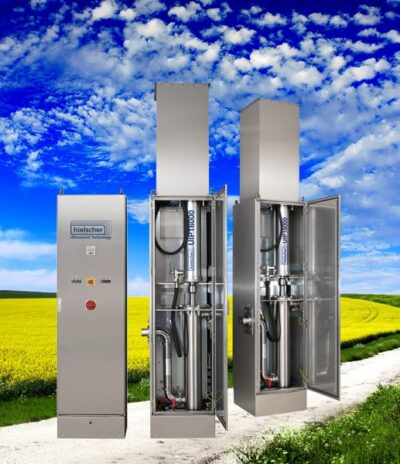
Industrial inline sonicator UIP16000hdT (16kW ultrasound power) for agrochemical production
Ingredients and Components in Agrochemicals
Agrochemesch Formuléierunge besteet aus verschiddene Komponenten. Déi wichtegst Ingredienten enthalen déi aktiv Substanzen (wéi chloréiert Kuelewaasserstoffer zB DDT, 2,4-D, 2,4,5-T), Organophosphate zB Parathion a Malathion, Carbamaten zB Carbaryl a Carbofuran, Triazin zB Atrazin a Simazin), Polymeren, Nanopartikelen, Elektrolyte (zB Salzer vu Glyphosat, Fomesafen, Glufosinat, Paraquat), Surfaktant flësseg Kristalle, Zwëscheprodukter (zB 2,2-Dimethoxypropan), Gelsystemer, Träger (zB Kuelewaasserstoffflëssegkeeten), anionesch & Net-ionesch Surfaktanten, Adjuvantë, Ueleger, Stabilisatoren an Emulgatoren. Dës Komponente mussen zouverlässeg veraarbecht ginn fir en effektiven landwirtschaftleche Produkt ze formuléieren dat Planzen a Ernte schützt vu schiedleche Schued, Pathogenen a Krankheeten.
Hielscher Ultrasonics’ homogenizers are established as reliable industrial mixing equipment to produce high quality chemicals.
FAQ – Ultrasonic Mixing Technology for Agrochemical Production
What agrochemical products can be processed with ultrasonic technology?
Ultrasonic processing is used across a wide range of agrochemical products, including:
- Dünger – micronutrient dispersions, liquid fertilizers, and NPK formulations
- Pestiziden – emulséierbar Konzentrate (EC), mehlbar Pulver (WP), Suspensiounskonzentrate (SC)
- Herbiziden, Insektiziden an Fungiziden – Verdeelung an Formuléierung vum aktive Wirkstoff
- Saaftbehandlungen – eenheetlech Uewerflächbedeckung an Verkapselung
- nanopartikel & Polymer Formuléierungen – kontrolléiert Synthese an Gréissereduktioun
Kënne Hielscher Ultraschallprozessoren héichviskos Agrochemikalieformulierungen bewältegen?
Jo. Hielscher Ultraschallprozessoren si an verschiddenen Konfiguratiounen verfügbar, inklusiv Batch-, Inline- an Multi-Stufesystemer, entwéckelt fir Formuléierungen vu variéierter Viskositéit ze bewältegen. Fir héichviskos agrochemikalesch Produkter garantéieren spezialiséiert Durchflusszellen an héich-Amplitud-Sonotroden eng effizient Energieiwwerdroung an eenheetlech Veraarbechtung.
Ass Ultraschallveraarbechtung gëeegent fir Agrochemikalieproduktioun op grousser Skala?
Absolutely. Hielscher provides industrial ultrasonic systems ranging from 100W to 16,000W per unit, with modular multi-unit configurations capable of processing liters to thousands of liters per hour. Many manufacturers use ultrasonic probes in inline flow-through mode, where the formulation is continuously sonicated through custom reactor vessels, enabling seamless scale-up from pilot to full production.
How do I choose the right ultrasonic processor for my agrochemical formulation?
The ideal ultrasonic processor depends on your formulation type, desired particle size, production volume, and processing mode (batch vs. inline). Our technical team can help you select the right equipment through:
- Free sample testing – bring your formulation to our application center for hands-on testing
- Prozessberodung – we’ll recommend optimal amplitude, energy input, and flow rate settings
- Benotzerdefinéiert Reaktordesign – ufgestallt Flowzellen a Sonotroden fir Är spezifësch Applikatioun
What are Agrochemical NPK Solutions?
NPK fertilizer supplies plants with three essential macronutrients–nitrogen (N), phosphorus (P), and potassium (K) – that drive vegetative growth, root development, and metabolic function. These fertilizers are typically manufactured in two forms: compound fertilizers, where nutrients are chemically bonded into uniform crystalline structures (e.g., monoammonium phosphate or potassium nitrate), and blended fertilizers, which are physical mixtures of granular or powdered components. Blended products offer flexible, customizable nutrient ratios but are prone to particle segregation during storage and transport, while compound formulations ensure consistent distribution but require precise chemical synthesis. In liquid or suspension-based NPK applications, advanced dispersion and mixing techniques – such as ultrasonic processing – kann Kristalliséierung verhënneren, Mikronährstoffsuspensiounen stabiliséieren, d'Léisung beschleunegen an d'Längtfristegkeet vun der Formuléierung verbesseren.
Literatur / Referenzen
- Nenciu, F.; Fatu, V.; Arsenoaia, V.; Persu, C.; Voicea, I.; Vladut, N.-V.; Matache, M.G.; Gageanu, I.; Marin, E.; Biris, S.-S.; et al. (2023): Bioactive Compounds Extraction Using a Hybrid Ultrasound and High-Pressure Technology for Sustainable Farming Systems. Agriculture 2023, 13, 899.
- Pimentel, David (2002): Encyclopedia of Pest Management. CRC Press 2002.
- Tadros, Tharwat (2013): Agrochemical Formulations. in: Encyclopedia of Colloid and Interface Science. Springer 2013. 3-80.

Industrial Sonicators for Agrochemical Processing
Ultrasonic Processing in Agrochemical Production:
- Dispergéieren
- Synthese vun Nanopartikelen
- Emulgatioun
- opléisen
- Bewässerung & hydratioun
- Partikel Funktionaliséierung
- Huminsäure-Extraktioun
- Polymeriséierung
- sonochemical Synthese
- Phase Transfer Catalysis (PTC)