Ultraschalltreatment fir aerob Verschmotzung vun Awäertungsschlamm
Ultrahéich Power Ultraschall zerstéiert verschmotzten aktivéierten Schlamm (WAS) virum oder während der aerob Verdauung. Akustesch Kavitatioun bräicht Schlammflocken, zerstéiert extrazellulär polymer Substanzen a mécht mikrobell Zellen oppen. Dëst mécht virdrun geschützt organescht Material méi zougänglech fir den aerob Digester.
For an aerobic process, the objective is not increased biogas production. Methane enhancement is relevant to anaerobic digestion. In an aerobic digester, the relevant performance indicators are volatile-solids destruction, oxygen consumption, digestion time, residual dry solids, dewaterability and total operating cost.
Hielscher industrial sonicators integrate into a pumped WAS line or a digester recirculation loop. Ultrasonic flow-cell reactors concentrate the treatment on a defined sludge flow and allow the process to be monitored by power, flow, solids concentration, pressure and temperature. The result is a compact retrofit that can add ultrasonic sludge disintegration without replacing the existing aerobic digester.

Hielscher industrial ultrasonic inline flow-skid for processing thickened WAS
Why Waste Activated Sludge Is Difficult to Digest
Waste activated sludge is the excess biological solids removed from an activated-sludge wastewater treatment process. It contains microorganisms, extracellular polymeric substances (EPS), captured organic material and inert solids.
In the secondary clarifier, settled activated sludge is divided into two streams:
- Return activated sludge (RAS) is returned to the aeration basin to maintain the required biomass concentration.
- Waste activated sludge (WAS) is removed from the liquid-treatment process and sent to thickening, stabilization, digestion or dewatering.
WAS contains a high proportion of microbial cell material. Much of its biodegradable organic content is enclosed by cell walls or bound inside compact sludge flocs. This physical protection slows natural cell lysis and hydrolysis.
Wärend der aerobescher Verdauung gëtt Sauerstoff geliwwert, während wéineg nei Liewensmëttel verfügbar ass. D'Mikroorganismen erakommen an endogen Atmung a verbrauchen gespäichert Material, dout Zellen an aner biologesch ofbaubare Schlammkomponenten. Den Zweck ass de Schlamm ze stabiliséieren, de Gerochpotenzial ze reduzéieren an d'Quantitéit u liichtflüchtege Feststoffer ze reduzéieren, déi entwässert an entsuergt musse ginn.
D'Verdauungsquote ass dacks limitéiert duerch Zougang zum Substrat. En Verdauungsapparat kann aktiv Mikroorganismen a genuch Residenzzäit hunn, awer déi organesch Matière an intakt Zellen an dichte Flocken bleift schwéier z'erreechen.
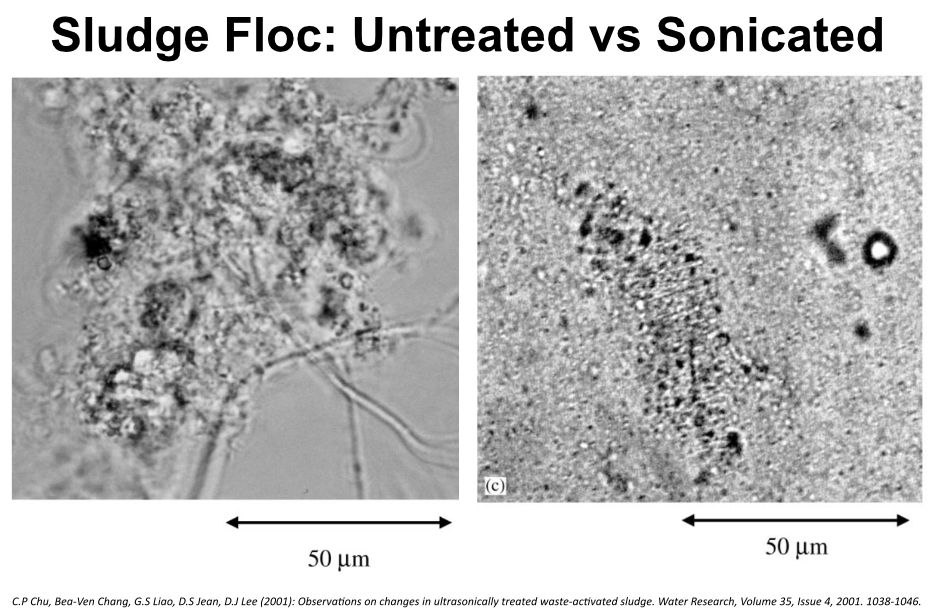
Verglach vun onbehandelt Flocken mat sonicated Schlamm: Sonication reduzéiert Flocken bedeitend.
Studie a Biller: ©Chu et al. 2001
Wéi Ultraschall Kavitatioun opmaacht WAS fir Aerob Verdauung
Hielscher industrielle Sonicatoren funktionnéieren bei 20kHz a generéieren intensiv akustesch Kavitatioun a Flëssegkeets- a Schlammstroum. Kavitatiounsblasen bilden, wuessen a kollapsen am Schlamm. Hiren Zesummebroch kreéiert mächteg lokal Schéierkräften déi direkt op Flocken, EPS a mikrobiellen Zellen handelen.
Ultraschallbehandlung produzéiert dräi wichteg Ännerungen am WAS:
Floc Desintegratioun
Kavitation brécht Schlammaggregaten op a beliicht Flächen, déi virdru vun extrazelluläre polymeresche Substanzen (EPS) zougemaach goufen. De behandelte Schlamm enthält méi kleng Partikelen an eng méi grouss zougänglech Uewerfläch.
EPS an Zell Stéierungen
Ultrasonic-aided disintegration increases the aerobic biodegradability of municipal waste activated sludge by breaking down tough sludge flocs and releasing trapped organic matter. Ultrasonic cavitation disrupts cell membranes and cell walls. Proteins and carbohydrates as well as other intracellular compounds move into the liquid phase.
Increased Bioavailability
Aerobic microorganisms can consume soluble and finely divided organic material more readily than intact microbial cells and compact flocs. Ultrasonication therefore performs part of the lysis and hydrolysis work mechanically before the biological oxidation step.
Sonication zielt déi déck Schutzmatrix vu Kläranlag fir mikrobiell Verdauung vill méi séier a méi effizient ze maachen. Dëst gëtt allgemeng als eng Erhéijung vun der soluble Chemical Sauerstoffbedarf (SCOD) beobachtet.

Industriell Ultraschallflussreaktor fir verbessert WAS Verdauung
Virdeeler vun Sonication an Aerobic Verdauung Planzen
D'Äntwert hänkt vum Schlamm an der Ultraschalldosis of. Wann d'Sonicatioun d'aerobe Biodegradabilitéit erhéicht, kann eng Ofwaasserbehandlungsanlag kréien:
- Méi liichtflüchtege Feststoffer Zerstéierung an der existéierender Verdauungszäit
- Vergläichbar Schlammstabiliséierung bei enger méi kuerzer Residenzzäit
- Niddereg Reschtoffall dréchen Feststoffer Produktioun
- Additional effective capacity from an existing aerobic digester
- Reduced biosolids hauling and disposal
- Improved process stability during periods of high solids loading
- Better control of filamentous organisms through floc and cell disruption
Inline Hielscher Sonicators for a Facile Retrofit
At full scale, it is generally more efficient to sonicate a concentrated sludge flow than the entire volume of the aerobic digester. Hielscher ultrasonic flow-cell reactors support two practical configurations.
WAS Feed-Line Pretreatment
The ultrasonic system is installed after WAS thickening and before the aerobic digester:
Thickened WAS -> feed pump -> Hielscher ultrasonic flow cell -> aerobic digester
This arrangement treats a defined dry-solids mass flow and provides a clear basis for controlling the specific ultrasonic energy input.
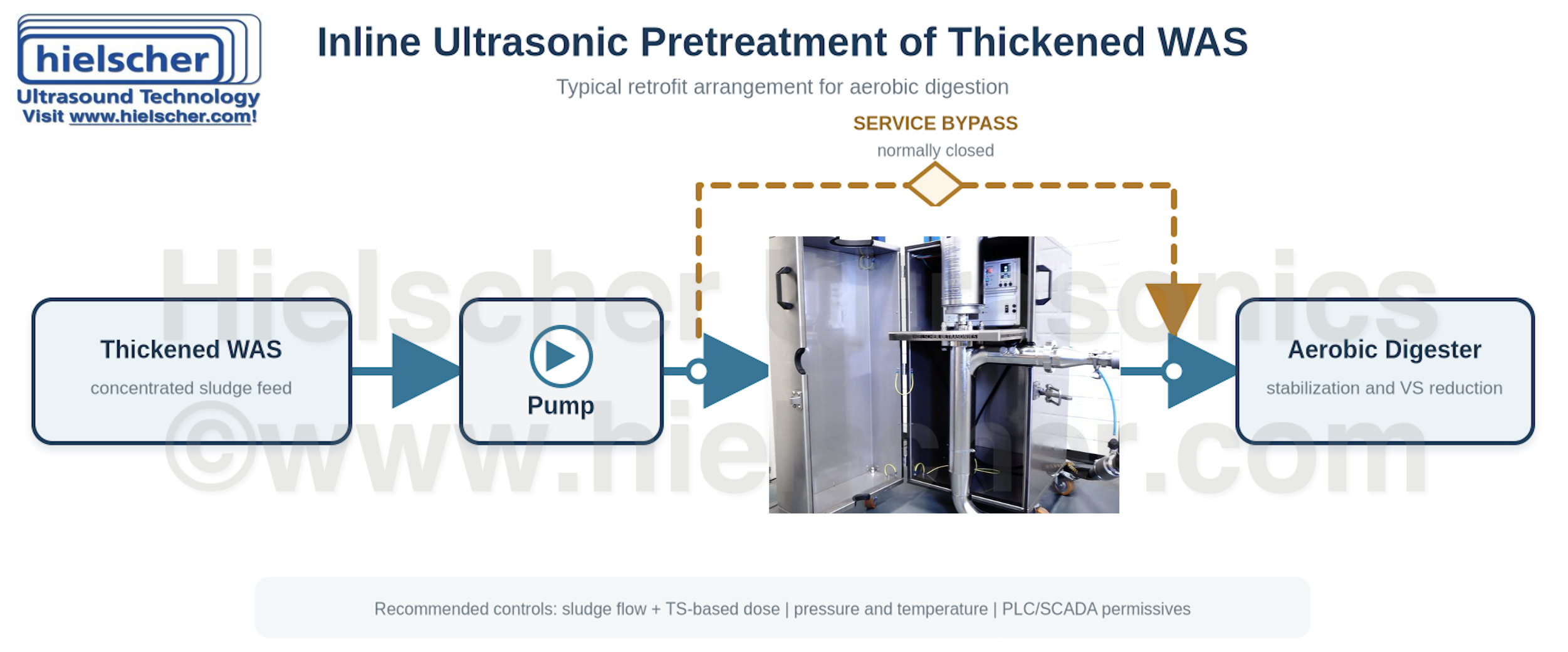
Flow chart: Thickened WAS -> feed pump -> Hielscher industrial inline sonicator UIP6000hdT -> aerobic digester
Digester Recirculation or Sidestream Treatment
A controlled fraction of sludge is pumped from the digester or sludge line through the sonicator and returned to the process. This configuration is useful when the existing feed line is difficult to modify or when only a selected fraction of the sludge should be treated.
Both arrangements can be installed as compact skids with a pump, ultrasonic flow cell, isolation valves, service bypass, pressure and temperature measurement, sampling points and process controls. The existing digester vessel remains unchanged.
This makes ultrasonic treatment particularly suitable for retrofitting existing wastewater treatment plants. The ultrasonic skid can be installed in a pumped line, operated independently and bypassed during inspection or maintenance.
Improve Aerobic Sludge Disintegration with Power Ultrasound!
Hielscher industrial sonicators provide a compact and scalable method for integrating high-power ultrasound into an existing WAS treatment line. Inline flow-cell processing concentrates the ultrasonic energy on the sludge stream, supports reproducible dose control and can be engineered for reliable 24/7 heavy-duty operation.
Design, Fabrikatioun a Berodung – Qualitéit Made in Germany
Hielscher Ultraschaller si bekannt fir hir héchst Qualitéit an Designnormen. Robustheet an einfach Operatioun erlaben déi glat Integratioun vun eisen Ultraschaller an industriellen Ariichtungen. Rau Konditiounen an erfuerderlech Ëmfeld ginn einfach vun Hielscher Ultraschaller gehandhabt.
Hielscher Ultrasonics ass eng ISO zertifizéiert Firma a setzt spezielle Wäert op High-Performance Ultrasonicatoren mat modernste Technologie a Benotzerfrëndlechkeet. Natierlech sinn Hielscher Ultraschaller CE konform an entspriechen d'Ufuerderunge vun UL, CSA a RoHs.

Hielscher Ultrasonics fabrizéiert High-Performance Ultrasonic Homogenisatoren fir d'Vermëschung vun Uwendungen, Dispersioun, Emulsifikatioun an Extraktioun op Labo, Pilot an Industrieskala.
Oft gestallten Froen
Does ultrasonic treatment produce more biogas in an aerobic digester?
No. Increased methane or biogas yield is an anaerobic-digestion benefit. For aerobic digestion, ultrasonic treatment should be evaluated by VS destruction, oxygen consumption, digestion time, residual dry solids, dewaterability and total cost.
Where is the ultrasonic system installed?
The system is generally installed inline after WAS thickening and before the aerobic digester. It can also operate in a controlled sidestream or digester recirculation loop. A service bypass allows sludge transfer to continue during maintenance.
Why use a 20kHz industrial sonicator?
Low-frequency, high-power ultrasound generates intense cavitation and mechanical shear. This is effective for breaking sludge flocs, disrupting EPS and opening microbial cells in liquid-solid streams.
Kann en Hielscher Sonicator kontinuéierlech schaffen?
Jo. D'Hielscher industriell hdT Sonicator Linnen si fir kontinuéierlech schwéier Aarbecht entworf an fir hir Haltbarkeet bekannt. Flow-Cell Reaktoren erlaben kontrolléiert inline oder Réckluftpraxis, während automatesch Dateprotokolléierung d'Ënneruechtung vum Prozess an d'Reproduzéierbarkeet ënnerstëtzt.
Wéi eng Donnéeë sinn néideg fir e Ultraschall-Schlamm-System ze dimensionéieren?
D'Haaptinpute sinn WAS Floss, TS a VS Konzentratioun, Schlammviskositéit, gezielte spezifesch Energie, erfuerderlecht Behandlungseffekt, Betriebsstonnen an disponibelen Drock. Pilotentest gëtt recommandéiert fir d'util Nëtzlech Dosis virun der Vollskala-Dimensionéierung ze bestëmmen.
Verbessert Sonikatioun d'Déier vum Schlamm?
D'Resultat hänkt vun den Eegeschafte vum Schlam an der Dosis of. En moderaten Traitement kann de Feststoffprozess verbesseren, während iwwerdriwwe Disintegratioun fein Partikelen a löslech Polymere generéiere kann, déi d'Fangung oder d'Kuchfeststoffer behënneren. Doheem Versuch fir Waasseren ze dréchnen sinn dofir en wesentlechen Deel vun der Prozessoptimiséierung.
Wat soen wëssenschaftlech Etüdë iwwer d'ultrasonesch WAS-Digestioun?
Laboratoire Étuë ënnerstëtzen d'Benotzung vum Ultraschall fir d'Zougänglechkeet an d'aerob Biodegradabilitéit vum WAS ze erhéijen.
In a study of combined alkaline and ultrasonic pretreatment before aerobic digestion, organic-matter degradation at the same digestion time was reported as 38.0% for untreated sludge and 42.5% for ultrasonically pretreated sludge. Combined alkaline and ultrasonic pretreatment increased degradation to 50.7%. The result demonstrates that ultrasound alone can improve aerobic degradation, while also showing that the attainable improvement depends on the pretreatment strategy and sludge characteristics. (cf. Jin et al., 2009)
Another investigation of municipal WAS reported increased sludge solubilization and aerobic biodegradability after ultrasonic-aided bacterial disintegration. The pretreated sludge showed a higher biodegradation or decay rate than the untreated control. (cf. Kavitha et al. 2016)
Ënnerstëtzt Sonikatioun aner Schlëmmprozesser?
Jo. Sonikatioun ënnerstëtzt verschidde Schlëmmbehandlungsprozesser duerch d'Disruptioun vun Flocs, EPS a mikrobielle Zellen:
Anaerob Verdauung/Biogasproduktioun: beschleunegt d'Hydrolyse, erhéicht löslechen COD a kann d'Zerstéierung vum VS an de Methan-Ausbezuel verbesseren.
Phosphorrécksouwéi: fräisetzt Zellgebonne an organesch Phosphor an d'Flëssegphase, verbessert d'Verfügbarkeet fir spéider Struvit- oder Vivianitäusfäll; Ultraschall kann och d'Phosphorlechung aus Schlëmmaschen intensivéieren.
Literatur / Referenzen
- Jin Y., Li H., Mahar R.B., Wang Z., Nie Y. (2009): Combined alkaline and ultrasonic pretreatment of sludge before aerobic digestion. Journal of Environmental Science 2009;21(3):279-284.
- Kavitha S., Jessin Brindha G.M., Sally Gloriana A., Rajashankar K., Yeom I.T., Rajesh Banu J. (2016): Enhancement of aerobic biodegradability potential of municipal waste activated sludge by ultrasonic aided bacterial disintegration. Bioresource Technology 2016 Jan;200:161-169.
- C. M. Braguglia, G. Mininni, A. Gianico (2008): Is sonication effective to improve biogas production and solids reduction in excess sludge digestion? Water Science Technology 1 March 2008; 57 (4): 479–483.
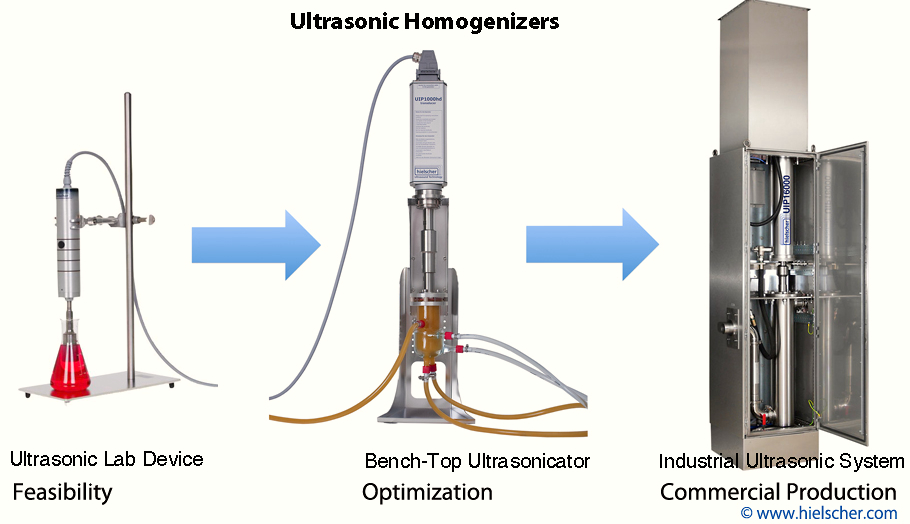
Hielscher Ultrasonics fabrizéiert High-Performance Ultrasonic Homogenisatoren aus Labo zu industriell Gréisst.