Valoriséierung vu Lebensmittelveraarbechtungs-Nebestréimungen mat ultraschallbaséierter Extraktioun
Liewensmëttelveraarbechtungs-Nebestréimungen – wéi Ënn an Kraidertrimmen, Orangeschuelen an proteinräich Reschter wéi Spent Grain vum Braueren – ginn dacks als Offall entsuergt oder op nidderegtwäertegt Déierefudder erofgestallt. Trotzdem bleiwen dës Sekundärprodukter räich un wäertvollen bioaktive Verbindungen, dorënner Proteinen, diatesch Faser, phenolesch Antioxidantien an natierlech Pigmenter.
Recovering these high-value ingredients requires gentle processing methods that preserve their functional and nutritional properties. Once extracted and refined, these compounds can be incorporated into a wide range of food and beverage applications, particularly in the growing plant-based food sector.
Ultrasonic extraction offers an efficient, non-thermal, and environmentally friendly solution for recovering valuable compounds from food waste and biomass. By using high-intensity ultrasound, manufacturers can maximize extraction yields while maintaining the integrity and functionality of sensitive bioactive ingredients.
Efficient Biorefineries Through Ultrasonic Process Intensification
Ultrasonication is a proven process-intensification technology that enhances the efficiency, sustainability, and profitability of modern biorefineries. By integrating high-power ultrasound into biomass processing operations, manufacturers can significantly improve extraction performance, accelerate chemical and biochemical reactions, and optimize mixing, homogenization, and dispersion processes.
Compared to conventional processing methods, ultrasonic treatment delivers:
- Higher extraction yields
- Faster reaction and processing times
- Improved conversion rates
- reduzéiert Energieverbrauch
- Enhanced product quality and purity
- Niddreg Betribskäschten
As a result, ultrasonic process intensification plays a key role in transforming biomass into high-value products more efficiently and sustainably.
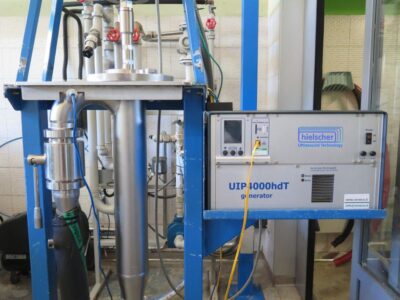
Sonicator UIP4000hdT for the efficient extraction of value compounds (e.g. proteins, polyphenols, pectins, lipids) from bio-waste.

What Is a Biorefinery?
A biorefinery is an integrated processing facility that converts renewable biomass into a range of valuable products, including food ingredients, animal feed, chemicals, biofuels, energy, and specialty materials.
Typical feedstocks include:
- Agricultural residues and crop waste
- Food processing by-products
- Industrial organic waste streams
- Forestry residues
- Municipal bio-waste
Like a petroleum refinery, which separates crude oil into multiple products, a biorefinery fractionates biomass into key intermediates–such as carbohydrates, proteins, lipids, and fibers – which are then further processed into value-added products.
A defining characteristic of modern biorefineries is the valorization of waste streams. Through innovative technologies, materials previously considered waste are converted into commercially valuable resources, supporting circular economy principles and reducing environmental impact.

Ultraschall verstäerkt Bioraffinerien
The integration of ultrasonic technology can significantly improve the performance of numerous biorefinery processes, including:
- Extraktioun vu bioaktive Verbindungen
- Biomass disintegration and cell disruption
- anaerobe Verdauung
- hydrolyse
- Fermentation support
- Transesterification of waste vegetable oils to biodiesel
- Emulgifikatioun an Homogeniséierung
- Particle size reduction and dispersion
Ultrasonic process intensification enables biorefineries to achieve higher productivity while reducing processing time and energy requirements. In addition, ultrasound-assisted processes often improve product purity and preserve the quality of heat-sensitive compounds.
By enhancing mass transfer, accelerating reaction kinetics, and increasing biomass accessibility, ultrasonication contributes to more sustainable and economically viable biorefinery operations. As demand for circular production systems and resource-efficient technologies continues to grow, ultrasound is becoming an increasingly important tool for maximizing the value of biomass and food processing side streams.
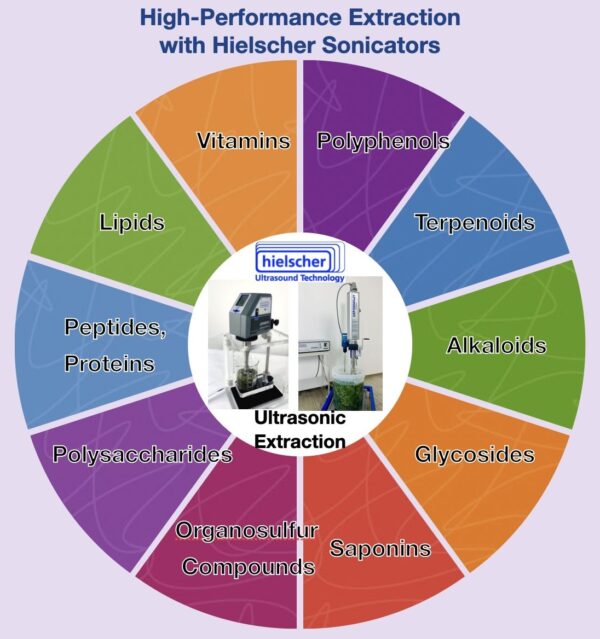
What Products Benefit from Sonication in Biorefineries?
High-Performance Ultrasonics ass eng Prozessintensivéierungstechnik, déi op verschidde Industrien applizéiert gëtt. Ultrasonication gëtt benotzt fir Flëssegkeeten a Schläim ze veraarbecht fir ze mëschen an homogeniséieren, Massentransfer förderen, Verbindungen extrahéieren an / oder chemesch Reaktiounen initiéieren.
Allgemeng Uwendungen vun Ultraschall an Bioraffinerien sinn:
- Extraktioun vu wäertvolle Verbindungen aus Biomass (zB Proteinen, Pektine, Stärke etc.)
- Bioethanol Produktioun
- Biodiesel Synthese vu verbrauchte Geméisueleg an Déierefetter
- Biodiesel aus Algen Ueleg
- lignocellulose Behandlung
- Stärke Modifikatioun
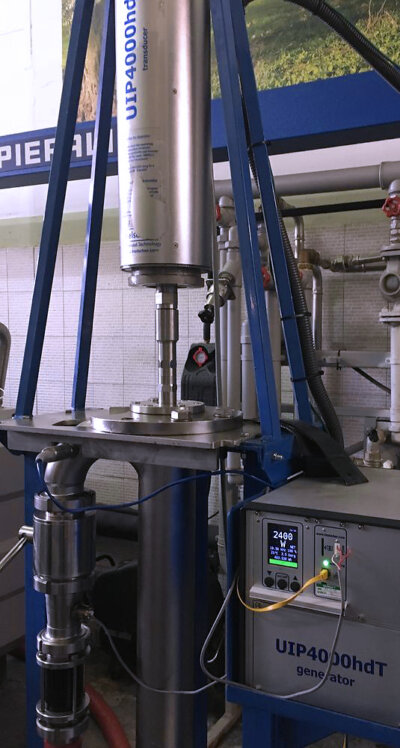
Ultraschall-Extraktor UIP4000hdT fir kontinuéierlech Extraktioun vu Proteinen, Lipiden a Phyto-Nährstoffer aus biologeschem Offall.

Protein extraction form duckweed: SEM images of duckweed samples: The upper row shows the intact cells of duckweed control samples
Déi ënnescht Zeil weist Duckweed Echantillon extrahéiert mam Sonicator UP400ST. D'Zellen weisen kloer mechanesch Decompte wéinst sonication.
Etude a Biller: ©2023 Inguanez et. al.
High-Performance Ultrasonic Prozessoren fir Bioraffinerien
 Hielscher Ultrasonics entwéckelt a fabrizéiert héichperformant Ultraschallprozessoren fir Biorefinery-Uwendungen weltwäit. Eis industriell Ultraschallreaktoren verbesseren d'Extraktioun, Biomassdisintegratioun, Homogeniséierung, Mëschung, Dispersioun, Degassing an sonochemesch Reaktiounen, wat den Operateuren hëlleft héijer Ausbezuelen, méi séier Veraarbechtung an verbesserten Konversiounsquote z'erreechen.
From laboratory feasibility studies to pilot-scale optimization and full-scale industrial production, Hielscher provides scalable ultrasonic solutions for every stage of process development. Established applications such as ultrasonic extraction, cell disruption, mass transfer enhancement, and biomass valorization can be rapidly implemented and scaled with predictable results.
Hielscher offers ultrasonic processors ranging from compact laboratory units to industrial systems processing multiple tons of biomass per hour. With the UIP16000hdT (16kW), the world’s most powerful ultrasonic processor, and scalable clustering options, virtually any production capacity can be achieved. All industrial systems are engineered for continuous 24/7 operation under demanding production conditions.
Ultrasonic Reactors and Probes for Any Production Scale
Hielscher’s product portfolio includes:
- Laboratory ultrasonicators for process development and feasibility testing
- Bench-top and pilot systems for scale-up studies
- Industrial ultrasonic processors for large-scale biomass processing
- Inline flow-cell reactors for continuous production
This broad product range ensures the ideal ultrasonic solution for your process, throughput requirements, and production goals.
Maximum Process Control for Consistent Results

Precise process control is essential for efficient biomass conversion and extraction. Hielscher ultrasonic processors allow accurate adjustment and monitoring of all critical sonication parameters, including amplitude, power, temperature, pressure, and energy input.
Amplitude is one of the most important factors affecting ultrasonic process efficiency. Hielscher systems provide precise amplitude control and can operate continuously at amplitudes of up to 200 µm under industrial conditions. Sonotrodes and booster horns allow further optimization for specific applications.
Integrated digital controls and browser-based monitoring enable real-time process management, ensuring reproducible results, maximum extraction efficiency, and reliable scale-up from laboratory to industrial production.
Fir kontinuéierlech industriell Operatioun gebaut
Hielscher Ultraschallveraarbechter si fir schwéier industriell Ëmfeld entwéckelt. Robust Design, héichwäerteg Komponenten an bewisen Zouverlässegkeet erlaben eng kontinuéierlech 24/7 Operatioun ënner voller Belaaschtung.
Haaptvirdeeler enthalen:
- Héich Extraktiounsproduktiounen a verbesserte Biomassennotzung
- Schnell an zouverlässeg Upgrades vun Lab zum Produktioun
- Kontinuéierlech Inline-Veraarbechtungsfäegkeet
- niddereg Ënnerhalt Ufuerderunge
- Ferniwwerwaachung a Prozessdatenopzeechnung
- Industriegrad Zouverlässegkeet fir ronderëm d'Auer Operatioun

däitsch Ingenieurwëssenschaft a Fabrikatiounsexzellenz
Als Familljebetrib an der Noperschaft vu Berlin, Däitschland, entwéckelt a fabrizéiert Hielscher Ultrasonics zënter Joerzéngten industriell Ultraschallapparat. All Ultraschallveraarbechter gëtt a Däitschland entwéckelt, gebaut a getest fir maximal Leeschtung, Zouverlässegkeet a laang Liewensdauer ze garantéieren.
Beyond equipment supply, Hielscher supports customers with application expertise, process optimization, scale-up assistance, technical training, and ongoing engineering support – helping biorefineries achieve efficient, profitable, and sustainable biomass processing.
D'Tabell hei drënner gëtt Iech eng Indikatioun vun der geschätzter Veraarbechtungskapazitéit vun eisen Ultraschaller:
| Batch Volume | Duerchflossrate | Recommandéiert Apparater |
|---|---|---|
| 10 bis 2000 ml | 20 bis 400 ml/min | UP200Ht, UP 400 St |
| 0.1 bis 20L | 02 bis 4 l/min | UIP2000hdT |
| 10 bis 100 l | 2 bis 10 l/min | UIP4000hdT |
| na | 10 bis 100 l/min | UIP16000 |
| na | méi grouss | Stärekoup vun UIP16000 |
Kontaktéiert eis! / Frot eis!
Oft gestallten Froen
What is the Biorefinery Concept?
D'Konzept vun der Biorefinery ass d'noue ëmweltfrëndlech Ëmwandlung vu Biomass an eng Rei vu wäertvollen Produkter, dorënner Iessenzutaten, Déierefudder, Chemikalien, Materialien, Biokraaftstoffer an Energie. Ähnlech wéi eng Petroleumraffinerie fraktiounéiert an verarbeitet eng Biorefinery Rohmaterialien an verschidde Produkter, maximéiert d'Ressourceneffizienz an miniméiert Offall.
Wat ass e Beispill vun enger Biorefinery?
Eng Liewensmëtteloffall-Biorefinery ass e gängegt Beispill. Si veraarbecht landwirtschaftlech Reschter, Fruucht schuelen, gebrëllgt Gromperegrob oder aner By-Produkter aus der Liewensmëttelveraarbechtung, fir wäertvoll Verbindungen wéi Proteinen, diätetesch Faser, Antioxidantien an bioaktiv Moleküle zréckzefannen, während déi verbleiwend Biomass an Bioenergie oder Biofäertilizer ëmgewandelt gëtt.
Wéi Materialien ginn an enger Biorefinery veraarbecht?
Biorefineries process renewable biomass, including agricultural residues, food processing side streams, forestry waste, energy crops, algae, animal by-products, and organic municipal waste. These feedstocks contain carbohydrates, proteins, lipids, fibers, and other compounds that can be converted into value-added products.
What is the Difference between a Refinery and a Biorefinery?
A conventional refinery uses fossil-based raw materials such as crude oil to produce fuels and petrochemicals, whereas a biorefinery uses renewable biomass as its feedstock. Biorefineries are designed to support a circular and sustainable economy by converting biological resources and waste streams into renewable fuels, chemicals, materials, and energy.

Hielscher Ultrasonics fabrizéiert High-Performance Ultrasonic Homogenisatoren fir d'Vermëschung vun Uwendungen, Dispersioun, Emulsifikatioun an Extraktioun op Labo, Pilot an Industrieskala.
Literatur / Referenzen
- García, A., González Alriols, M., Wukovits, W. et al. (2014): Assessment of biorefinery process intensification by ultrasound technology. Clean Techn Environ Policy 16, 1403–1410 (2014).
- Velmuruga, Rajendran; Muthukumar, Karuppan (2011): Utilization of sugarcane bagasse for bioethanol production: Sono-assisted acid hydrolysis approach. Bioresource Technology Vol. 102, Issue 14; 2011. 7119-7123.
- Lukavski, T.; Šarčević, I.; Vukoje Bezjak, M. (2026): Influence of Solvent and Ultrasound-Assisted Extraction on the UV Spectral Profiles of Extracts from Agro-Waste. Science 2026, 8, 96.
- Marina Fernández-Delgado, Esther del Amo-Mateos, Mónica Coca, Juan Carlos López-Linares, M. Teresa García-Cubero, Susana Lucas (2023): Enhancement of industrial pectin production from sugar beet pulp by the integration of surfactants in ultrasound-assisted extraction followed by diafiltration/ultrafiltration. Industrial Crops and Products, Volume 194, 2023.