Kemijski reaktori poboljšani sonikacijom – Vrste, dizajni i mehanizmi
Kemijski reaktori su srž industrijske kemije, sinteze materijala, proizvodnje finih kemikalija, farmaceutske proizvodnje i ekološke obrade. Kako industrije teže bržima, čišćim i energetski učinkovitijim procesima, sonikacija, poznata i kao ultrazvučna obrada, postala je sve relevantnija metoda za intenzifikaciju reaktora. Tehnologija ultrazvučnih reaktora mijenja kemijsku obradu poboljšavajući miješanje, prijenos mase, kinetiku reakcija i heterogenu katalizu u serijskim i kontinuiranim reaktorskim sustavima.
Kako sonikacija poboljšava kemijske reaktore
By introducing high-power ultrasound into a chemical reactor, engineers can generate ultrasonic oscillatory flow mixing and acoustic cavitation inside the reaction medium. These mechanisms improve contact between reactants, accelerate mass transfer and can enhance reaction rates, selectivity and yield. Sonication is especially effective in solid-liquid systems, such as heterogeneous catalysis, and liquid-liquid systems, such as emulsification, extraction and biphasic reactions. It is used less frequently in gas-liquid mixtures because acoustic cavitation is generated less efficiently in liquids with high gas contents.
U modernom dizajnu sonokemijskih reaktora, tekućine se miješaju ultrazvučnim oscilacijama i kavitacijom, obično koristeći amplitude u rasponu od 10 do 200 μm. To omogućuje snažne mikroskopske efekte miješanja koje je teško postići samo konvencionalnim mehaničkim miješanjem.
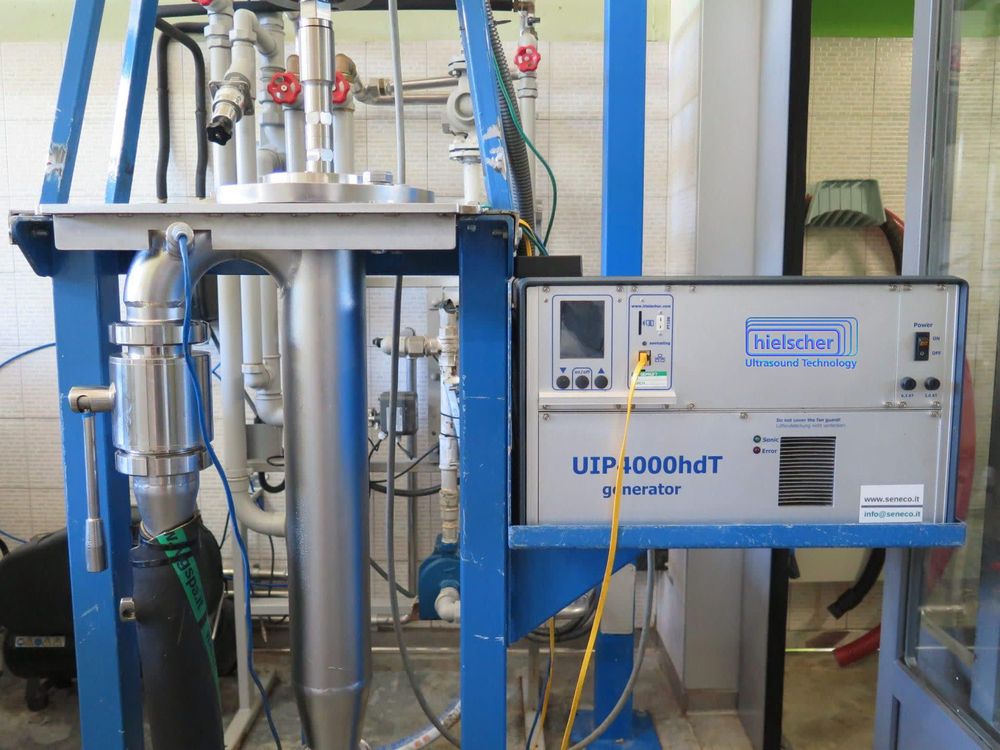
Inline sonicator UIP4000hdT s protočnom ćelijom za intenzivirane kemijske reakcije
Zašto sonikacija intenzivira kemijske reaktore
Industrijska važnost sonikacije leži u njenoj sposobnosti da utječe na kemijske i fizičke pojave transporta na mikro- i mezo-razini. Za razliku od konvencionalnog miješanja, ultrazvuk ne pomiče samo masu tekućine. On generira tlakove valove, oscilacijsko gibanje, kavitačke mjehuriće i lokalizirane zone visoke energije.
Kada se oblikuju, rastu i urušavaju kavitački mjehurići, oni kreiraju intenzivne mikro-okoline. Ti događaji mogu proizvesti:
- visoke lokalne sile smicanja
- mikromlazove u blizini čvrstih površina
- udarne valove
- brzo mikromiješanje
- poboljšanu disperziju čestica
- poboljšani međufazni kontakt
- ubrzan prijenos mase i topline
- efekte čišćenja površina i aktivacije katalizatora
Ovi fenomeni čine sonikaciju izuzetno vrijednom za intenziviranje procesa, posebno kada su reakcije ograničene difuzijom, lošim kontaktom faza, zaprljanjem katalizatora ili nedovoljnim miješanjem.
Sonikacija u serijskim reaktorima
Serijski reaktori široko se koriste u laboratorijima, pilot postrojenjima i proizvodnji specijalnih kemikalija. Fleksibilni su, jednostavni za upravljanje i pogodni za probu reakcija, sintezu malih količina i proizvode visoke vrijednosti.
Kada se sonikacija primijeni u serijskim reaktorima, može značajno poboljšati miješanje i uniformnost reakcije. Ultrazvučne sonde, strujne ćelije ili transduseri montirani izvana mogu izravno unijeti akustičnu energiju u reakcijsko sredstvo.
U serijskim sustavima, sonikacija je osobito korisna za:
- heterogena kataliza
- sinteza nanočestica
- kontrolu kristalizacije
- emulgiranje
- Izvlačenje
- polimerizacija
- rastvaranje i disperziju čvrstih tvari
Za kruto-tekuće reakcije, ultrazvuk može spriječiti aglomeraciju čestica i poboljšati pristup katalitičkim ili reaktivnim površinama. U sustavima tekućina-tekućina, sonikacija može stvoriti fine emulzije i povećati međufazno područje između nemiješajućih se faza, što često dovodi do bržih brzina reakcije.
Reaktori s protokom za kontinuiranu sonokemijsku obradu
Reaktori s protokom spadaju među najvažnije dizajne za industrijsku sonikaciju. Umjesto obrade fiksnog volumena tekućine, reakcijska smjesa kontinuirano prolazi kroz ultrazvučnu reaktorsku komoru.
Ovaj dizajn je vrlo privlačan za povećanje obujma proizvodnje jer omogućava inženjerima preciznije kontroliranje vremena zadržavanja, protoka, temperature, tlaka i unosa ultrazvučne energije. Sonokemijski reaktori s protokom se često koriste kada su potrebna dosljedna kvaliteta proizvoda i kontinuirani rad.
Glavne prednosti sonikiranih reaktora s protokom uključuju:
- sposobnost kontinuirane proizvodnje
- poboljšanu reproducibilnost procesa
- bolju kontrolu temperature
- kontroliranu distribuciju vremena zadržavanja
- lakšu integraciju u industrijske procesne linije
- skalabilnu arhitekturu reaktora
U ovim sustavima, ultrazvučno oscilatorno miješanje može poboljšati radijalno i aksijalno miješanje, smanjiti koncentracijske gradijente i poboljšati interakciju reaktanata. Ovo je osobito vrijedno u procesima gdje performanse reakcije ovise o brzom faznom kontaktu ili brzoj disperziji.
Ultrazvučni umetak višefaznog kavitatora s protočnom ćelijom
 The MultiPhaseCavitator Insert-MPC48 is a specialized insert for Hielscher ultrasonic flow cell reactors designed to intensify liquid/liquid and liquid/gas processes directly in the ultrasonic cavitation zone. By injecting a second liquid phase or gas phase through 48 fine cannulas into the primary liquid stream, the MultiPhaseCavitator creates very small droplets or gas bubbles with a high specific interfacial area. This makes it especially efficient for ultrasonic emulsification, where immiscible phases are dispersed into fine emulsions, and for catalytic gas reactions, where the injected gas phase is rapidly dispersed and brought into intimate contact with the liquid phase, dissolved reactants, or suspended catalysts. The resulting cavitational shear, micro-mixing, and enhanced mass transfer can improve reaction kinetics, phase-boundary contact, and process efficiency in continuous or batch flow-through operation.

Sonikator UIP2000hdT s kemijskim serijskim reaktorom
Dizajni kemijskih reaktora i prednosti sonikacije
| Vrsta reaktora | Tipična primjena | Glavni učinci sonikacije | Tehnička važnost |
|---|---|---|---|
| Reaktori s kašom | Heterogena kataliza s suspendiranim čvrstim česticama katalizatora u tekućoj fazi; koristi se u hidrogenaciji, oksidaciji, pretvorbi biomase, procesima tipa Fischer-Tropsch, fotokatalizi i obradi otpadnih voda. | Sonikacija poboljšava disperziju katalizatora, deaglomeraciju čestica, smanjenje graničnog sloja, obnavljanje površine, prijenos mase tekućina-kruto, čišćenje površine katalizatora i smanjenje naslaga. | Posebno relevantno jer je mnogo katalitičkih reakcija u suspenziji ograničeno time koliko učinkovito reaktanti dopiru do aktivnih mjesta. Akustična kavitacija poboljšava kontakt na sučelju katalizator-tekućina i može poboljšati kinetiku reakcije. |
| Kontinuirano miješani reaktori (CSTR) | Kontinuirane reakcije u tekućoj fazi, emulgacija, katalitičke reakcije, taloženje, kristalizacija, reakcije polimera i suspenzije čvrsto-tekućih tvari. | Ultrazvuk poboljšava mikromješanje, suspendiranje čestica, emulgaciju, disperziju i lokalni unos energije. Može se kombinirati s mehaničkim miješanjem radi poboljšanja i makro-miješanja i mikro-miješanja. | Sonicated CSTRs are useful when conventional impellers cannot fully eliminate dead zones, poor dispersion or local mass-transfer limitations. Ultrasound supports more uniform reaction conditions and improved process intensification. |
| Fixed Bed Reactors | Stationary catalyst beds used in hydrogenation, oxidation, environmental catalysis, petrochemical processing and liquid-phase heterogeneous catalysis. | Sonication can improve catalyst wetting, liquid movement through the bed, boundary layer reduction, surface cleaning, fouling mitigation and mass transfer to catalytic sites. | Fixed bed performance is often limited by channeling, poor wetting, diffusion resistance and deposit formation. Ultrasonic process intensification can improve catalyst utilization and reaction uniformity. |
| Fluidized Bed Reactors | Dynamic beds of suspended particles used in catalysis, particle processing, coating, polymerization, drying and solid-liquid reactions. | Ultrasonic excitation can improve particle dispersion, reduce agglomeration, enhance fluid-solid contact, stabilize suspensions and improve catalyst surface accessibility. | Sonication is especially effective in liquid-solid fluidized beds, where cavitation can be generated efficiently. In gas-rich systems, cavitation is less effective, making ultrasound more suitable for liquid-based reactor applications. |
| Membrane Reactors | Integrated reaction-separation systems used for selective product removal, reactant dosing, catalytic membrane processes and filtration-assisted reactions. | Ultrazvuk može smanjiti zaprljanost membrane, poboljšati protok permeata, poboljšati čišćenje površine, smanjiti polarizaciju koncentracije i poboljšati miješanje u blizini površine membrane. | Sonikacija povezuje reaktivno inženjerstvo s znanošću o separaciji. Posebno je vrijedna tamo gdje zaprljanost, otpornost prijenosa tvari ili slaba povezanost reakcije i separacije ograničava rad membranskog reaktora. |
Mehanizmi intenzifikacije ultrazvučnog reaktora
Prednosti sonikacije u kemijskim reaktorima temelje se na nekoliko međusobno povezanih mehanizama.
- Akustična kavitacija je najvažniji mehanizam. Ona uključuje formiranje, rast i kolaps mikroskopskih mjehurića u tekućini izložene ultrazvuku velike intenziteta. Kolaps mjehurića proizvodi lokalizirano oslobađanje energije i jake mehaničke sile.
- Akustično strujanje stvara stalno gibanje tekućine uzrokovano ultrazvučnim valovima. Ovo poboljšava miješanje i transport u zonama gdje mehaničko miješanje može biti slabo.
- Miješanje oscilirajućim tokom događa se kada ultrazvučna vibracija uzrokuje brzo naprijed-nazad kretanje tekućine. U reaktorskim sustavima, amplitude od približno 10 do 200 µm mogu proizvesti vrlo učinkovito miješanje i poboljšani prijenos mase.
- Mikromlazovi i udarni valovi javljaju se u blizini kolapsirajućih kavitacijskih mjehurića, posebno blizu čvrstih površina. Ovi učinci mogu čistiti površine katalizatora, narušavati granične slojeve i poboljšati pristup tekućine do aktivnih mjesta.
- Povećanje međufazne površine posebno je važno u sustavima tekućina-tekućina. Ultrazvuk može stvoriti fine kapljice i stabilne disperzije, povećavajući površinu dostupnu za reakciju ili prijenos tvari.
Zajedno, ovi mehanizmi čine sonikaciju snažnim alatom za intenziviranje kemijskih reaktora.
Industrijska važnost dizajna sonokemijskog reaktora
Industrijski značaj sonikacijom obrađenih reaktora nadilazi brže miješanje. Sonikacija pruža način manipulacije reakcijskim okruženjima na skalama koje konvencionalna oprema teško može dosegnuti.
U kemijskom inženjerstvu, mnoga ograničenja reaktora proizlaze iz transportnih pojava, a ne iz intrinzičnih brzina reakcija. Reaktanti možda neće dovoljno brzo stići do katalitičkih mjesta. Nemješljive tekućine mogu imati nedovoljno dodirne površine. Tvari u krutom agregatu mogu se slegnuti. Membrane se mogu začepljati. Površine katalizatora mogu postati blokirane.
Sonikacija rješava ova ograničenja izravnim poboljšanjem fizičkih uvjeta unutar reaktora. Ovo je relevantno za nekoliko istraživačkih i industrijskih prioriteta:
- ekološki prihvatljivija kemijska obrada
- smanjena potrošnja energije i otapala
- poboljšana učinkovitost katalizatora
- viša selektivnost reakcije
- brži razvoj procesa
- kontinuirana proizvodnja
- intenzivirani modularni reaktorski sustavi
- sintetiziranje naprednih materijala
- održiva konverzija biomase i otpadnih tokova
Za istraživače, sonikacija nudi kontrolirani način proučavanja odnosa između ulaza akustične energije, ponašanja kavitacije, poboljšanja transporta i kemijske učinkovitosti. Za industriju, ona nudi praktičan put prema kompaktnim, učinkovitima i skalabilnim reaktorima.

Ultrazvučni homogenizator UIP2000hdT za kemijske reakcije u protočnom reaktoru
Prednosti sonikacije u kemijskim reaktorima
Integracija ultrazvuka u dizajn reaktora nudi nekoliko operativnih i znanstvenih prednosti:
- brže reakcije kroz poboljšani prijenos tvari
- bolje miješanje u više-faznim sustavima
- poboljšana disperzija čvrstih tvari i kapljica
- poboljšano korištenje katalizatora
- smanjena ograničenja difuzije
- čišći katalizator i površine membrana
- poboljšana ponovljivost procesa u flow sustavima
- potencijalno smanjenje temperature, tlaka ili vremena reakcije
- kompatibilnost s serijskim i kontinuiranim radom
- velika važnost za heterogenu katalizu i biphasne reakcije
Ove prednosti čine tehnologiju ultrazvučnih reaktora posebno atraktivnom za fine kemikalije, specijalne kemikalije, katalizu, nanomaterijale, zelenu kemiju i intenzifikaciju procesa.

Ultrazvučna staklena protočna ćelija
Intenzivirajte svoj kemijski reaktor s Hielscher sonicatorima!
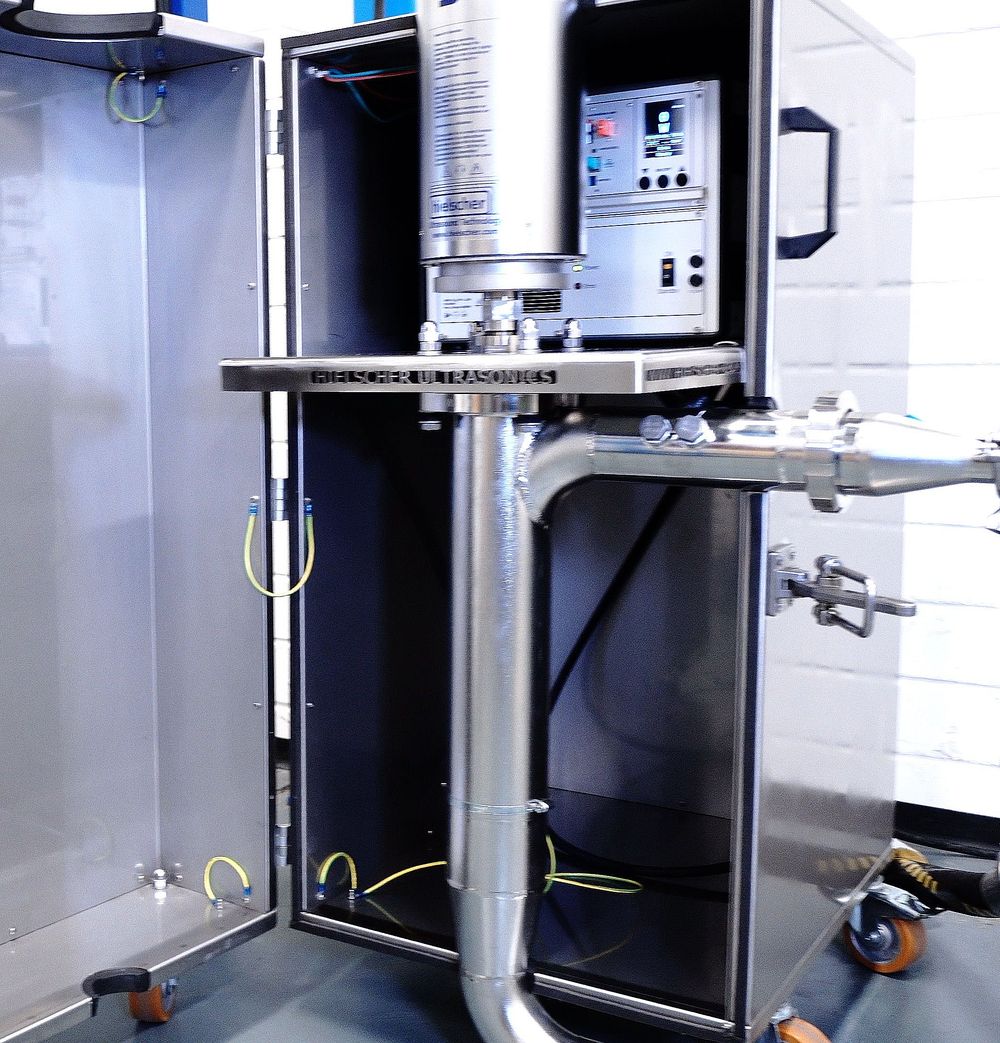 Hielscher sonicators are well suited for customized integration into chemical reactors because they are available as robust, high-power ultrasonic systems with adaptable sonotrodes, flow cells, reactor inserts, and process-specific accessories. Depending on the reaction setup, Hielscher ultrasonic processors can be installed in batch reactors, continuously stirred tank reactors, inline flow reactors, recirculation loops, pressurized systems, and pilot or production-scale plants. This flexibility allows ultrasound to be applied exactly where cavitation is most effective: at the liquid-solid, liquid-liquid, or liquid-gas interface. Hielscher Ultrasonics also offers various types of ultrasonic batch and inline reactors, enabling controlled sonochemical processing, emulsification, dispersion, catalyst activation, surface cleaning, mass-transfer intensification, and reaction acceleration. With precise control of amplitude, power input, temperature, pressure, flow rate, and residence time, Hielscher sonicators can be tailored to the specific requirements of laboratory research, process development, scale-up, and industrial chemical production.
Donja tablica daje vam naznaku približnog kapaciteta obrade naših ultrazvučnih uređaja:
| Volumen serije | Protok | Preporučeni uređaji |
|---|---|---|
| 1 do 500 ml | 10 do 200 ml/min | UP100H |
| 10 do 2000 ml | 20 do 400 ml/min | UP200Ht, UP400St |
| 0.1 do 20L | 0.2 do 4L/min | UIP2000hdT |
| 10 do 100l | 2 do 10L/min | UIP4000hdT |
| 15 do 150L | 3 do 15L/min | UIP6000hdT |
| na | 10 do 100L/min | UIP16000hdT |
| na | veći | klaster od UIP16000hdT |
Projektiranje, proizvodnja i savjetovanje – Kvaliteta Proizvedeno u Njemačkoj
Hielscher ultrasonicators su poznati po svojim najvišim standardima kvalitete i dizajna. Robusnost i jednostavan rad omogućuju glatku integraciju naših ultrazvučnih uređaja u industrijske objekte. Teški uvjeti i zahtjevna okruženja lako se nose s Hielscher ultrasonicators.
Hielscher Ultrasonics je ISO certificirana tvrtka i stavlja poseban naglasak na ultrazvučne uređaje visokih performansi koji sadrže najsuvremeniju tehnologiju i jednostavnu su za korištenje. Naravno, Hielscher ultrasonicators sukladni su CE i ispunjavaju zahtjeve UL, CSA i RoHs.

Ultrazvučni homogenizator UIP1500hdT s reaktorom protoka opremljenim rashladnim plaštom za kontrolu temperature procesa tijekom sonikacije.
Često postavljana pitanja
Što su kemijski reaktori?
Kemijski reaktori su konstruirani spremnici ili sustavi u kojima se kemijske reakcije izvode pod kontroliranim uvjetima kao što su temperatura, tlak, miješanje, vrijeme zadržavanja i koncentracija reaktanata. Njihova svrha je pretvoriti sirovine u željene proizvode s definiranim prinosom, selektivnošću i učinkovitošću procesa.
Koje su glavne vrste kemijskih reaktora?
Glavne vrste kemijskih reaktora uključuju serijske reaktore, kontinuirano miješane spremničke reaktore, reaktore s tokom čepa, reaktore s fiksnim slojem, reaktore s fluidiziranim slojem, suspenzijske reaktore, membranske reaktore te fotokemijske ili elektrokemijske reaktore. Svaka vrsta reaktora razlikuje se po ponašanju toka, režimu miješanja, svojstvima prijenosa topline i mase te prikladnosti za homogene ili heterogene reakcije.
Koja je razlika između reaktora s fluidiziranim slojem i reaktora s fiksnim slojem?
In a fixed bed reactor, solid catalyst particles remain stationary while reactants flow through the packed catalyst bed. In a fluidized bed reactor, an upward-flowing fluid suspends and moves the solid particles, creating a dynamic bed with strong mixing, improved heat transfer, and better particle-fluid contact. Fixed beds are simpler and mechanically stable, while fluidized beds provide higher mixing and heat-transfer efficiency but require more complex flow control.
What is a Catalyst Bed?
Katalitičko ležište je definirani volumen čvrstih čestica katalizatora raspoređenih unutar reaktora. Ono pruža aktivnu površinu na kojoj se odvijaju kemijske reakcije. Katalitička ležišta mogu biti stacionarna, kao u reaktorima s fiksnim slojem, ili dinamički suspendirana, kao u fluidiziranim reaktorima. Njihova učinkovitost ovisi o aktivnosti katalizatora, veličini čestica, poroznosti, površini, raspodjeli protoka, prijenosu topline i prijenosu tvari.
Literatura / Reference
- Yu, Hang Gao, Jing; Zhong, Qili; Guo, Yahui; Xie, Yunfei; Yao, Weirong; Zhou, Weibiao (2018): Acoustic pressure and temperature distribution in a novel continuous ultrasonic tank reactor: a simulation study. IOP Conference Series: Materials Science and Engineering 2018.
- Francisco J. Navarro-Brull; Andrew R. Teixeira; Jisong Zhang; Roberto Gómez; Klavs F. Jensen (2018): Reduction of Dispersion in Ultrasonically-Enhanced Micropacked Beds. Industrial & Engineering Chemistry Research 57, 1; 2018. 122–128.
- M. Ajmal, S. Rusli, G. Fieg (2016): Modeling and experimental validation of hydrodynamics in an ultrasonic batch reactor. Ultrasonics Sonochemistry, Volume 28, 2016. 218-229.
- L. Castrillón, E. Marañón, Y. Fernández-Nava, P. Ormaechea, G. Quiroga (2013): Thermophilic co-digestion of cattle manure and food waste supplemented with crude glycerin in induced bed reactor (IBR). Bioresource Technology, Volume 136, 2013. 73-77.
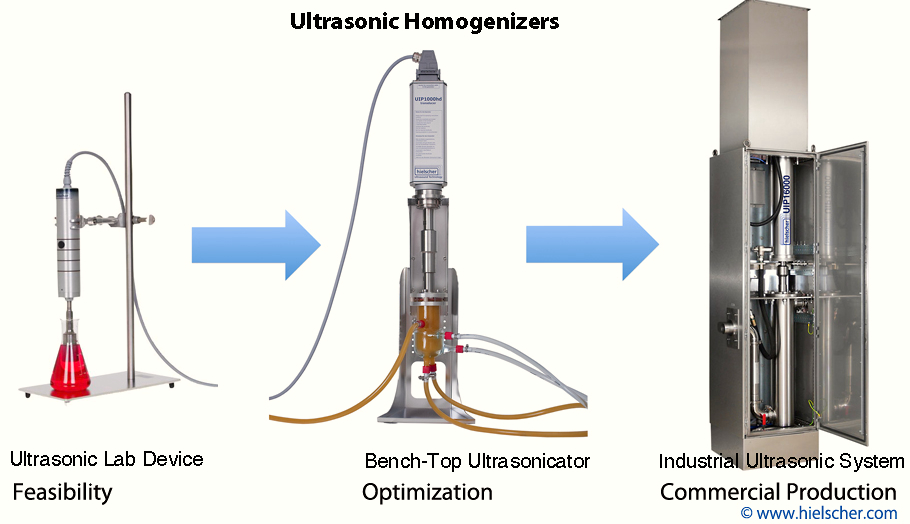
Hielscher Ultrasonics proizvodi ultrazvučne homogenizatore visokih performansi od laboratorija do industrijska veličina.