Reactores químicos mejorados mediante sonicación – Tipos, diseños y mecanismos
Los reactores químicos constituyen el núcleo de la química industrial, la síntesis de materiales, la producción de productos químicos finos, la fabricación de productos farmacéuticos y el tratamiento medioambiental. A medida que las industrias buscan procesos más rápidos, más limpios y más eficientes desde el punto de vista energético, la sonicación, también conocida como procesamiento ultrasónico, se ha convertido en un método cada vez más relevante para la intensificación de los reactores. La tecnología de reactores ultrasónicos está transformando el procesamiento químico al mejorar la mezcla, la transferencia de masa, la cinética de reacción y la catálisis heterogénea en sistemas de reactores tanto discontinuos como continuos.
Cómo mejora la sonicación el rendimiento de los reactores químicos
Al introducir ultrasonidos de alta potencia en un reactor químico, los ingenieros pueden generar una mezcla por flujo oscilatorio ultrasónico y cavitación acústica en el interior del medio de reacción. Estos mecanismos mejoran el contacto entre los reactivos, aceleran la transferencia de masa y pueden aumentar las velocidades de reacción, la selectividad y el rendimiento. La sonicación resulta especialmente eficaz en sistemas sólido-líquido, como la catálisis heterogénea, y en sistemas líquido-líquido, como la emulsificación, la extracción y las reacciones bifásicas. Se utiliza con menos frecuencia en mezclas gas-líquido, ya que la cavitación acústica se genera con menor eficacia en líquidos con un alto contenido de gas.
En el diseño moderno de los reactores sonoquímicos, los fluidos se agitan mediante oscilaciones ultrasónicas y cavitación, normalmente con amplitudes que oscilan entre 10 y 200 µm. Esto permite obtener potentes efectos de mezcla a escala microscópica que son difíciles de conseguir únicamente con la agitación mecánica convencional.
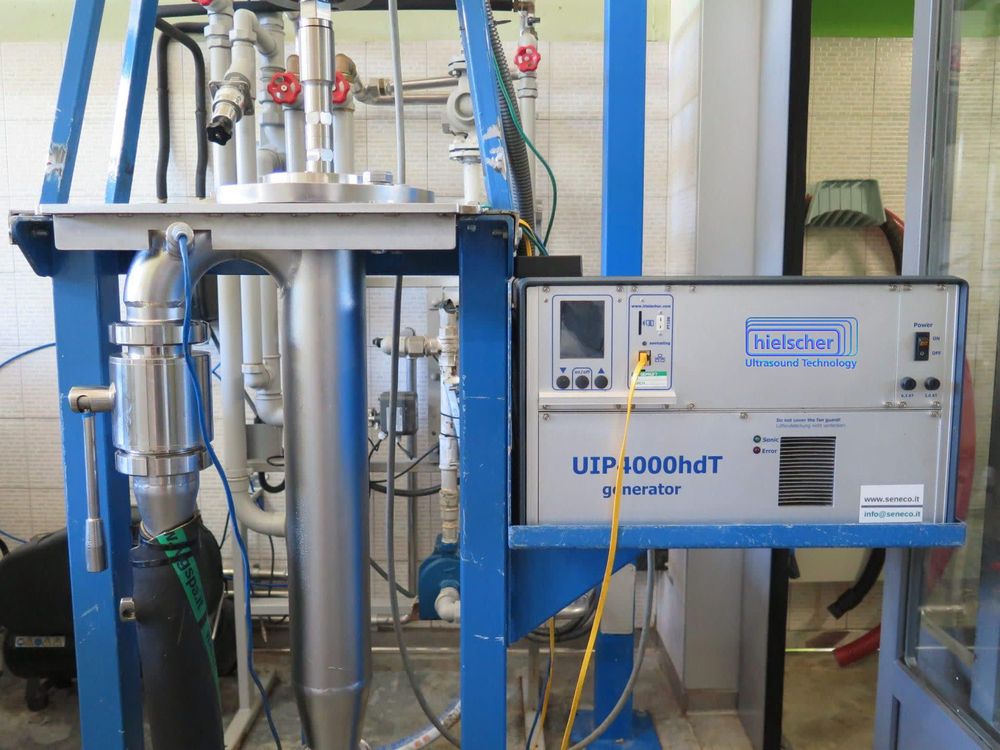
Sonicador en línea UIP4000hdT con celda de flujo para intensificar las reacciones químicas
¿Por qué la sonicación potencia los reactores químicos?
La relevancia industrial de la sonicación radica en su capacidad para influir en los fenómenos de transporte químico y físico a escala micro y meso. A diferencia de la agitación convencional, el ultrasonido no se limita a mover el líquido a granel. Genera ondas de presión, movimiento oscilatorio, burbujas de cavitación y zonas localizadas de alta energía.
Cuando las burbujas de cavitación acústica se forman, crecen y colapsan, crean microentornos intensos. Estos fenómenos pueden producir:
- elevadas fuerzas de cizallamiento locales
- microchorros cerca de superficies sólidas
- ondas de choque
- micromezclado rápido
- dispersión mejorada de las partículas
- mejor contacto interfacial
- transferencia acelerada de masa y calor
- efectos de la limpieza de superficies y la activación de catalizadores
Estos fenómenos hacen que la sonicación resulte muy valiosa para la intensificación de procesos, especialmente cuando las reacciones se ven limitadas por la difusión, un contacto deficiente entre las fases, la obstrucción del catalizador o una mezcla insuficiente.
La sonicación en reactores discontinuos
Los reactores discontinuos se utilizan ampliamente en laboratorios, plantas piloto y en la producción de productos químicos especializados. Son flexibles, fáciles de manejar y adecuados para el cribado de reacciones, la síntesis de pequeños volúmenes y la fabricación de productos de alto valor.
Cuando se aplica la sonicación a los reactores discontinuos, puede mejorar significativamente la mezcla y la uniformidad de la reacción. Las sondas ultrasónicas, las celdas de flujo o los transductores montados externamente pueden introducir energía acústica directamente en el medio de reacción.
En los sistemas por lotes, la sonicación resulta especialmente útil para:
- catálisis heterogénea
- síntesis de nanopartículas
- control de la cristalización
- emulsión
- Extracción
- Polimerización
- disolución y dispersión de sólidos
En las reacciones sólido-líquido, los ultrasonidos pueden evitar la aglomeración de partículas y mejorar el acceso a las superficies catalíticas o reactivas. En los sistemas líquido-líquido, la sonicación puede crear emulsiones finas y aumentar el área interfacial entre fases inmiscibles, lo que a menudo da lugar a velocidades de reacción más rápidas.
Reactores de flujo continuo para el procesamiento sonoquímico continuo
Los reactores de flujo continuo se encuentran entre los diseños más importantes para la sonicación industrial. En lugar de tratar un volumen fijo de líquido, la mezcla de reacción pasa continuamente a través de la cámara del reactor ultrasónico.
Este diseño resulta muy interesante para la ampliación a escala industrial, ya que permite a los ingenieros controlar con mayor precisión el tiempo de residencia, el caudal, la temperatura, la presión y la energía ultrasónica aplicada. Los reactores sonoquímicos de flujo continuo se utilizan a menudo cuando se requiere una calidad constante del producto y un funcionamiento continuo.
Entre las principales ventajas de los reactores de flujo continuo con ultrasonidos se incluyen:
- capacidad de producción continua
- mayor reproducibilidad del proceso
- mejor control de la temperatura
- distribución controlada del tiempo de residencia
- una integración más sencilla en las líneas de producción industriales
- arquitectura de reactor escalable
En estos sistemas, la mezcla por flujo oscilatorio ultrasónico puede potenciar la mezcla radial y axial, reducir los gradientes de concentración y mejorar la interacción entre los reactivos. Esto resulta especialmente valioso en procesos en los que el rendimiento de la reacción depende de un contacto rápido entre las fases o de una dispersión rápida.
Inserto ultrasónico para célula de flujo «MultiPhaseCavitator»
 El MultiPhaseCavitator Insert-MPC48 es un inserto especializado para los reactores de célula de flujo ultrasónicos de Hielscher, diseñado para intensificar los procesos líquido-líquido y líquido-gas directamente en la zona de cavitación ultrasónica. Al inyectar una segunda fase líquida o gaseosa a través de 48 cánulas finas en la corriente líquida principal, el MultiPhaseCavitator crea gotitas muy pequeñas o burbujas de gas con una elevada superficie interfacial específica. Esto lo hace especialmente eficaz para la emulsificación ultrasónica, en la que se dispersan fases inmiscibles en emulsiones finas, y para reacciones catalíticas con gases, en las que la fase gaseosa inyectada se dispersa rápidamente y entra en contacto íntimo con la fase líquida, los reactivos disueltos o los catalizadores en suspensión. El cizallamiento cavitacional resultante, la micromezcla y la transferencia de masa mejorada pueden mejorar la cinética de reacción, el contacto entre las fases y la eficiencia del proceso, tanto en operaciones continuas como por lotes.

Sonicator UIP2000hdT con un reactor químico por lotes
Diseños de reactores químicos y las ventajas de la sonicación
| Tipo de reactor | Aplicación típica | Principales efectos de la sonicación | Relevancia técnica |
|---|---|---|---|
| Reactores de suspensión | Catálisis heterogénea con partículas de catalizador sólido en suspensión en una fase líquida; se utiliza en hidrogenación, oxidación, conversión de biomasa, procesos de tipo Fischer-Tropsch, fotocatálisis y tratamiento de aguas residuales. | La sonicación mejora la dispersión del catalizador, la desaglomeración de las partículas, la reducción de la capa límite, la renovación de la superficie, la transferencia de masa líquido-sólido, la limpieza de la superficie del catalizador y la reducción de las incrustaciones. | Esto es especialmente relevante porque muchas reacciones catalíticas en fase de suspensión están limitadas por la eficiencia con la que los reactivos llegan a los sitios activos. La cavitación acústica potencia el contacto en la interfaz entre el catalizador y el líquido y puede mejorar la cinética de la reacción. |
| Reactores de tanque con agitación continua (CSTR) | Reacciones continuas en fase líquida, emulsificación, reacciones catalíticas, precipitación, cristalización, reacciones de polímeros y suspensiones sólido-líquido. | El ultrasonido mejora la micromezcla, la suspensión de partículas, la emulsificación, la dispersión y el aporte local de energía. Se puede combinar con la agitación mecánica para mejorar tanto la macromezcla como la micromezcla. | Los CSTR con ultrasonidos resultan útiles cuando los impulsores convencionales no pueden eliminar por completo las zonas muertas, la dispersión deficiente o las limitaciones locales en la transferencia de masa. Los ultrasonidos favorecen unas condiciones de reacción más uniformes y una mayor intensificación del proceso. |
| Reactores de lecho fijo | Lechos catalíticos fijos utilizados en hidrogenación, oxidación, catálisis medioambiental, procesos petroquímicos y catálisis heterogénea en fase líquida. | La sonicación puede mejorar la humectación del catalizador, el movimiento del líquido a través del lecho, la reducción de la capa límite, la limpieza de superficies, la mitigación de las incrustaciones y la transferencia de masa a los sitios catalíticos. | El rendimiento de los lechos fijos suele verse limitado por la canalización, la humectación deficiente, la resistencia a la difusión y la formación de depósitos. La intensificación del proceso mediante ultrasonidos puede mejorar la utilización del catalizador y la uniformidad de la reacción. |
| Reactores de lecho fluidizado | Lechos dinámicos de partículas en suspensión utilizados en catálisis, tratamiento de partículas, recubrimiento, polimerización, secado y reacciones sólido-líquido. | La excitación ultrasónica puede mejorar la dispersión de las partículas, reducir la aglomeración, potenciar el contacto entre el fluido y el sólido, estabilizar las suspensiones y mejorar la accesibilidad a la superficie del catalizador. | La sonicación resulta especialmente eficaz en lechos fluidizados líquido-sólido, donde la cavitación puede generarse de forma eficiente. En sistemas ricos en gas, la cavitación es menos eficaz, lo que hace que los ultrasonidos sean más adecuados para aplicaciones en reactores basados en líquidos. |
| Reactores de membrana | Sistemas integrados de reacción y separación utilizados para la eliminación selectiva de productos, la dosificación de reactivos, los procesos catalíticos con membranas y las reacciones asistidas por filtración. | El ultrasonido puede reducir la suciedad en las membranas, mejorar el flujo de permeado, potenciar la limpieza de superficies, reducir la polarización de concentración y mejorar la mezcla cerca de la interfaz de la membrana. | La sonicación vincula la ingeniería de reacciones con la ciencia de la separación. Resulta especialmente útil en aquellos casos en los que la obstrucción, la resistencia a la transferencia de masa o un acoplamiento débil entre la reacción y la separación limitan el rendimiento de los reactores de membrana. |
Mecanismos de intensificación en reactores ultrasónicos
Las ventajas de la sonicación en los reactores químicos se basan en varios mecanismos que interactúan entre sí.
- La cavitación acústica es el mecanismo más importante. Consiste en la formación, el crecimiento y el colapso de burbujas microscópicas en un líquido expuesto a ultrasonidos de alta intensidad. El colapso de las burbujas genera una liberación de energía localizada y fuertes fuerzas mecánicas.
- La corriente acústica genera un movimiento constante del fluido inducido por ondas ultrasónicas. Esto mejora la mezcla y el transporte en zonas en las que la agitación mecánica puede resultar insuficiente.
- La mezcla por flujo oscilatorio se produce cuando la vibración ultrasónica provoca un rápido movimiento de vaivén del líquido. En los sistemas de reactores, las amplitudes de entre 10 y 200 µm aproximadamente pueden generar una agitación muy eficaz y mejorar la transferencia de masa.
- El microchorro y las ondas de choque se producen cerca de las burbujas de cavitación que colapsan, especialmente cerca de superficies sólidas. Estos efectos pueden limpiar las superficies de los catalizadores, romper las capas límite y mejorar el acceso del líquido a los sitios activos.
- El aumento de la superficie de interfaz reviste especial importancia en los sistemas líquido-líquido. Los ultrasonidos pueden generar gotitas finas y dispersiones estables, lo que aumenta la superficie disponible para la reacción o la transferencia de masa.
En conjunto, estos mecanismos convierten a la sonicación en una potente herramienta para la intensificación de los reactores químicos.
Relevancia industrial del diseño de reactores sonoquímicos
La importancia industrial de los reactores con sonicación va más allá de una mezcla más rápida. La sonicación ofrece una forma de manipular los entornos de reacción a escalas que los equipos convencionales no pueden alcanzar fácilmente.
En ingeniería química, muchas de las limitaciones de los reactores se deben a fenómenos de transporte más que a las velocidades de reacción intrínsecas. Es posible que los reactivos no lleguen a los sitios catalíticos con la rapidez suficiente. Los líquidos inmiscibles pueden tener una superficie de contacto insuficiente. Los sólidos pueden aglomerarse. Las membranas pueden ensuciarse. Las superficies de los catalizadores pueden obstruirse.
La sonicación resuelve estas limitaciones al mejorar directamente las condiciones físicas en el interior del reactor. Esto la convierte en una técnica relevante para varias prioridades de investigación e industriales:
- procesos químicos más respetuosos con el medio ambiente
- menor consumo de energía y de disolventes
- mayor eficiencia del catalizador
- mayor selectividad de reacción
- un desarrollo más rápido de los procesos
- fabricación en continuo
- sistemas de reactores modulares mejorados
- síntesis de materiales avanzados
- conversión sostenible de la biomasa y los flujos de residuos
Para los investigadores, la sonicación ofrece un método controlado para estudiar la relación entre la energía acústica aportada, el comportamiento de la cavitación, la mejora del transporte y el rendimiento químico. Para la industria, supone una vía práctica hacia sistemas de reactores compactos, eficientes y escalables.

Homogeneizador ultrasónico UIP2000hdT para reacciones químicas en un reactor de flujo
Ventajas de la sonicación en los reactores químicos
La integración de la ecografía en el diseño de los reactores ofrece varias ventajas operativas y científicas:
- velocidades de reacción más rápidas gracias a una mejor transferencia de masa
- mejor mezcla en sistemas multifásicos
- mayor dispersión de sólidos y gotas
- mejor utilización del catalizador
- limitaciones de difusión reducida
- superficies más limpias del catalizador y de la membrana
- mayor reproducibilidad de los procesos en los sistemas de flujo
- posible reducción de la temperatura, la presión o el tiempo de reacción
- compatibilidad con el funcionamiento por lotes y en continuo
- gran relevancia para la catálisis heterogénea y las reacciones bifásicas
Estas ventajas hacen que la tecnología de reactores ultrasónicos resulte especialmente atractiva para los productos químicos finos, los productos químicos especializados, la catálisis, los nanomateriales, la química verde y la intensificación de procesos.

Celda de flujo ultrasónica de vidrio
¡Potencia tu reactor químico con los sonicadores de Hielscher!
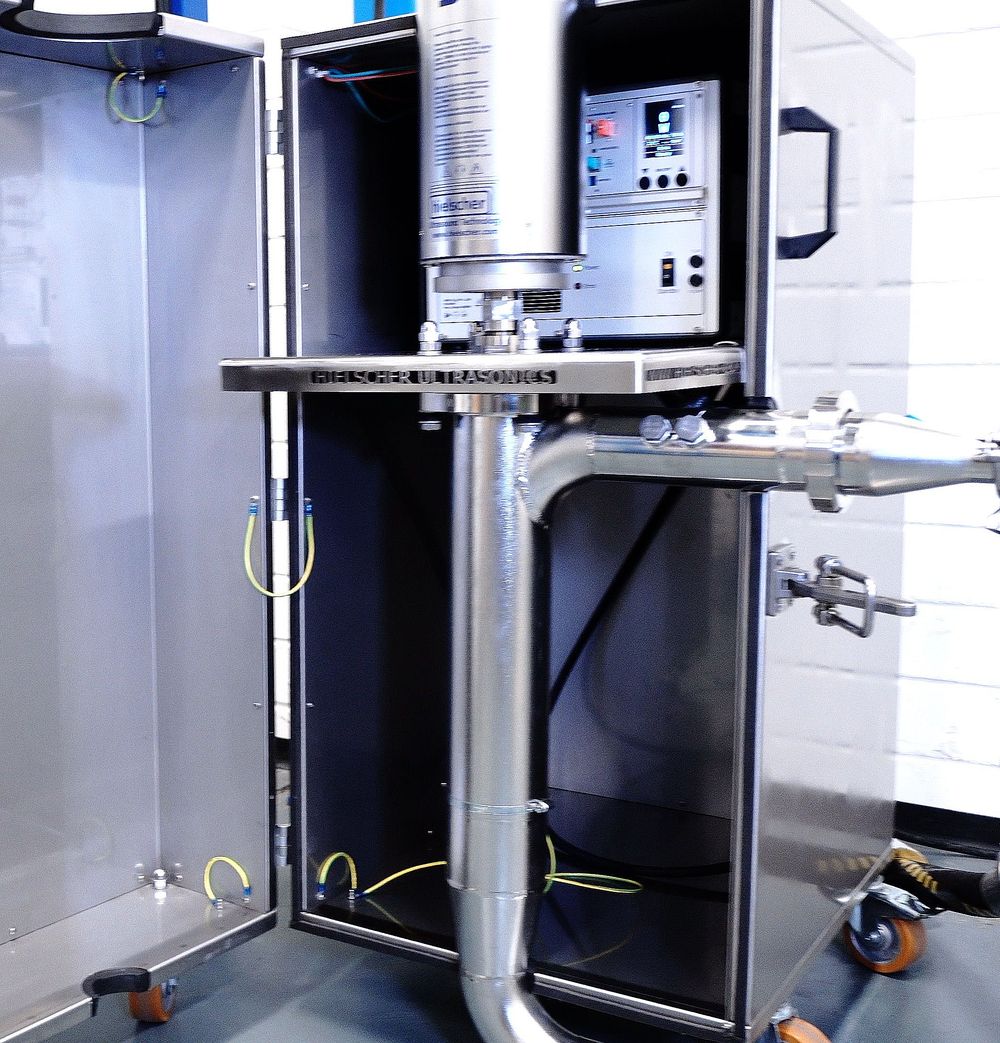 Los sonicadores de Hielscher son ideales para su integración a medida en reactores químicos, ya que se ofrecen como sistemas ultrasónicos robustos y de alta potencia, con sonotrodos adaptables, celdas de flujo, insertos para reactores y accesorios específicos para cada proceso. Dependiendo de la configuración de la reacción, los procesadores ultrasónicos de Hielscher pueden instalarse en reactores discontinuos, reactores de tanque con agitación continua, reactores de flujo en línea, circuitos de recirculación, sistemas presurizados y plantas a escala piloto o de producción. Esta flexibilidad permite aplicar el ultrasonido exactamente donde la cavitación es más eficaz: en la interfaz líquido-sólido, líquido-líquido o líquido-gas. Hielscher Ultrasonics también ofrece diversos tipos de reactores ultrasónicos por lotes y en línea, lo que permite el procesamiento sonoquímico controlado, la emulsificación, la dispersión, la activación de catalizadores, la limpieza de superficies, la intensificación de la transferencia de masa y la aceleración de reacciones. Gracias al control preciso de la amplitud, la potencia de entrada, la temperatura, la presión, el caudal y el tiempo de residencia, los sonicadores de Hielscher pueden adaptarse a los requisitos específicos de la investigación de laboratorio, el desarrollo de procesos, la ampliación de escala y la producción química industrial.
En la siguiente tabla encontrará algunas indicaciones sobre la capacidad de procesamiento aproximada de nuestros sonicadores:
| Volumen del lote | Tasa de flujo | Dispositivos recomendados |
|---|---|---|
| 1 a 500 mL | 10 a 200 mL/min. | UP100H |
| 10 a 2000 mL | 20 a 400 mL/min. | UP200Ht, UP400St |
| 0,1 a 20 L | 0,2 a 4 L/min | UIP2000hdT |
| 10 a 100 L | 2 a 10 L/min | UIP4000hdT |
| 15 a 150L | De 3 a 15 l/min | UIP6000hdT |
| n.a. | 10 a 100 L/min | UIP16000hdT |
| n.a. | mayor | Grupo de UIP16000hdT |
Diseño, fabricación y consultoría – Calidad Made in Germany
Los ultrasonidos de Hielscher son conocidos por sus elevados estándares de calidad y diseño. Su robustez y fácil manejo permiten una integración sin problemas de nuestros ultrasonidos en las instalaciones industriales. Los ultrasonidos de Hielscher soportan sin problemas las condiciones más duras y los entornos más exigentes.
Hielscher Ultrasonics es una empresa con certificación ISO y pone especial énfasis en los ultrasonidos de alto rendimiento con tecnología punta y facilidad de uso. Por supuesto, los ultrasonidos de Hielscher cumplen la normativa CE y los requisitos de UL, CSA y RoHs.

Homogeneizador ultrasónico UIP1500hdT con un reactor de flujo provisto de una camisa de refrigeración para controlar la temperatura del proceso durante la sonicación.
Preguntas frecuentes
¿Qué son los reactores químicos?
Los reactores químicos son recipientes o sistemas diseñados en los que se llevan a cabo reacciones químicas en condiciones controladas, tales como la temperatura, la presión, la agitación, el tiempo de residencia y la concentración de los reactivos. Su finalidad es convertir las materias primas en los productos deseados con un rendimiento, una selectividad y una eficiencia del proceso definidos.
¿Cuáles son los principales tipos de reactores químicos?
Entre los principales tipos de reactores químicos se incluyen los reactores discontinuos, los reactores de tanque con agitación continua, los reactores de flujo pistón, los reactores de lecho fijo, los reactores de lecho fluidizado, los reactores de suspensión, los reactores de membrana y los reactores fotoquímicos o electroquímicos. Cada tipo de reactor se diferencia en cuanto al comportamiento del flujo, el régimen de mezcla, las características de transferencia de calor y masa, y su idoneidad para reacciones homogéneas o heterogéneas.
¿Cuál es la diferencia entre un reactor de lecho fluidizado y un reactor de lecho fijo?
En un reactor de lecho fijo, las partículas sólidas del catalizador permanecen inmóviles mientras que los reactivos fluyen a través del lecho de catalizador empaquetado. En un reactor de lecho fluidizado, un fluido que fluye hacia arriba suspende y desplaza las partículas sólidas, creando un lecho dinámico con una intensa mezcla, una mejor transferencia de calor y un mejor contacto entre las partículas y el fluido. Los lechos fijos son más sencillos y mecánicamente estables, mientras que los lechos fluidizados ofrecen una mayor eficiencia en la mezcla y la transferencia de calor, pero requieren un control del flujo más complejo.
¿Qué es un lecho catalítico?
Un lecho catalítico es un volumen definido de partículas sólidas de catalizador dispuestas en el interior de un reactor. Proporciona la superficie activa en la que tienen lugar las reacciones químicas. Los lechos catalíticos pueden ser estacionarios, como en los reactores de lecho fijo, o estar suspendidos dinámicamente, como en los reactores de lecho fluidizado. Su rendimiento depende de la actividad del catalizador, el tamaño de las partículas, la porosidad, la superficie específica, la distribución del flujo, la transferencia de calor y la transferencia de masa.
Literatura / Referencias
- Yu, Hang Gao, Jing; Zhong, Qili; Guo, Yahui; Xie, Yunfei; Yao, Weirong; Zhou, Weibiao (2018): Acoustic pressure and temperature distribution in a novel continuous ultrasonic tank reactor: a simulation study. IOP Conference Series: Materials Science and Engineering 2018.
- Francisco J. Navarro-Brull; Andrew R. Teixeira; Jisong Zhang; Roberto Gómez; Klavs F. Jensen (2018): Reduction of Dispersion in Ultrasonically-Enhanced Micropacked Beds. Industrial & Engineering Chemistry Research 57, 1; 2018. 122–128.
- M. Ajmal, S. Rusli, G. Fieg (2016): Modeling and experimental validation of hydrodynamics in an ultrasonic batch reactor. Ultrasonics Sonochemistry, Volume 28, 2016. 218-229.
- L. Castrillón, E. Marañón, Y. Fernández-Nava, P. Ormaechea, G. Quiroga (2013): Thermophilic co-digestion of cattle manure and food waste supplemented with crude glycerin in induced bed reactor (IBR). Bioresource Technology, Volume 136, 2013. 73-77.
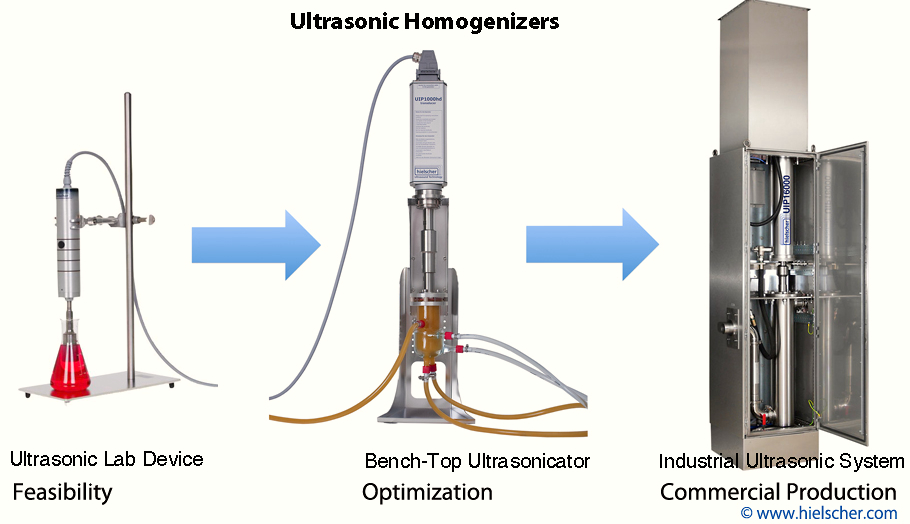
Hielscher Ultrasonics fabrica homogeneizadores ultrasónicos de alto rendimiento de laboratorio a tamaño industrial.