Paladyum Nanopartiküllerinin Sonokimyasal İndirgenmesi
Palladyum (Pd), katalitik özellikleriyle iyi bilinir ve ayrıca malzeme araştırmaları, elektronik üretimi, tıp, hidrojen saflaştırma ve çeşitli kimyasal uygulamalarda yaygın olarak kullanılır. Sonokimyasal bir yöntem kullanılarak, PVP/Pd oranı ayarlanarak paladyum parçacıklarının boyutu ve morfolojisi kontrol edilebilir. Bu, çok ince, tek dağılımlı nanoparçacıkların veya daha büyük paladyum agregatlarının ultrasonik sentezini mümkün kılar ve parçacık boyutlarının optimum katalitik performans için özelleştirilmesine olanak tanır.
Paladyum Nanopartiküllerin Ultrasonik Üretimi
 Ultrasonik paladyum nanoparçacık indirgemesi, akustik kavitasyon yoluyla yerel olarak yüksek enerjili koşullar yaratarak ve çözeltideki indirgeyici radikalleri kullanarak Pd(0) nanoparçacıklarına ulaşmak için hızlı ve reaktif tasarrufu sağlayan bir yöntem sunar; bu sayede paladyum iyonları, geleneksel yüksek sıcaklık işlemlerine gerek kalmadan indirgenebilir.
En önemli avantajlardan biri proses kontrolüdür: sonikasyon süresi ve PVP/Pd oranı gibi stabilizatör konsantrasyonu, ürünün yaklaşık 5 nm boyutunda iyi dağılmış, yuvarlak nanopartiküller mi yoksa yaklaşık 20 nm boyutunda daha büyük agregalar mı oluşturacağını etkileyebilir; bu durum endüstriyel açıdan önemlidir çünkü katalizde paladyumun performansı, partikül boyutu, morfolojisi, dağılımı ve yüzey alanına büyük ölçüde bağlıdır. Paladyum nanopartiküller, heterojen katalizörler, elektrokatalizörler ve fonksiyonel malzemeler olarak yaygın bir şekilde değerli olduğundan, ultrasonik indirgeme, nispeten ılımlı sıvı faz koşulları altında ince dağılmış Pd katalizörleri üretmek için caziptir; bu, kimyasal sentez, çevresel kataliz, yakıt hücresi teknolojileri ve yüksek katalitik aktivite ile verimli asil metal kullanımının ekonomik açıdan önemli olduğu diğer süreçler için potansiyel faydalar sağlar.

Endüstriyel nanoparçacık işleme sonikatör UIP2000hdT ile
Numune Hazırlama Prosedürü
Örnekler aşağıdaki gibi hazırlandı:
Numuneler için 30 mL EG ve 5·10 karışımları-6PVP’nin mol’u, manyetik karıştırma altında 15 dakika boyunca hazırlandı. Farklı numuneler için, 1,5 mL ve 2 mL olmak üzere farklı miktarlarda Pd(NO₃)₂ çözeltisi ilave edildi. Numune karışımları, 2·10-3(a) numaralı numunede mol Pd(NO₃)₂ ve 2,66·10-3(b) numaralı numunede mol Pd(NO₃)₂. Her iki karışım da prob tipi bir ultrasonik cihaz kullanılarak 20 mL’lik bir şişede ultrasonik işleme tabi tutuldu. Numuneler, 30, 60, 90, 120, 150 ve 180 dakikalık ultrasonik işlem sürelerinin ardından alındı.
Deneysel sonuçların analizi şunu göstermektedir:
- 1. Pd (II) 'nin Pd (0) 'a sonokimyasal indirgenmesi, sonikasyon süresine bağlıdır.
- 2. Yüksek PVP/Pd(II) molar oranı, yuvarlak bir şekle ve yaklaşık 5 nm ortalama çapa sahip monodispers paladyum parçacıklarının oluşumuna yol açar.
- 3. Bununla birlikte, düşük PVP / Pd (II) molar oranı, 20nm'de merkezlenmiş büyük bir boyut dağılımına sahip agrega paladyum nanopartiküllerinin elde edilmesini içerir.
Paladyum (II) iyonlarını indirgemenin sonokimyasal yolu Pd(II) paladyum atomlarına Pd(0) aşağıdaki gibi varsayılabilir:
- (1) Suyun pirolizi: H₂O → •OH + •H
- (2) Radikal oluşumu: RH (İndirgeyici) + •OH(•H) → •R + H₂O(H₂)
- (3) İyon indirgeme: Pd(II) + indirgeyici radikaller (•H, •R) → Pd(0) + R•CHO + H+
- (4) Parçacık oluşumu: NPd(0) → Pdn
Sonuç: PVP/Pd(II) oranına bağlı olarak, dağınık veya toplanmış PdN elde edildi.
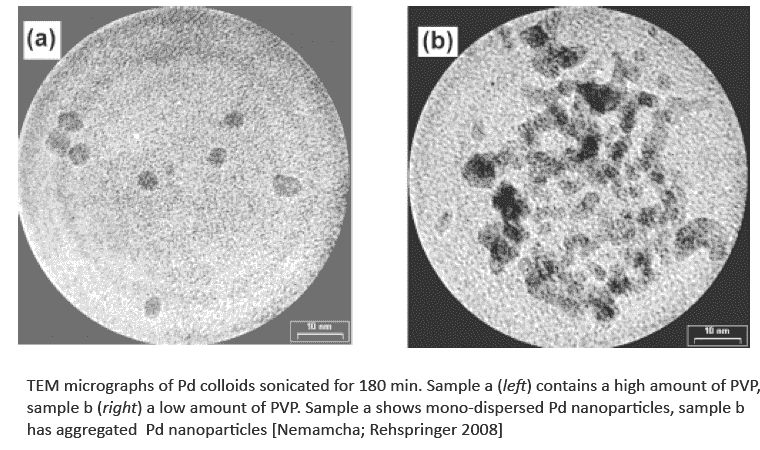
Palladyumun sonokimyasal indirgenmesi: a numunesi (solda) yüksek miktarda PVP içerirken, b numunesi (sağda) düşük miktarda PVP içermektedir. UP100H ile sonikasyon süresi: 180 dakika. a numunesinde tek dağılımlı Pd nanopartikülleri, b numunesinde ise kümelenmiş Pd nanopartikülleri görülmektedir.
Görseller ve araştırma: ©Nemamcha ve Rehspringer, 2008
Analiz ve Sonuçlar
UV görünür absorpsiyon analizleri, paladyum (II) iyonlarının paladyum (0) atomlarına sonokimyasal indirgenmesi ile ultrasonik alanda tutma süresi arasındaki ilişkiyi doğrular. Paladyum (II) iyonlarının paladyum (0) atomlarına indirgenmesi ilerler ve artan sonikasyon süresi ile tamamen elde edilebilir. Transmisyon elektron mikroskobunun (TEM) mikrografları şunu göstermektedir:
- Yüksek miktarda PVP eklendiğinde, paladyum iyonlarının sonokimyasal indirgenmesi, küresel şekilli ve ortalama çapı yaklaşık 5 nm olan monodispers paladyum parçacıklarının oluşmasına yol açar.
- Az miktarda PVP kullanılması, paladyum nanopartiküllerinin agregatlarının elde edilmesini sağlar. Dinamik ışık saçılımı (DLS) ölçümleri, paladyum nanopartikül agregatlarının 20 nm’de yoğunlaşan geniş bir boyut dağılımına sahip olduğunu ortaya koymaktadır.

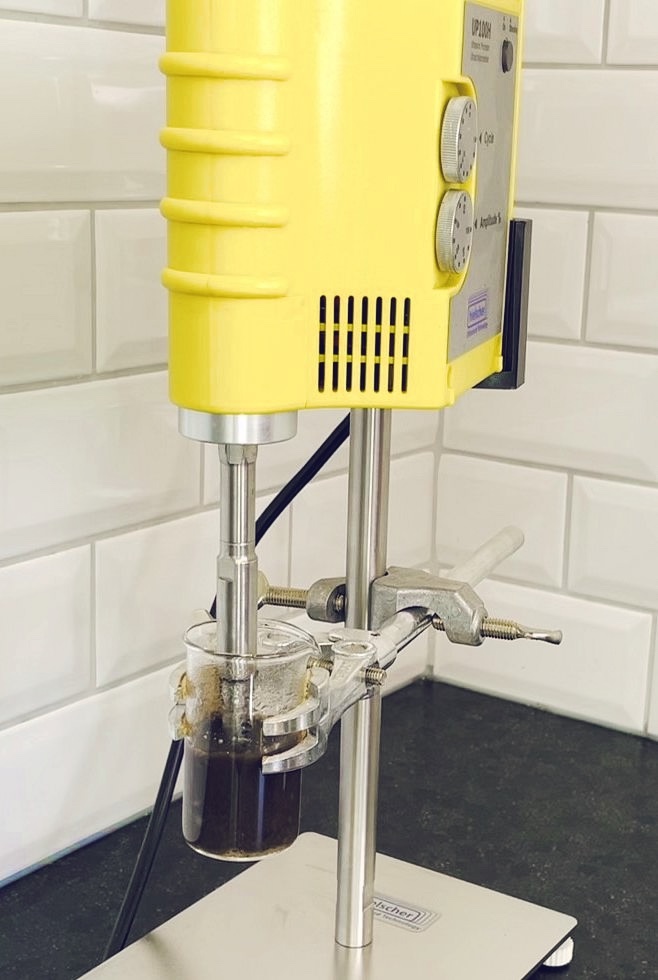
UP100H laboratuvar ultrasonik cihazı paladyum nanoparçacıklarının hazırlanmasında kullanılmıştır.

Paladyum (Pd) nano parçacıklar sonikasyon ile hazırlanabilir
Tasarım, İmalat ve Danışmanlık – Almanya'da Üretilen Kalite
Hielscher ultrasonicators en yüksek kalite ve tasarım standartları için iyi bilinir. Sağlamlık ve kolay kullanım, ultrasonicators'ımızın endüstriyel tesislere sorunsuz bir şekilde entegre edilmesini sağlar. Zorlu koşullar ve zorlu ortamlar Hielscher ultrasonicators tarafından kolayca ele alınır.
Hielscher Ultrasonics, ISO sertifikalı bir şirkettir ve en son teknoloji ve kullanıcı dostu özelliklere sahip yüksek performanslı ultrasonicators'a özel önem vermektedir. Tabii ki, Hielscher ultrasonicators CE uyumludur ve UL, CSA ve RoHs gereksinimlerini karşılar.
Literatür/Referanslar
- Nemamcha, A.; Rehspringer, J. L. (2008): Morphology of dispersed and aggregated PVV-Pd nanoparticles prepared by ultrasonic irradiation of Pd(NO₃)₂ solution in ethylene glycol. Rev. Adv. Mater. Sci. 18;2008. 685-688.
- Prekob, Á., Muránszky, G., Kocserha, I. et al. (2020): Sonochemical Deposition of Palladium Nanoparticles Onto the Surface of N-Doped Carbon Nanotubes: A Simplified One-Step Catalyst Production Method. Catalysis Letters 150, 2020. 505–513.
- Haitao Zheng, Mphoma S. Matseke, Tshimangadzo S. Munonde (2019): The unique Pd@Pt/C core-shell nanoparticles as methanol-tolerant catalysts using sonochemical synthesis. Ultrasonics Sonochemistry, Volume 57, 2019. 166-171.
Bilmeye Değer Gerçekler
Palladyum nedir?
Paladyum, kimyasal sembolü Pd ve atom numarası 46 olan, nadir bulunan, gümüş beyazı bir değerli metaldir. Platin grubu metallere aittir ve kimyasal olarak kararlı olması, elektrik iletmesi, hidrojeni emmesi ve mükemmel bir katalizör görevi görmesi nedeniyle değerlidir. İnce parçacıklı paladyum, özellikle hidrojenleme ve dehidrojenleme reaksiyonlarında etkilidir; ısıtıldığında ise hidrojenin içinden difüze olmasına izin verir, bu da onu hidrojen ayrıştırma ve saflaştırma işlemleri için kullanışlı kılar.
Palladyum nanopartikülleri ne için kullanılır?
Palladyum nanopartikülleri, esas olarak yüksek yüzey alanlı katalizörler olarak kullanılır. Nanopartiküller, kütle halindeki palladyuma kıyasla çok daha fazla aktif yüzey alanı sundukları için, katalizör verimliliğini artırabilir ve gerekli olan pahalı asil metal miktarını azaltabilirler. Tipik uygulama alanları arasında kimyasal sentez, hidrojenasyon reaksiyonları, karbon-karbon birleştirme reaksiyonları, elektrokataliz, yakıt hücresi araştırmaları, hidrojen algılama ve depolama, çevresel kataliz ve antimikrobiyal, fototermal ve antikanser sistemleri gibi bazı biyomedikal araştırma alanları yer alır. Paladyumun katalitik davranışı, büyük ölçüde parçacık boyutu, morfolojisi ve dispersiyonuna bağlıdır.
Palladyum nanopartikülleri, katalitik işlevler elde etmek amacıyla diğer partikülleri katkılama amacıyla da kullanılır. Fischer-Tropsch katalizörü olarak Pd/N-BCNT'yi sentezlemeye yönelik ultrasonik yöntem hakkında daha fazla bilgi edinin!
Palladyum Zehirli midir?
Elementel metalik paladyumun genel olarak düşük toksisiteye sahip olduğu ve bilinen bir biyolojik rolü olmadığı kabul edilir; ancak paladyum bileşikleri, tuzları, tozları ve nano ölçekli formları dikkatli bir şekilde kullanılmalıdır. Mesleki veya laboratuvar ortamında maruz kalma, bileşiğe ve maruz kalma yoluna bağlı olarak tahrişe veya duyarlılığa neden olabilir; örneğin, paladyum klorür çözeltileri mukoza zarlarını tahriş edebilir. Endüstriyel kullanım açısından pratik cevap şudur: dökme metalik paladyum nispeten düşük risklidir; ancak paladyum tozları, çözünür paladyum tuzları ve paladyum nanopartikülleri, toz kontrolü, havalandırma, eldiven, göz koruması ve uygun atık yönetimi önlemleri alınarak potansiyel olarak tehlikeli maddeler olarak değerlendirilmelidir.