Ultraschall Ausleechung vu rare Äerdelementer aus Äschen
Ultrasonic leaching can increase extraction yields and shorten processing times when recovering rare earth elements from ash. By improving contact between ash particles and leaching agents, power ultrasound accelerates dissolution and helps make valuable elements more accessible. Studies on coal fly ash demonstrate the potential: researchers reported 97% yttrium extraction, while a separate study on gallium and vanadium reduced the acid leaching time from 180 to 20 minutes.
Ash as a Secondary Resource for Rare Earth Elements
Ashes represent a promising secondary resource for rare earth elements (REEs). Coal combustion residues can contain yttrium and other rare earths used in electronics, energy technologies and advanced materials. Recovering these elements from existing ash streams and deposits could diversify raw material supplies and turn a disposal material into a useful feedstock.
The extraction potential depends on both elemental concentration and accessibility. An ash may contain valuable elements, yet release only a limited fraction during leaching if the surrounding mineral matrix restricts reagent access. Consequently, ash composition, pretreatment and leaching chemistry must be considered together. Recovering several valuable elements from the same feedstock may also improve the prospects of a process.
Ultrasonic leaching fragments ash particles making rare earths available to leaching reagents. By improving mass transfer between particles and reagent, sonication increases recovery whilst shortening processing time!
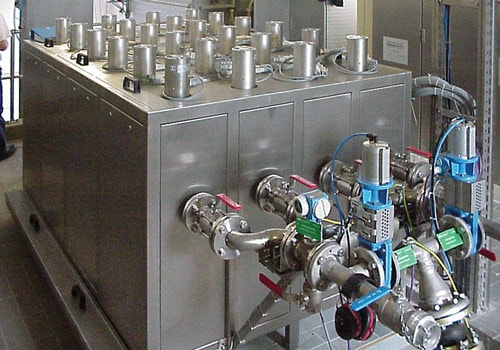
Industrial installation of Hielscher sonicators: 48kW sonicator cluster for the inline leaching of rare earth elements from coal ashes
How Ultrasound Improves Ash Leaching
Power ultrasound intensifies solid–liquid extraction through acoustic cavitation. Microscopic bubbles form and collapse in the liquid, generating local shear forces, microjets and intense mixing. These effects can disperse particle agglomerates, clean exposed surfaces and improve transport of leaching agents to reactive sites. Dissolved species are transported away more rapidly, helping sustain dissolution.
For ash processing, these effects offer several practical advantages:
- Faster leaching: Enhanced mass transfer can shorten the time needed to extract accessible metals.
- Higher extraction yields: Improved surface contact can help release material that remains insufficiently leached under conventional mixing.
- Combination with pretreatment: Ultraschall kann d'Lachstadium verstäerken nodeems d'Aktivatioun resistente Phasen méi zougänglech gemaach huet.
- Flexibel Prozess Entwécklung: D'Sonikatioun kann entwéckelt an un ënnerschiddlech Säckekonzentratioun, Fixstoffbeladung, Temperatur an Behandlungzäit ugepasst ginn.
Fuerschung Beispiller: High Yields a Kuerz Leaching Times
Déi folgend Studien illustréieren dës Virdeeler ënner spezifesche experimentellen Konditiounen. Yttrium ass e rare Äerdelement; Gallium a Vanadium sinn aner wäertvoll Metaller. Hir Extraktioun bitt komplementär Beweiser fir Ultraschallveraarbechtung vun Asche.
Yttrium a Vanadium: Bis zu 97% an 100% Extraktioun
Masoum et al. (2021) investigated the extraction of vanadium and yttrium from coal fly ash using sulfuric acid, hydrogen peroxide and ultrasound. The researchers applied response surface methodology to optimize the solid-to-liquid ratio and the proportions of sulfuric acid and hydrogen peroxide. Under the optimized conditions, reported extraction reached 100% for vanadium and 97% for yttrium.
A modified shrinking core model indicated that mass diffusion controlled the reaction rate. This finding highlights the importance of transport processes in the investigated system and supports targeting mass transfer during process optimization. The results demonstrate that high yttrium extraction is achievable with the combined treatment, although the reported yields reflect the complete reagent and ultrasound system.
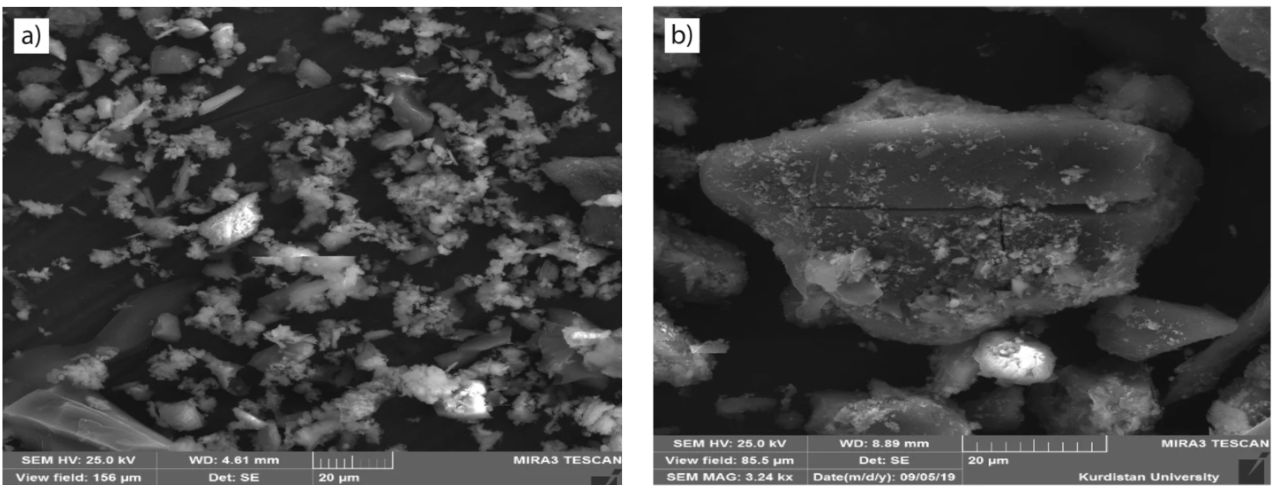
FESEM images of raw coal ash (a) left before leaching coal ash, (b) after ultrasonic leaching.
Study and images: ©Masoum et al., 2021
Gallium and Vanadium: 88.89% Shorter Leaching Time
Zhang et al. (2026) investigated ultrasonic acid leaching following sodium carbonate activation roasting. The optimized pretreatment consisted of roasting at 850°C for 60 minutes, using a fly ash-to-Na₂CO₃ mass ratio of 2:1. Subsequent ultrasonic acid leaching achieved high gallium and vanadium extraction within 20 minutes.
| Parameter | Ultrasonic leaching after activation roasting | Conventional leaching |
|---|---|---|
| Leaching time | 20 min | 180 min |
| Gallium leaching efficiency | 98.14% | 63.81% |
| Vanadium leaching efficiency | 92.32% | 83.56% |
D'Reduktioun vun 180 op 20 Minutten entsprécht enger 88,89% méi kuerzer Leaching-Phase. Kinetesch Analysen huet erhéicht Ratekonstanten an Engerung vum Massentransfer an interfacial Reaktiounsprozesser gewisen. Dës Resultater weisen d'Potenzial, Aktivéierungs-Roasting mat ultraschallgestäerter Leaching ze kombinéieren. D'Zäitspuerung gëllt fir d'Leaching; Roasting bleift e weidere Veraarbechtungsstadium.

Ultraschall verstäerkte Säureausleechung funktionnéiert mat enger Rate zwielef Mol méi séier wéi konventionell Säureausleechung, wéinst der beneficieller mechanescher Handlung vu Kavitatiounsblasen, déi no der Uewerfläch platzen. Dëst Phänomen verbessert d'Sauerléisungsmëschung, an doduerch d'Transporteigenschaften verbessert.
Bild a Studie: © Canciani et al., 2024
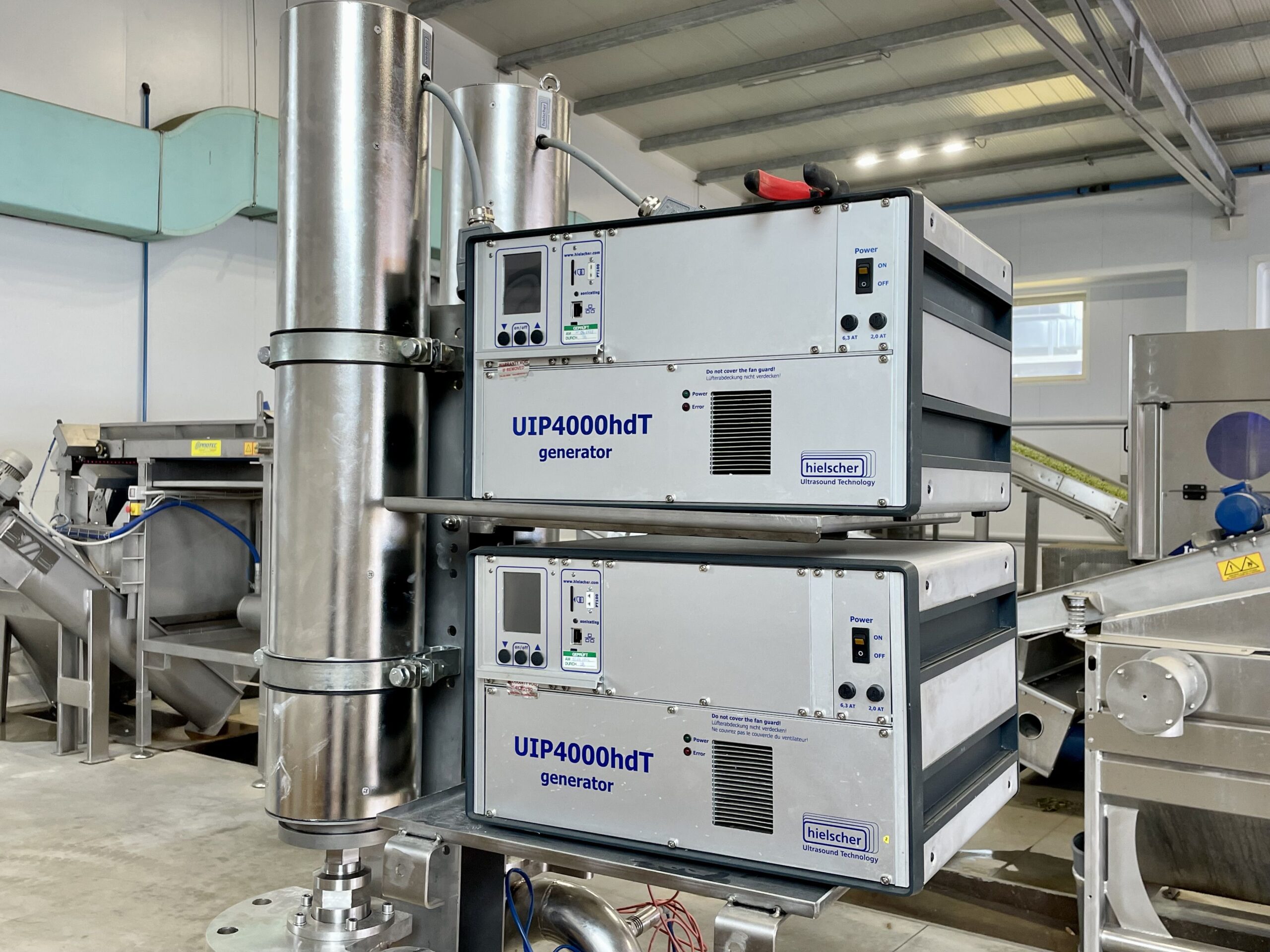
2 industriell Sonicatoren UIP4000hdT fir schwéier Veraarbechtung
Entwéckelt Äre Ultrasonic Auslaugungsprozess fir héich Erhuelung vu rare Äerdmetaller.
Fir praktesch Extraktioun vu rare Äerdmetaller gëtt no der Auslaugung eng Trennung an Reinigung vun den opgeléiste Elementer gemaach. Héich Auslaugungswäerter representéieren dofir e wichtegt mëttlerent Resultat amplaz vum Ertrag vun engem fäerdege rare Äerdprodukt. D'Bewäertung vum Prozess sollt d'nofolgend Erhuelung, Utilisatioun vu Reagentien an d'Energiepraxis fir souwuel d'Virbehandlung wéi och d'Sonikatioun abannen.
Hielscher offers industrial-grade bench-top sonicators and heavy-duty ultrasonic flow reactors for developing and implementing intensified leaching processes. Equipment selection and trials can establish suitable amplitude, solids loading, residence time and temperature control for a particular ash.
Simple scale-up to large volumes: Once established parameters for optimal recovery can be then linearly scaled-up to any commercial leaching volume.

Hielscher Ultrasonics fabrizéiert High-Performance Ultrasonic Homogenisatoren fir d'Vermëschung vun Uwendungen, Dispersioun, Emulsifikatioun an Extraktioun op Labo, Pilot an Industrieskala.

SEM Biller fir Partikelen zu verschiddenen Zäite vu konventioneller (a–c) an Ultraschall (d–f) Ausleechung.
Bild a Studie: © Canciani et al., 2024
Oft gestallten Froen
How does ultrasound improve rare earth leaching from ash?
Ultrasound generates acoustic cavitation in the leaching slurry. Collapsing bubbles produce intense local mixing, shear forces and microjets that improve contact between ash particles and the leaching solution. These effects expose reactive surfaces and accelerate mass transfer, helping increase extraction yields and shorten leaching times.
Wéi eng selten Äerderelementer a wäertvoll Metall kënne vun Asche geléist ginn?
Ofhängeg vun hirem Ursprong an hirer mineraler Zusammensetzung kënnen Aschen geléist ginn fir selten Äerderelementer erauszeschlecken, abegraff Lanthan (La), Cer (Ce), Neodym (Nd), Dysprosium (Dy), Yttrium (Y) an Scandium (Sc). Kuelfligerascht ass eng potenziell Quell vun dëse Elementer.
Aner wäertvoll Metaller enthalen Gallium (Ga) an Vanadium (V) an passende Kuelaschen, an Kupfer (Cu) an Zink (Zn) an der Stied-Offällverbrennung.
Why use a heavy-duty probe sonicator for ash leaching?
A probe sonicator introduces ultrasonic energy directly into the slurry through a sonotrode (ultrasonic probe/rod). This enables intensive treatment of solid–liquid mixtures and provides adjustable processing conditions. Hielscher industrial sonication equipment supports integration into leaching circuits where controlled energy input and reliable operation are essential. The configuration should match the slurry composition, solids loading and required throughput.
Here are a few of Hielscher leaching applications:
Can Hielscher sonicators operate continuously?
Yes. Hielscher industrial sonicators such as the UIP500hdT (500W) up to UIP16000hdT (16,000W) are designed for continuous 24/7 operation. They can be configured for batch treatment, recirculation or continuous processing through an ultrasonic flow cell. For ash leaching, an installation is integrated into slurry pumping, temperature control and the selected leaching chemistry.
Can ultrasonic leaching be scaled up to industrial production?
Yes, Hielscher sonicators allow a linear scale-up. Hielscher offers equipment for laboratory trials, pilot processing and industrial production, including 16 kW processors that can be combined in clusters. Scale-up starts with trials to establish suitable amplitude, energy input, temperature and residence time. These results provide the basis for selecting reactor capacity and validating extraction performance at the required throughput.
Does ultrasound replace acids or activation roasting?
Ultrasound intensifies the leaching process, while chemical reagents provide the chemistry needed to dissolve the target elements. Some ashes may also require pretreatment to make resistant mineral phases accessible.
Which process parameters can be monitored?
All Hielscher sonicators from 200 watts up support monitoring and automatic recording of amplitude, power, treatment time and temperature, with pressure measurement available through an optional sensor. These data help compare trials and reproduce operating conditions reliably. Rare earth elements extraction efficiency must be determined separately through chemical analysis of the feed, leachate and remaining solids.
Can ultrasonic equipment be used with acidic, abrasive ash slurries?
Hielscher Ultrasonics offers solutions to sonicate acidic, abrasive ash slurries. Sonotrodes, flow cells, seals and other wetted components need to be selected against acid composition, concentration, temperature and particle abrasiveness.
Bedeit méi héich Auslaugungseffizienz och méi héich final Erhuelung vu rare Äerdmetaller?
Jo, méi héich Ausleecheffizienz bedeit datt méi vum Zilelement an d'Flëssegkeetsphase transferéiert gëtt. D'Produktioun vun engem benotzbare selten Äerdprodukt erfuerdert och Downstream Trennung a Reinigung. Allgemeng Erhuelung hänkt vun der Leeschtung vum komplette Prozess of.
Wéi wielen ech en Hielscher Sonicator fir mäi Prozess?
Fänkt mat representativen Äscheproben un an definéiert d'Zilelementer, d'Schläimkonzentratioun, d'Lachchemie, d'Batchvolumen oder d'Flowrate, an d'gewënscht Extraktiounsausgab. Mir bei Hielscher kënnen Iech hëllefen Ausrüstung fir Machbarkeetstudien a spéider linear Skala-up ze wielen. Eisen techneschen Zentrum a Prozesslaboratoire bitt och Tester fir Ausrüstungsauswiel z'ënnerstëtzen.
Literatur / Referenzen
- Masoum, H.G., Rastegar, S.O. and Khamforoush, M. (2021): Ultrasound-Assisted Leaching of Vanadium and Yttrium from Coal Ash: Optimization, Kinetic and Thermodynamic Study. Chemical Engineering and Technology 44, 2021. x2249-2256.
- Qian Zhang, Deqing Zhu, Siwei Li, Jian Pan, Zhengqi Guo, Congcong Yang, Jiachen Gong (2026):
Ultrasonic enhanced leaching for the synergistic extraction of Ga and V from fly ash. Journal of Environmental Chemical Engineering, Volume 14, Issue 5, 2026. - Chiara Canciani, Elia Colleoni, Varaha P. Sarvothaman, Paolo Guida, William L. Roberts (2024): On the effect of cavitation on particles in leaching processes: implications to battery recycling. Environmental Advances, Volume 17, 2024.
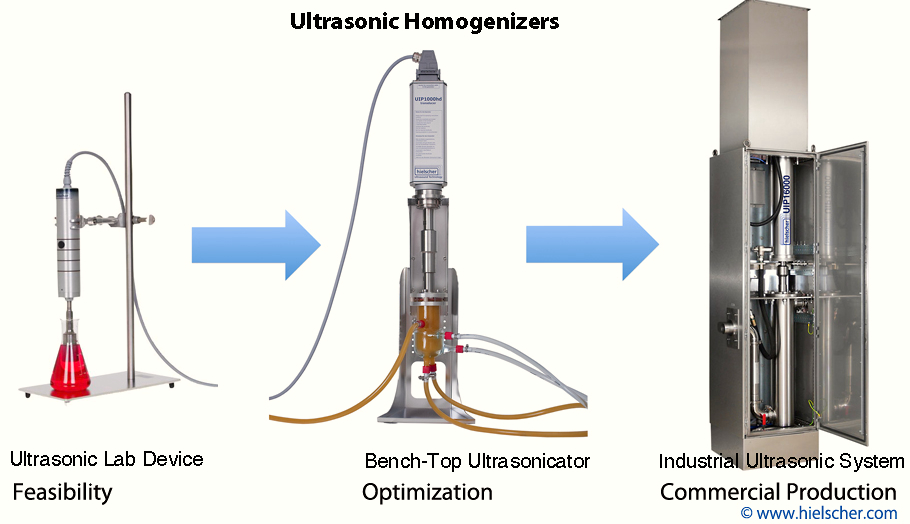
Hielscher Ultrasonics fabrizéiert High-Performance Ultrasonic Homogenisatoren aus Labo zu industriell Gréisst.