Ultrasonic Extraction with Deep Eutectic Solvents
Deep eutectic solvents (DES) and natural deep eutectic solvents (NADES) are powerful, tunable and environmentally friendly extraction media for botanicals, foods, nutraceuticals, cosmetics and pharmaceutical ingredients. Hielscher probe-type sonicators intensify DES extraction by accelerating mass transfer, disrupting plant cell structures and improving solvent penetration – even when working with viscous solvent systems such as glycerol-based NADES.
Whether you are screening solvent formulations in the lab, optimizing extraction parameters for a specific phytochemical, or scaling up to continuous inline production, Hielscher ultrasonic extractors provide reproducible amplitude control, robust 24/7 operation and scalable processing from milliliters to industrial flow rates.
Why Extract Producers Choose Hielscher for DES Extraction
- Higher extraction efficiency for polyphenols, flavonoids, cannabinoids, terpenes, anthocyanins and other bioactive compounds
- Faster extraction compared with conventional maceration and stirred-tank solvent extraction
- Compatible with DES, NADES, glycerine, water, ethanol and mixed solvent systems
- Effective processing of high-viscosity solvents using high-amplitude probe sonication
- Batch, recirculation and continuous flow-through setups
- Precise control of amplitude, energy input, temperature and process time
- Easy scale-up from feasibility testing to pilot and full industrial production

Ultrasonic Extraktioun mat (natierlechen) déif eutektesche Léisungsmëttel ass eng héich effizient Method fir super botanesch Extrakten. D'Bild weist den Ultraschallprozessor UP400St (400W) mat enger 8L Batch fir botanesch Extraktioun.
Why Sonication Improves DES and NADES Extraction
 Ultraschall Sonde-Typ Extraktioun mat déif eutektesche Léisungsmëttel an natierlech déif eutektesch Léisungsmëttel kënne verschidde Virdeeler fir d'Extraktioun vu bioaktive Verbindungen ubidden. Ee vun den Haaptvirdeeler ass d'erhéite Extraktiounseffizienz vu phenolesche Verbindungen an aner Phytochemikalien aus natierleche Quellen. Déif eutektesch Léisungsmëttel si bekannt fir héich Extraktiounseffizienz, déi souguer duerch ultraschall-assistéiert Extraktioun verbessert kënne ginn. Wéinst hirer Net-Toxizitéit si se eng super Léisungsmëtteloptioun fir pharmazeutesch a Liewensmëttelprodukter. Dëst mécht d'Ultraschallextraktioun mat déif eutektesche Léisungsmëttel eng gréng an nohalteg Method fir d'Erhuelung vu bioaktive Verbindungen. D'synergetesch Notzung vun Ultraschall mat déif eutektesche Léisungsmëttel ass wëssenschaftlech bewisen datt et zu méi héije Rendementer vu verschiddene bioaktive Verbindungen resultéiert. Am Allgemengen, Ultraschall Sonde-Typ Extraktioun mat déif eutektesche Léisungsmëttel an natierlech déif eutektesch Léisungsmëttel bitt eng méi effizient an ëmweltfrëndlech Approche fir d'Extraktioun vu bioaktive Verbindungen.
Geméis Glycerin ass en idealen Extraktiounsléisungsmëttel wéinst sengen net-gëftege, net-irritéierend Eegeschaften a seng Fäegkeet fir d'Stabilitéit an d'Potenz vu sensiblen bioaktive Verbindungen ze erhaalen. Béid, reng Glycerin a Glycerin-Waassermëschungen, sinn nëtzlech Léisungsmëttel fir d'Produktioun vun Extrakter fir Ergänzungen an Nutraceuticals, Aromaextrakter, Nahrungsadditive a Kosmetik.
Geméis Glycerin ass en idealen Extraktiounsléisungsmëttel wéinst sengen net-gëftege, net-irritéierend Eegeschaften a seng Fäegkeet fir d'Stabilitéit an d'Potenz vu sensiblen bioaktive Verbindungen ze erhaalen. Béid, reng Glycerin a Glycerin-Waassermëschungen, sinn nëtzlech Léisungsmëttel fir d'Produktioun vun Extrakter fir Ergänzungen an Nutraceuticals, Aromaextrakter, Nahrungsadditive a Kosmetik.
Ultraschall-Extraktioun vun Anthocyaninen mat DES
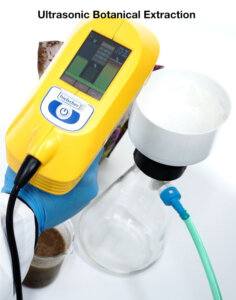 Anthocyanins are valuable natural pigments and antioxidants found in black carrots, berries, grapes, purple corn and other plant materials. Deep eutectic solvents are well suited for anthocyanin extraction because their hydrogen-bonding network can be adjusted to match the polarity and stability requirements of these color compounds. When combined with probe-type ultrasonication, DES extraction becomes significantly more efficient: ultrasonic cavitation disrupts plant cell structures, improves solvent penetration and accelerates the release of anthocyanins into the extraction medium. A study on black carrot anthocyanins using the sonicator UP400St show that choline chloride-based DES, especially when combined with ultrasound-assisted extraction, can provide a sustainable and effective alternative to conventional acidified ethanol or methanol extraction. (cf. Türker et al., 2021)
Ultrasonic Extraction of Polyphenols with DES
Polyphenols, including flavonoids, phenolic acids and related antioxidant compounds, are important target molecules in botanical, food, nutraceutical and cosmetic extraction. Glycerol-based deep eutectic solvents are particularly attractive for polyphenol recovery because their polarity and hydrogen-bonding capacity support the solubilization of phenolic compounds. Probe-type ultrasound further intensifies the process by increasing mass transfer, reducing extraction time and improving contact between the DES and the plant matrix.
A research study used a glycerol-ammonium acetate DES with ultrasound-assisted extraction under optimized parameters such as temperature, DES concentration and ultrasonic amplitude. The result demonstrated that ultrasonic DES extraction enabled efficient recovery of total phenols, flavonoids and antioxidant activity from chinaberry fruits, demonstrating the potential of ultrasonic extraction using DES as a green extraction method for industrial botanical processing. (cf. Jamshed et al., 2022)
- Héich Effizienz
- séiere Prozess
- Net gëfteg
- Genau tunable op déi spezifesch botanesch
- Mëll Veraarbechtung Konditiounen
- Batch- a Flowmodus
- Einfach a sécher
- Ëmweltfrëndlech / biodegradéierbar
- Recycléierbar
- Net entzündlech
- Bëlleg
- Einfach zougänglech
Wat sinn Deep Eutectic Solvents (DES)?
 Deep eutectic solvents (DESs) are mixtures of at least one hydrogen bond acceptor (HBA) and one hydrogen bond donor (HBD), including carboxylic acids and other renewable compounds. According to Cai et al. (2019), “the strong hydrogen bonding interaction between HBA and HBD is the most important factor for the formation of DESs.” [Cai et al. 2019]
Fir Waasserstoffbindungsspender ginn dacks Verbindunge wéi Zucker, Aminosäuren, Karboxylsäuren (z.B. Benzoinsäure, Zitrounesaier, Succininsäure) oder Aminen (zB Harnstoff, Benzamid) benotzt. De chemesche Interaktiounspotenzial vu Waasserstoffbindungsspender ass déi Haaptfaktoren déi zur Bildung an Effizienz vun déif eutektesche Léisungsmëttel bäidroen. Halidsalze wéi Cholinchlorid oder Zinkchlorid kënnen och a Verbindung mat de Waasserstoffbindungsspender benotzt ginn. Aner Cholinchlorid-baséiert déif eutektesch Léisungsmëttel gi mat Malonsäure, Phenol oder Glycerin geformt. Als Resultat vun de staarke Waasserstoffbindungsinteraktiounen gëtt de Schmelzpunkt vun déif eutektesche Léisungsmëttel wesentlech reduzéiert am Verglach mat hiren eenzelne Komponenten. Am Géigesaz zu konventionelle Léisungsmëttelen (zB Ethanol, Methanol, Hexan, Butan etc.) sinn déif eutektesch Léisungsmëttel net flüchteg, dat heescht datt se e ganz nidderegen Dampdrock hunn an doduerch kaum brennbar sinn. D'Toxizitéit vun déif eutektesche Léisungsmëttel ass niddereg, hir biologesch Ofbaubarkeet ass héich, an déi néideg Virgänger si preiswert, einfach a vill verfügbar souwéi erneierbar.
Natierlech déif eutektesch Léisungsmëttel (NADES) sinn nach méi ëmweltfrëndlech well all Virgänger aus natierleche Quelle kommen. Déif eutektesch Léisungsmëttel bidden och eng ofstëmmbar Solvabilitéit baséiert op der Chemie vum Solut an der Spezies déi benotzt gëtt fir déif eutektesch Léisungsmëttel ze kreéieren. E puer natierlech déif eutektesch Léisungsmëttel weisen eng héich Viskositéit a si sinn dofir net ganz gëeegent fir Batchextraktioun. Wéi och ëmmer, natierlech déif eutektesch Léisungsmëttel mat méi héije Viskositéiten kënnen erfollegräich als Léisungsmëttel an der Ultraschall-Flow-Through-Extraktioun applizéiert ginn.
D'Tabell hei ënnen weist e puer exemplaresch Kompositioune vun Natural Deep Eutectic Solvents (NADES) fir d'Extraktioun vu Phytochemikalien:
| NADES Kompositioun | Molar Verhältnis |
|---|---|
| Cholinchlorid: Milchsäure | 1: 2 |
| Cholinchlorid: Zitrounesaier: Waasser | 1:1:2 |
| Cholinchlorid: Äppelsäure: Waasser | 1:1:2 |
| Cholinchlorid: Wäinsäure | 1: 2 |
| Cholinchlorid: Glycerol | 1: 2 |
| Cholinchlorid: 1,2-propandiol | 1: 3 |
| Cholinchlorid: Sorbitol | 1: 1 |
| Cholinchlorid: Glukose: Waasser | 2:1:1 |
| Cholinchlorid: Fruktose: Waasser | 2:1:1 |
| Cholinchlorid: Urea | 1: 2 |
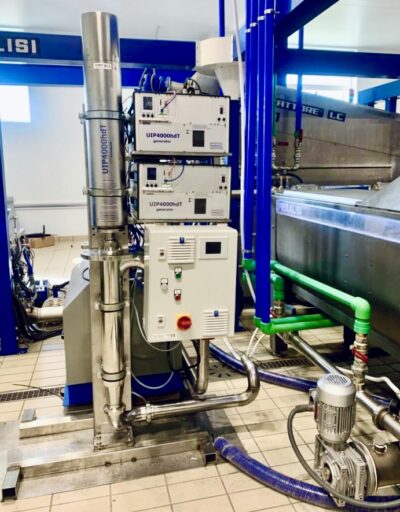
Industrie-Sonikator UIP4000hdT with flow cells for continuous inline extraction
Wéi funktionnéiert Ultraschall Extraktioun mat Deep Eutektesche Léisungsmëttel?
 Ultrasonic Extraktioun baséiert op de sonomechanische Effekter vun héijer Intensitéit, Low-Frequenz Ultraschall. Fir d'Extraktioun vu botanesche Verbindungen (dh bioaktive Substanzen) iwwer Ultraschall ze förderen an ze verstäerken, ginn High-Power Ultraschallwellen iwwer eng Ultraschallsonde (och Ultraschallhorn oder Sonotrode genannt) an de flëssege Medium gekoppelt, dh d'Schläim, déi aus dem botanesche Roh besteet. Material an den (natierlechen) déif eutektesche Léisungsmëttel. D'Ultraschallwellen reesen duerch d'Flëssegkeet a kreéieren ofwiesselnd Low-Drock / High-Drock Zyklen. Wärend Déifdrockzyklen entstinn Minutt Vakuumblasen (sougenannte Kavitatiounsblasen), déi iwwer verschidden Drockzyklen wuessen. Wärend deene Zyklen vum Blasenwuesstem ginn déi opgeléist Gase an der Flëssegkeet an d'Vakuumblase an, sou datt d'Vakuumblase sech a wuessend Gasblasen transforméiert. No e puer Zyklen wuessen d'Vakuumblasen eng gewësse Gréisst, bei där se net méi Energie absorbéiere kënnen, sou datt se während engem Héichdrockzyklus hefteg implodéieren. D'Bubble-Implosioun zeechent sech duerch intensiv Kavitatiounskräften, dorënner ganz héich Temperaturen an Drock, déi bis zu 4000K respektiv 1000atm erreechen; souwéi entspriechend Héichtemperatur- an Drockdifferenzen. Dës ultraschall generéiert Turbulenzen a Schéierkräften briechen Planzenzellen op a befreien déi intrazellulär bioaktiv Verbindungen an dat (natierlecht) déif eutektescht Léisungsmëttel. Ultrasonic Extraktioun mécht d'Zellstruktur vu Botanik op a verstäerkt Massentransfer tëscht Planzmaterial a Léisungsmëttel. Sonication fördert domat d'Effizienz vun natierlechen déif eutektesche Léisungsmëttelen. Ultrasonic Extraktioun mat (natierlechen) déif eutektesche Léisungsmëttel resultéiert an aussergewéinlech héich Ausbezuele bannent enger ganz kuerzer Veraarbechtungszäit.

Kraaft Ultraschallwellen stéieren d'Zellstruktur vu Botanik, befreien déi bioaktiv Verbindungen a förderen de Massentransfer tëscht dem Planzmaterial an dem Léisungsmëttel (zB déif eutektesch Léisungsmëttel).
D'Kombinatioun vun der Ultraschallextraktioun mat (natierlechen) déif eutektesche Léisungsmëttel gëtt Iech d'Méiglechkeet fir d'Prozessverstäerkungskraaft vum Ultraschall mat de bemierkenswäerte Solubiliséierungseffekter an aussergewéinlecher Designbarkeet vun déif eutektesche Léisungsmëttelen ze kombinéieren. Wéinst der super Effizienz vun der Ultraschallextraktioun, Ultraschaller ginn och erfollegräich fir Waasserextraktioun benotzt.
Kontaktéiert eis elo fir méi iwwer déi mächteg Ultraschallextraktiounsapplikatioun ze léieren déi déif eutektesch Léisungsmëttel benotzt!

Ultraschall Extraktor UIP2000hdT (2kW) fir d'Produktioun vu botaneschen Extrakten
Ultrasonic Extractors for Lab, Pilot and Industrial DES Extraction
 Ultrasonic Extraktioun ass eng zouverlässeg Veraarbechtungstechnologie, déi d'Produktioun vu qualitativ héichwäerteg Extrakten aus verschiddene botaneschen wéi och all Léisungsmëttel erliichtert a beschleunegt. Ultrasonic Extraktioun ass héich kompatibel mat (natierlechen) déif eutektesche Léisungsmëttelen, déi favorabel sinn wéinst hirer exzellenter Solubiliséierungskraaft, Designbarkeet zum Extrait, Nohaltegkeet, Biodegradabilitéit an Öko-Frëndlechkeet. D'Kombinatioun vun der Prozessintensivéierung vum Kraaft-Ultraschall mat de Virdeeler vun (natierlechen) déif eutektesche Léisungsmëttel gëtt dës Prozesstechnologie Iwwerleeënheet op ville Niveauen. Hielscher Ultrasonics Portfolio deckt déi ganz Palette vu kompakten Labo Ultraschaller bis industriell Extraktiounssystemer. All si selbstverständlech gëeegent fir d'Extraktioun mat déif eutektesche Léisungsmëttelen.
Eis laangjäreg erfuerene Mataarbechter hëllefen Iech vu Machbarkeetstester a Prozessoptimiséierung bis zur Installatioun vun Ärem Ultraschallsystem op endgülteg Produktiounsniveau.
| Extraction Volume | Recommended Sonicator |
|---|---|
| Method development, R&D, screening | UP100H (100W), UP200Ht (200W), UP400St (400W) |
| Viscous DES/NADES batches | UIP500hdT (500W), UIP1000hdT (1000W) |
| Pilot production | UIP1000hdT oder UIP2000hdT (2000W) |
| Continuous industrial extraction | UIP4000hdT (4000W), UIP6000hdT (6000W), UIP16000hdT (16kW) or clusters |
Kontaktéiert eis! / Frot eis!
Profitéiert vun der Ultraschallextraktioun a benotzt en Hielscher Sonicator fir botanesch Extraktioun mat oniwwertraff Effizienz an Nohaltegkeet!
Profitéiert vun der Ultraschallextraktioun a benotzt en Hielscher Sonicator fir botanesch Extraktioun mat oniwwertraff Effizienz an Nohaltegkeet!
Glycerin (Glycerin) ass fäeg d'Integritéit vu bioaktive Verbindungen ze erhaalen, kombinéiert mat senger net gëfteg a biologesch ofbaubar Natur, mécht et en attraktive Léisungsmëttel fir pharmazeutesch, kosmetesch a Liewensmëttelindustrie. Kombinéiert mat de mëllen Extraktiounsbedéngungen vun der Ultraschall, Ultraschall Glycerinextrakter weisen exzellent Qualitéit a Bioverfügbarkeet. De Sonikatiounsprozess garantéiert héchst Effizienz, wat zu héijen Ausbezuelen, reduzéierter Extraktiounszäit a gerénger Veraarbechtungskäschte resultéiert! Benotzt d'Léisungsmëttel vun Ärer Wiel, erreecht exzellent Extraktiounsausgaben a super Extraktqualitéit mat Hielscher Sonicatoren!
Frequently Asked Questions about Ultrasonic Extraction with Deep Eutectic Solvents
What is ultrasonic extraction with deep eutectic solvents?
Ultrasonic extraction with deep eutectic solvents combines probe-type sonication with DES or NADES solvent systems. The ultrasonic probe introduces high-intensity sound waves into the plant-solvent slurry. The resulting cavitation disrupts plant cell structures, improves solvent penetration and accelerates the transfer of bioactive compounds into the deep eutectic solvent.
Why use ultrasound for DES and NADES extraction?
Ultrasound improves DES and NADES extraction by increasing mass transfer, reducing extraction time and helping the solvent reach intracellular compounds more effectively. This is especially useful for botanical materials where target compounds are trapped inside plant cells, fibers or resinous structures.
Which compounds can be extracted with DES and NADES using sonication?
Ultrasonic DES and NADES extraction can be used for many bioactive compounds, including polyphenols, flavonoids, anthocyanins, terpenes, cannabinoids, alkaloids, antioxidants, pigments, aroma compounds and other phytochemicals. The solvent composition should be selected according to the polarity, stability and solubility of the target compound.
Are deep eutectic solvents compatible with Hielscher ultrasonic extractors?
Yes. Hielscher probe-type sonicators are suitable for extraction with deep eutectic solvents, natural deep eutectic solvents, glycerine-based solvent systems, water, ethanol and many other extraction media. For viscous DES or NADES systems, a powerful probe sonicator is particularly useful because it provides intense mixing, cavitation and mass transfer directly in the liquid.
Can ultrasonic DES extraction process high-viscosity solvents?
Yes. Many DES and NADES formulations have higher viscosity than conventional solvents. Hielscher ultrasonic processors are well suited for viscous extraction media because the sonotrode introduces high-amplitude ultrasound directly into the solvent-material mixture. For larger volumes or continuous processing, flow-through reactors can improve mixing, heat control and process uniformity.
Is ultrasonic DES extraction suitable for food, nutraceutical and cosmetic production?
Yes. DES and NADES are often selected for applications where low volatility, reduced solvent hazards and tunable extraction performance are important. Depending on the selected solvent components and regulatory requirements, ultrasonic DES extraction can be used for food ingredients, nutraceutical extracts, cosmetic actives, botanical concentrates and research-grade extracts.
Can ultrasonic extraction with DES be scaled up?
Yes. Ultrasonic extraction is highly scalable because the same process parameters – such as amplitude, energy input, residence time, temperature and solid-liquid ratio – can be transferred from lab trials to pilot and industrial production. Hielscher supplies ultrasonic extractors for small laboratory samples, bench-top optimization, pilot batches and continuous industrial flow-through extraction.
Should I use batch or inline ultrasonic extraction for DES processes?
Batch extraction is often best for laboratory testing, formulation screening and small production volumes. Inline ultrasonic extraction is usually preferred for pilot and industrial production because it provides controlled residence time, improved reproducibility, easier cooling and continuous throughput. The best setup depends on viscosity, plant material, solvent ratio, target compound and production capacity.
How do I choose the right ultrasonic extractor for DES extraction?
The right ultrasonic extractor depends on your sample volume, batch size, flow rate, solvent viscosity, target compound, extraction temperature and production goal. Small lab units are suitable for method development, while UIP-series industrial ultrasonicators are used for pilot and production-scale DES extraction. Hielscher can recommend a configuration based on your raw material, solvent system and required throughput.
What process parameters are important for ultrasonic DES extraction?
Important parameters include ultrasonic amplitude, energy input, extraction time, temperature, DES or NADES composition, water content, solid-liquid ratio, particle size, viscosity and flow rate. These parameters should be optimized for each botanical material and target compound to achieve high yield, good extract quality and reproducible production.
Literatur / Referenzen
- Türker, D.A., Doğan, M. (2021): Application of deep eutectic solvents as a green and biodegradable media for extraction of anthocyanin from black carrots. LWT – Food Science and Technology, Volume 138, March 2021.
- Duygu Aslan Türker, Mahmut Doğan (2022): Ultrasound-assisted natural deep eutectic solvent extraction of anthocyanin from black carrots: Optimization, cytotoxicity, in-vitro bioavailability and stability. Food and Bioproducts Processing, Volume 132, 2022. 99-113.
- Sumbal Jamshed, Dildar Ahmed (2022): Optimization of ultrasound-assisted extraction of valuable compounds from fruit of Melia azedarach with glycerol-choline chloride deep eutectic solvent. Sustainable Chemistry and Pharmacy, Volume 29, 2022.
- Křížek, et al. (2018): Menthol-based Hydrophobic Deep Eutectic Solvents: Towards Greener and Efficient Extraction of Phytocannabinoids. Journal of Cleaner Production, 193, 2018. 391-396.
- Chemat F, et al. (2019): Review of Alternative Solvents for Green Extraction of Food and Natural Products: Panorama, Principles, Applications and Prospects. Molecules, vol.24, no.16, 2019. 3007.
- Lores, H.; Romero, Vanesa; Costas Mora, Isabel; Bendicho, Carlos; Lavilla, Isela (2016): Natural deep eutectic solvents in combination with ultrasonic energy as a green approach for solubilisation of proteins: application to gluten determination by immunoassay. Talanta 2017. 453-459.
- Cai, et al. (2019): Green Extraction of Cannabidiol from Industrial Hemp (Cannabis sativa L.) Using Deep Eutectic Solvents Coupled with Further Enrichment and Recovery by Macroporous Resin. Journal of Molecular Liquids, 2019.

High performance ultrasonics! Hielscher's product range covers the full spectrum from the compact lab ultrasonicator over bench-top units to full-industrial ultrasonic systems.