Zougemaach Ultraschallreaktor fir pharmazeutesch Batchveraarbechtung
Transforméiert Är Batchprozesser mat kontrolléierter, skalierbarer a sécherer Ultraschallveraarbechtung. Vun Nanomaterial oder API Synthese bis chemesch Reaktiounen, Hielscher zougemaach Batch Reaktoren fir Sonikatiounsprozesser liwweren oniwwertraff Konsistenz, Effizienz a Prozesskontrolle – entwéckelt fir modern R&D an Produktioun Ëmfeld.
Héich-Intensitéit Ultraschall an zougemaach Batch Systemer: Prozess Intensifikatioun
Vill Prozesser wéi Vermëschung, Dispergéierung an Extraktioun vun héichwäertege Materialien ginn als Batchprozess duerchgefouert. Hielscher zougemaach Ultraschallreaktor ass ideal fir eng integréiert Ultraschallveraarbechtung ënner zouenen a präzis kontrolléierte Konditiounen. Hielscher zouene Ultraschallreaktor ass perfekt gëeegent fir Ultraschallbatchprozesser an engem sécheren an zouenen Ëmfeld – zB fir déi kleng Produktioun vu wäertvollen Materialien.
Virdeeler vun zougemaach Ultrasonic Batch Reactors
- Verbesserte Prozesseffizienz: Ultraschall-Undriff Kavitatioun erhéicht d'Mass an d'Wärmetransfer dramatesch, d'Reaktiounszäiten ze schneiden an d'Ausbezuelen ze verbesseren.
- Superior Produktqualitéit: Schmuel Partikelgréisst Verdeelungen, homogen Mëschung, a konsequent Emulsiounen iwwer all Batch.
- Zou-System Sécherheet & Konformitéit: Fully sealed design prevents solvent release, enables inert gas purging, and meets environmental and safety standards.
- skalierbar & Reproduzéierbar: Hielscher industrial-grade sonicators ensure seamless scale-up from lab to pilot to full production.
- Energie & Cost Effective: Lower processing temperatures, shorter cycle times, and reduced solvent usage translate to significant operational savings.
- Flexible Integration: Compatible with pressure sensors, temperature probes, and automated control systems for advanced industrial workflows.
Loosst lues Kinetik net Äre Prozess ophalen. Frot eng gratis Berodung bei eise Sonikatiounsexperten un, fir erauszefannen, wéi zouene Batchreaktoren Reaktiounsgradienten erhéijen, Produktkonsistenz verbesseren a Energie spueren kënnen!
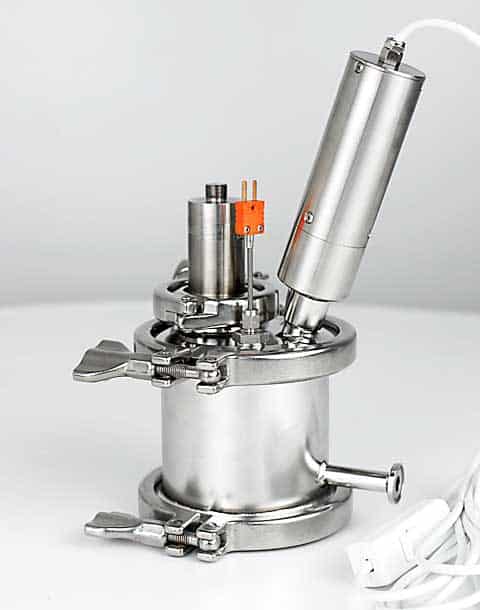
Closed reactor for sonication processes
Zouen Ultrasonic Batchreaktoren: Mikro- an Makro-Mëschung fir optimum Resultater
De zouene ultrasonic Batchreaktor ass mat engem elektresche Rührer ausgestatt, deen effiziente Makro-Mëschung am ganzen Apparat bitt. Wéi de Rührer d'entire Batch zirkuléiert an eng uniform Bulkbewegung erhaalt, generéiert de Sonikator intensiv Mikro-Mëschung, akustesch Kavitatioun an héich Scherrkräfte. Zesummen suergen dës komplementär Mëschmechancen fir homogen an effektiv Batchveraarbechtung.
What is Ultrasonic Batch Processing Used for?
Batch processing is a common manufacturing method, that is very prevalent in the pharmaceutical and chemical industry. Ultrasonic batch processes are commonly installed for the production of pharmaceutical ingredients (APIs) and the extraction of bioactive compounds, whilst the manufacturing of specialty chemicals applies ultrasonics predominantly for dispersing and sonochemical reactions.
Technesch Detailer:
- Edelstahl-Reaktor
- fir verschidde Bänn verfügbar
- mat integréierten elektresche Rührer
- präzis kontrolléierbar Prozessbedéngungen
- Drockbar bis zu 6 barg
- fir d'Veraarbechtung ënner kritesche Bedéngungen (zB Léisungsmëttel bei héijen Temperaturen)
- purgeable (zB mat Stickstoff)
- kille jacket
- Temperatur Sensor
- autoklaverbar, héich hygienesch
- einfach Montage / Demontage
- séier änneren tëscht vill
- personaliséierbar Adaptatiounen
- kompatibel mat den Sonikator Modeller UIP500hdT (500W), UIP1000hdT (1000W), UIP1500hdT (1500W), UIP2000hdT (2000W) an UIP4000hdT (4000W)
Frequently Asked Questions about Sonication using Closed Batch Reactors
What is a closed ultrasonic reactor?
A closed ultrasonic reactor is a sealed processing vessel that applies high-intensity ultrasound to a liquid batch under controlled conditions. Ultrasonic cavitation intensifies mixing, dispersing, extraction and sonochemical reactions. The closed stainless-steel design helps isolate the product from the surrounding environment while allowing parameters such as temperature, pressure, agitation and processing time to be controlled.
Which pharmaceutical processes can be performed in an ultrasonic batch reactor?
Closed ultrasonic batch reactors can be used for the production and processing of active pharmaceutical ingredients (APIs), extraction of bioactive or intracellular compounds, cell disruption and lysis, homogenization, dispersion, emulsification, degassing and sonochemical synthesis. The appropriate reactor configuration and sonication parameters depend on the formulation, raw materials and required product specifications.
Why use a closed reactor instead of an open sonication vessel?
A closed ultrasonic reactor provides better control over the processing atmosphere, temperature and pressure. It also helps contain solvents, vapors and valuable process materials. This makes closed sonication particularly useful for pharmaceutical batches involving volatile solvents, oxygen-sensitive materials, elevated temperatures or high-value ingredients.
How are temperature and pressure controlled during sonication?
The reactor can be equipped with a cooling jacket and temperature sensor to manage the heat generated during high-intensity sonication. Hielscher closed batch reactors can be pressurized up to 6 barg, depending on the selected configuration. This enables ultrasonic processing under elevated pressure and at controlled temperatures, including processes involving solvents under critical operating conditions.
Can the ultrasonic reactor operate under nitrogen or another controlled atmosphere?
Jo. De zouenen Reaktor kann mat Stickstoff gereinegt ginn, fir den Sauerstoffgehalt ze reduzéieren an eng inert Veraarbechtungsatmosphär ze etabléieren. Dëst ka virdeeler fir oxidatiounsempfindlech Materialie an ausgewielte Léisungsmëttelbaséiert Prozesser sinn. De Reinigungsgaas, Betribsdrock a gëeegent Sécherheetsmoossnamen mussen no der Formulatioun an den Ufuerderunge vun der Anlag ausgewielt ginn.
Firwat huet de Reaktor en elektrescht Rëchelmëttel?
The integrated stirrer circulates the complete batch and continuously moves material through the ultrasonic cavitation zone. Mechanical stirring and ultrasonication therefore complement each other: the stirrer provides bulk movement, while ultrasound generates intense localized shear and mass transfer. This combination supports uniform treatment, including batches containing suspended solids or components with different densities.
How is the reactor cleaned between pharmaceutical batches?
The stainless-steel reactor is designed for hygienic processing and is autoclavable. Easy mounting and disassembly provide access to reactor components and support fast changeovers between lots. The required cleaning, sterilization and validation procedure should be established for the specific product, process and quality system.
Which Hielscher ultrasonic processors can be used with closed batch reactors?
Ultrasonic closed batch reactors can be configured for Hielscher industrial ultrasonic processors including the UIP500hdT, UIP1000hdT, UIP1500hdT, UIP2000hdT and UIP4000hdT. These systems provide ultrasonic power levels from 500 to 4,000 watts. Selection depends on factors such as batch volume, viscosity, solids content, required energy input, processing time and temperature limits.
Can an ultrasonic pharmaceutical batch process be scaled up?
Yes. Ultrasonic processes can be transferred from laboratory trials to pilot and production volumes by maintaining important parameters such as amplitude, temperature, pressure and ultrasound exposure. Higher production capacity can be achieved with a more powerful ultrasonic processor, a larger reactor and sonotrode, multiple parallel systems or the transfer to a continuous inline sonication process. Process parameters are verified at each scale to ensure the required product quality and batch consistency.
How do I select the right ultrasonic reactor configuration?
Wichteg Selektiounskriterien enthalen d'Prozessobjektiv, Batchvolumen a Geometrie, Formuléierungsviskositéit, Feststoffkonzentratioun, Léisungsmëttelsystem, Ziltemperatur, erfuerderlechen Drock oder Atmosphär, Botzenfuerderungen a gewënschten Zykluszäit. Hielscher Ultrasonics wäert dës Ufuerderunge mat Iech evaluéieren an e passende Reaktorvolumen, Ultraschallprozessor, Sonotrode a Betribsparameter recommandéieren.
Literatur / Referenzen
- Sumbal Jamshaid, Dildar Ahmed (2022): Optimization of ultrasound-assisted extraction of valuable compounds from fruit of Melia azedarach with glycerol-choline chloride deep eutectic solvent. Sustainable Chemistry and Pharmacy, Volume 29, 2022.
- Štengl, Václav; Henych, Jiří (2013): Strongly luminescent monolayered MoS2 prepared by effective ultrasound exfoliation. Nanoscale, 5(8), 2013.
- Vernès, Léa; Vian, Maryline; Maâtaoui, Mohamed; Tao, Yang; Bornard, Isabelle; Chemat, Farid (2019): Application of ultrasound for green extraction of proteins from spirulina. Mechanism, optimization, modeling, and industrial prospects. Ultrasonics Sonochemistry, 54, 2017.
- Priyanka Roy, Nandini Das (2017): Ultrasonic assisted synthesis of Bikitaite zeolite: A potential material for hydrogen storage application. Ultrasonics Sonochemistry, Volume 36, 2017. 466-473.
- Ye, Yubin (2015): Effect of High Intensity Ultrasound on Crystallization Behavior and Functional Properties of Lipids. Graduate These and Dissertation – Utah State University 2015.

Ultraschallprozessor UIP2000hdT (2kW) with batch reactor for the industrial processes