Pallaadiumi nanoosakeste sonokeemiline redutseerimine
Palladium (Pd) on hästi tuntud oma katalüütiliste omaduste poolest ning seda kasutatakse laialdaselt ka materjaliteaduses, elektroonikatööstuses, meditsiinis, vesiniku puhastamisel ja mitmesugustes keemilistes rakendustes. Sonokeemilist meetodit kasutades on võimalik reguleerida pallaadiumiosakeste suurust ja morfoloogiat, muutes PVP/Pd suhet. See võimaldab ultrahelisünteesida kas väga peeneid, monodispersseid nanokübemeid või suuremaid pallaadiumikogumeid, mis võimaldab osakeste mõõtmeid kohandada optimaalse katalüütilise toimivuse saavutamiseks.
Pallaadiumi nanoosakeste ultraheli tootmine
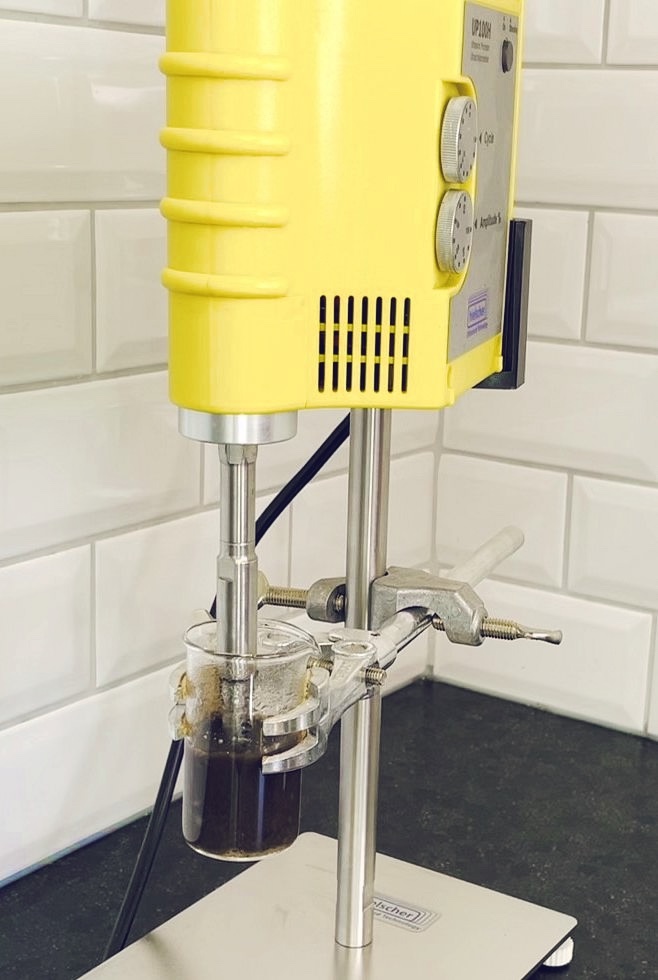 Palladiumi nanokübemete redutseerimine ultraheliga pakub kiiret ja reagente säästvat viisi Pd(0) nanokübemete saamiseks, kasutades akustilist kavitatsiooni lokaalsete kõrge energiaga tingimuste loomiseks ja redutseerimisradikaalide tekitamiseks lahuses, mis võimaldab palladiumioone redutseerida ilma tavapärase kõrgtemperatuurilise töötlemiseta.
Peamine eelis on protsessi juhtimine: ultrasonikatsiooni aeg ja stabilisaatori kontsentratsioon, näiteks PVP/Pd suhe, võivad mõjutada seda, kas toode moodustub hästi dispergeeritud, ümarate, umbes 5 nm suuruste nanotükkidena või suuremate, umbes 20 nm suuruste agregaatidena, mis on tööstuslikult oluline, kuna pallaadiumi katalüütiline toime sõltub tugevalt osakeste suurusest, morfoloogiast, dispersioonist ja pindalast. Kuna pallaadiumnanotükid on laialdaselt väärtuslikud heterogeensete katalüsaatorite, elektrokatalüsaatoritena ja funktsionaalsete materjalidena, on ultrahelireduktsioon atraktiivne peenelt dispergeeritud Pd-katalüsaatorite tootmiseks suhteliselt leebetes vedelafaasi tingimustes, millel on potentsiaalsed eelised keemilises sünteesis, keskkonnakatalüüsis, kütuseelementide tehnoloogias ja muudes protsessides, kus kõrge katalüütiline aktiivsus ja väärismetallide tõhus kasutamine on majanduslikult olulised.

Tööstuslik nanotükkide töötlemine koos sonikaatoriga UIP2000hdT
Proovi ettevalmistamise kord
Proovid valmistati järgmiselt:
Proovide puhul segud, mis sisaldavad 30 ml EG ja 5 ·10-6PVP-d valmistati ette, segades seda magnetseadmega 15 minutit. Erinevatele proovidele lisati erinev kogus Pd(NO₃)₂ lahust – 1,5 ml ja 2 ml. Proovide segud valmistati suhtes 2·10-3mol Pd(NO₃)₂ proovis (a) ja 2,66·10-3mol Pd(NO₃)₂ proovis (b). Mõlemat segu töödeldi ultraheliga 20 ml viaalis, kasutades sond-tüüpi ultraheliseadet. Proovid võeti pärast 30, 60, 90, 120, 150 ja 180-minutilist ultrahelitöötlust.
Katsetulemuste analüüs näitab, et:
- 1. Pd(II) sonokkeemiline redutseerimine Pd(0-ks) sõltub ultrahelitöötluse ajast.
- 2. Kõrge PVP/Pd(II) molaarsuhe viib monodisperssete pallaadiumiosakeste moodustumiseni, millel on ümar kuju ja keskmine läbimõõt umbes 5 nm.
- 3. Madal PVP/Pd(II) molaarsuhe hõlmab aga agregaatide pallaadiumi nanoosakeste saamist, mille suur jaotus on tsentreeritud 20 nm-le.
Pallaadiumi (II) ioonide redutseerimise sonokeemiline tee Pd(II) pallaadiumi aatomitele Pd(0) võib eeldada, et see on järgmine:
- (1) Veepürolüüs: H₂O → •OH + •H
- (2) Radikaalide teke: RH (redutseerija) + •OH(•H) → •R + H₂O(H₂)
- (3) Ioonide redutseerimine: Pd(II) + redutseerivad radikaalid (•H, •R) → Pd(0) + R•CHO + H+
- (4) Osakeste moodustumine: NPd(0) → Pdn
Tulemus: sõltuvalt PVP/Pd(II) suhtest, hajutatud või agregeeritud PdN saadi.
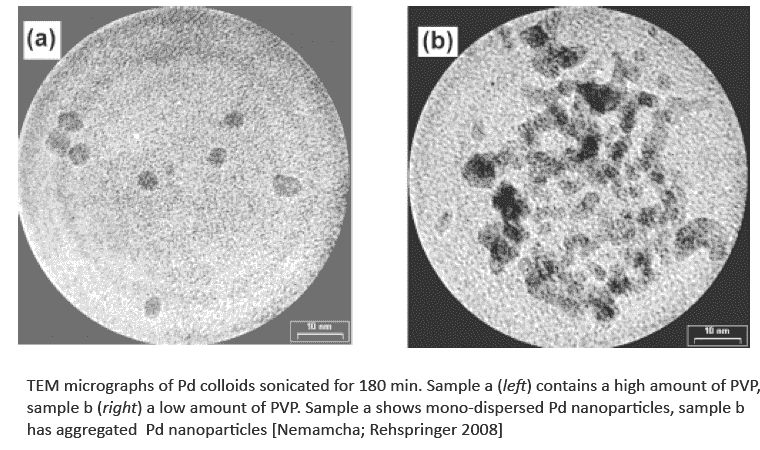
Palladiumi sonokeemiline redutseerimine: proov a (vasakul) sisaldab suurt kogust PVP-d, proov b (paremal) väikest kogust PVP-d. Sonikatsiooni kestus seadmega UP100H: 180 min. Proovis a on näha monodispersseid Pd-nanotükke, proovis b aga agregaatideks koondunud Pd-nanotükke.
Pildid ja uuring: ©Nemamcha ja Rehspringer, 2008
Analüüs ja tulemused
UV-nähtavad neeldumisanalüüsid kinnitavad seost pallaadium(II)ioonide sonokeemilise redutseerimise ja pallaadiumi(0) aatomite ning ultraheli retentsiooniaja vahel. Pallaadium(II) ioonide redutseerimine pallaadiumi(0) aatomiteks edeneb ja seda on võimalik täielikult saavutada ultrahelitöötluse aja pikenemisega. Transmissiooni elektronmikroskoopia (TEM) mikrograafid näitavad, et:
- Kui lisatakse suures koguses PVP-d, tekivad pallaadiumioonide sonokeemilise redutseerimise tulemusel monodisperssed, kerakujulised pallaadiumiosakesed, mille keskmine läbimõõt on umbes 5 nm.
- Väikese koguse PVP kasutamisel tekivad pallaadiumi nanokübemete agregaadid. Dünaamilise valgushajumise (DLS) mõõtmised näitavad, et pallaadiumi nanokübemete agregaatidel on lai suurusjaotus, mille keskpunktiks on 20 nm.

Laboratoorne ultraheliseade UP100H on kasutatud pallaadiumi nanotükkide valmistamiseks.

Pallaadiumi (Pd) nanoosakesi saab valmistada ultrahelitöötlusega
Disain, tootmine ja nõustamine – Kvaliteet Valmistatud Saksamaal
Hielscheri ultrasonikaatorid on tuntud oma kõrgeimate kvaliteedi- ja disainistandardite poolest. Vastupidavus ja lihtne kasutamine võimaldavad meie ultrasonikaatorite sujuvat integreerimist tööstusrajatistesse. Hielscheri ultrasonikaatorid saavad kergesti käsitseda karmid tingimused ja nõudlikud keskkonnad.
Hielscher Ultrasonics on ISO sertifitseeritud ettevõte ja paneb erilist rõhku suure jõudlusega ultrasonikaatoritele, millel on tipptasemel tehnoloogia ja kasutajasõbralikkus. Loomulikult on Hielscheri ultrasonikaatorid CE-nõuetele vastavad ja vastavad UL, CSA ja RoHs nõuetele.
Kirjandus / viited
- Nemamcha, A.; Rehspringer, J. L. (2008): Morphology of dispersed and aggregated PVV-Pd nanoparticles prepared by ultrasonic irradiation of Pd(NO₃)₂ solution in ethylene glycol. Rev. Adv. Mater. Sci. 18;2008. 685-688.
- Prekob, Á., Muránszky, G., Kocserha, I. et al. (2020): Sonochemical Deposition of Palladium Nanoparticles Onto the Surface of N-Doped Carbon Nanotubes: A Simplified One-Step Catalyst Production Method. Catalysis Letters 150, 2020. 505–513.
- Haitao Zheng, Mphoma S. Matseke, Tshimangadzo S. Munonde (2019): The unique Pd@Pt/C core-shell nanoparticles as methanol-tolerant catalysts using sonochemical synthesis. Ultrasonics Sonochemistry, Volume 57, 2019. 166-171.
Faktid, mida tasub teada
Mis on pallaadium?
Palladium on haruldane, hõbedavalge väärismetall, mille keemiline sümbol on Pd ja aatomnumber 46. See kuulub plaatinagrupi metallide hulka ning on hinnatud oma keemilise stabiilsuse, elektrijuhtivuse, vesiniku neeldumisvõime ja suurepäraste katalüsaatoromaduste tõttu. Peeneks jaotatud pallaadium on eriti efektiivne hüdrogenimise ja dehüdrogenimise reaktsioonides, ning kuumutatud pallaadium võimaldab vesinikul selle kaudu difundeeruda, mis muudab selle kasulikuks vesiniku eraldamisel ja puhastamisel.
Milleks kasutatakse pallaadiumi nanotükke?
Palladiumi nanokübemeid kasutatakse peamiselt suure pindalaga katalüsaatoritena. Kuna nanokübemed pakuvad palju suuremat aktiivset pindala kui tavaline palladium, võivad need parandada katalüsaatori tõhusust ja vähendada vajaliku kalli väärismetalli kogust. Tüüpilised rakendused hõlmavad keemilist sünteesi, hüdrogenimise reaktsioone, süsinik–süsiniku ühendamisreaktsioone, elektrokatalüüsi, kütuseelementide uurimist, vesiniku tuvastamist ja ladustamist, keskkonnakatalüüsi ning mõningaid biomeditsiinilisi uurimisvaldkondi, nagu antimikroobsed, fototermilised ja vähivastased süsteemid. Palladiumi katalüütiline käitumine sõltub tugevalt osakeste suurusest, morfoloogiast ja dispersioonist.
Palladiumi nanotükke kasutatakse ka teiste osakeste legeerimiseks, et saavutada katalüütilisi omadusi. Loe lähemalt ultraheli meetodist Pd/N-BCNT sünteesimiseks Fischer-Tropschi katalüsaatorina!
Kas pallaadium on mürgine?
Puhta metallilise pallaadiumi toksilisust peetakse üldiselt madalaks ja tal puudub teadaolev bioloogiline roll, kuid pallaadiumühendeid, sooli, tolmu ja nanomõõtmelisi vorme tuleb käsitseda ettevaatlikult. Kokkupuude töökohal või laboris võib sõltuvalt ühendist ja kokkupuuteviisist põhjustada ärritust või ülitundlikkust; näiteks pallaadiumkloriidi lahused võivad ärritada limaskesti. Tööstusliku käitlemise puhul on praktiline vastus järgmine: metalliline pallaadium lahtiselt on suhteliselt madala riskiga, kuid pallaadiumpulbreid, lahustuvaid pallaadiumsooli ja pallaadiumnanopartikleid tuleks käsitleda potentsiaalselt ohtlike materjalidena, tagades tolmu kontrolli, ventilatsiooni, kindad, silmakaitse ja nõuetekohase jäätmekäitluse.