Ultrasonik intensivlashtirilgan qattiq yotoqli reaktorlar
Sonikatsiya asosan qadoqlangan katalizator qatlami atrofida va ichida massani uzatishni kuchaytirish orqali qattiq yotoqli reaktorlarda katalitik reaksiyalarni yaxshilashi mumkin. Bundan tashqari, sonikatsiya katalizator yuzasidan passivatsiya va ifloslanish qatlamlarini olib tashlab, katalizatorni doimiy ravishda qayta tiklaydi.
Sonication qanday qilib qat'iy qatlamli katalizni yaxshilaydi
Qattiq yotoqli reaktorda katalizator zarrachalari harakatsiz qoladi, while suyuqlik, gaz yoki ko'p fazali reaktantlar yotqizilgan qatlam orqali oqadi. Reaksiya samaradorligi ko'pincha tashqi massa uzatish, teshik bo'shliqidagi diffuziya, kanallanish, tozalash va issiqlik uzatish gradientlari bilan cheklangan. Ultrasonik bir nechta cheklovlarni akustik kavitatsiya, mikro oqim, qirqish kuchlari va bosim oscillatsiyalarini hosil qilib kamaytirishi mumkin.

Sonicator UIP2000hdT qattiq yotoqli reaktorda integratsiyalashgan
Ultrasonik ravishda kuchaytirilgan qattiq yotoqli reaksiyalarning asosiy ta'sirlari
- Tashqi massa uzatish yaxshilandi: Ultrasonik mikro oqim katalizator zarrachalari atrofidagi to'xtagan chegaraviy qatlamni kamaytiradi va reaktantlarning faol saytga yanada samarali yetib borishini ta'minlaydi.
- Teshiklarga kirishni yaxshilash: Kavitatsiya ta'sirida bosim o'zgarishlari va suyuqlik harakati reaktantlarning katalizator teshiklariga kirishini va mahsulotlarni teshiklardan olib chiqishini yaxshilashi mumkin.
- Ifloslanish va passivatsiyani kamaytirish: Sonication katalizatordan depozitlar, polimer plyonkalari, koks prekursorlari yoki boshqa passivlovchi qatlamlarni olib tashlashga yordam beradi sirtlar, katalitik faollikni uzoqroq saqlab qolish.
- To'ldirilgan kataklarda kanallanishning kamayishi: Mikro to'ldirilgan katak tadqiqotlarida ultratovush oqim xulqini o'zgartirish va dispersiyani kamaytirishga yordam berishi ko'rsatilgan, bu esa reaktorni yanada ideal plug-oqim xatti-harakatiga yaqinlashtiradi.
- Kengaytirilgan issiqlik uzatish: Akustik oqim va turbulensiya mahalliy issiqlik tarqalishini yaxshilaydi, katalizator qatlamidagi issiq nuqtalar yoki sovuq zonalarni kamaytiradi.
- Yuqori aylanish va rentabellik: Massa uzatishni va katalizatorga kirishni yaxshilash orqali sonikatsiya reaksiyaning tezligini, aylanishni va mahsulot hosildorligini oshirishi mumkin, ayniqsa reaksiyaning to‘liq kinematik cheklovga ega emas, balki transport cheklangan bo‘lsa.
Suyuq-qattiq kontaktni yaxshilash: Ultratovush katalizator zarrachalarining yaxshiroq namlanishini rag'batlantiradi, bu ayniqsa trickle-bed, slurry-fed yoki suyuq fazali fixlangan katakli tizimlarda foydalidir.
Sonikatsiya Qattiq Qatlamdagi Katalizni Qanday Yaxshilaydi?
Asosiy mexanizm akustik kavitatsiya: ultratovush to‘lqinlari mikrobop shakldagi pufakchalarni hosil qiladi, ular kattalashadi va keskin qulaydi. Ularning qulashida lokal kesish kuchi, mikrojetlar, zarba to‘lqinlari va kuchli aralashish yuzaga keladi. Katalizator sathlariga yaqin joylarda bu ta’sirlar qattiq-suyuqlik interfeysini tozalash, faollashtirish va yangilash imkonini beradi. Sonokatalizning sharhlari buni ultratovush va qattiq katalizatorlar o‘rtasidagi sinergiya sifatida ta’riflaydi, bunda issiqlik uzatish, massa almashish va katalitik sathlardagi lokal ta’sirlar yaxshilanadi.
Sonikatsiya eng foydali bo‘ladi, agar mustahkam yotoq reaktsiyasi quyidagi muammolarga duch kelsa:
- katalizator teshiklariga sekin diffuziya kirishi,
- katalizator zarralarining yomon namlanishi,
- mahsulotlarning teshiklar ichida to‘planishi,
- ifloslanish yoki sathning passivlanishi,
- massa uzatishga cheklangan kinetika,
- ko‘p fazali oqimning noto‘g‘ri taqsimlanishi,
- to‘plangan yotoq orqali yo‘l topib o'tish.
Ruxsat etilgan yotoq katalizatorlari
Ruxsat etilgan to'shaklar (ba'zan o'ralgan yotoq deb ham ataladi) odatda katalizator granulalari bilan yuklanadi, ular odatda diametri 1-5 mm gacha bo'lgan granulalardir. Ular reaktorga bitta to'shak, alohida qobiqlar yoki quvurlar shaklida yuklanishi mumkin. Katalizatorlar asosan nikel, mis, osmiy, platina va rodiy kabi metallarga asoslangan.
Quvvatli ultratovushning heterogen kimyoviy reaksiyalarga ta'siri sanoat katalitik jarayonlarida keng qo'llaniladi. Qattiq yotoqli reaktorda katalitik reaksiyalar ham sonikatsiya muolajasidan foyda ko'radi. Qattiq yotoqli katalizatorning ultratovushli nurlanishi yuqori reaktiv sirtlar hosil qiladi, suyuq faza (reaktantlar) va katalizator o'rtasidagi massa tashishini oshiradi va yuzadan passiv qoplamalarni (masalan, oksid qatlamlarini) olib tashlaydi.
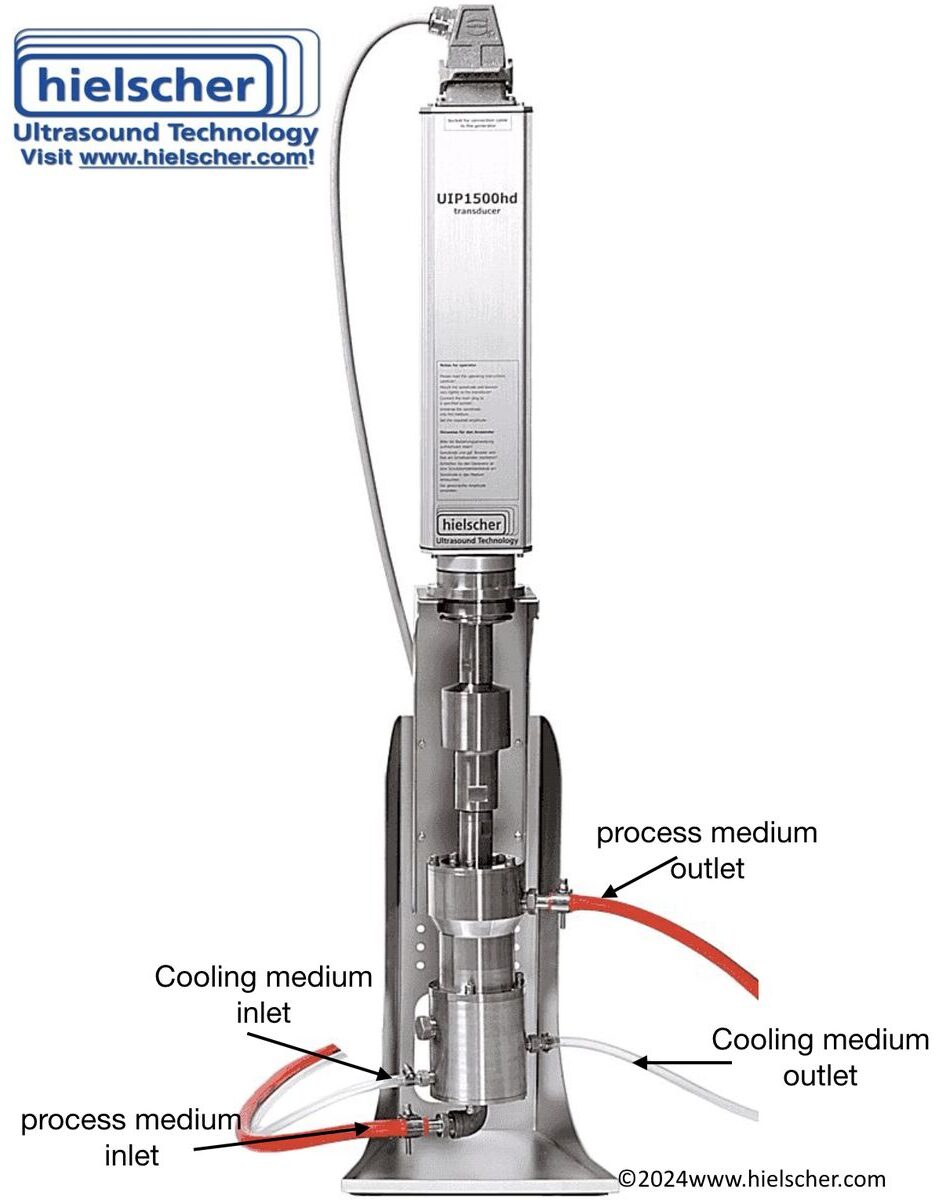
Sonicator UIP1500hdT va ishlatilgan katalizatorlarni qayta faollashtirish va qayta ishlash uchun oqim hujayrasi
- Yaxshilangan samaradorlik
- Reaktivlikning oshishi
- Konvertatsiya tezligining oshishi
- yuqori hosil
- Katalizatorni qayta ishlash
Katalitik reaksiyalarning ultratovushli kuchayishi
Ultrasonik aralashtirish va aralashtirish reaktiv va katalizator zarralari o'rtasidagi aloqani yaxshilaydi, yuqori reaktiv sirtlarni yaratadi va kimyoviy reaktsiyani boshlaydi va / yoki kuchaytiradi.
Ultrasonik katalizator tayyorlash kristallanish harakati, dispersiya / deaglomeratsiya va sirt xususiyatlarining o'zgarishiga olib kelishi mumkin. Bundan tashqari, oldindan hosil bo'lgan katalizatorlarning xususiyatlariga passivlashtiruvchi sirt qatlamlarini olib tashlash, yaxshiroq dispersiya, massa o'tkazuvchanligini oshirish orqali ta'sir ko'rsatishi mumkin.
Ultratovush bilan takomillashtirilgan reaksiyalar misollari
- Gidrogenatsiya reaktsiyalari uchun Ni katalizatorini ultratovush bilan oldindan tozalash
- Tartar kislotasi bilan soniklangan Raney Ni katalizatori juda yuqori enantioselektivlikka olib keladi
- Ultrasonik sintez qilingan Fischer-Tropsch katalizatorlari
- Reaktivlikni oshirish uchun sonokimyoviy ishlov berilgan amorf kukunli katalizatorlar
- Amorf metall kukunlarining sono-sintezi
Ultrasonik katalizatorni tiklash
Solid catalysts in fixed-bed reactors are commonly used in the form of spherical beads, pellets, extrudates, or cylindrical particles. During chemical reactions, the catalyst surface can become passivated by a fouling layer, resulting in a gradual loss of catalytic activity and/or selectivity over time.
The timescale of catalyst deactivation varies considerably. For example, the deactivation of a cracking catalyst may occur within seconds, whereas an iron catalyst used in ammonia synthesis may remain active for 5–10 years. Nevertheless, catalyst deactivation is observed in virtually all catalytic processes. Although different deactivation mechanisms can occur – including chemical, mechanical, and thermal degradation – fouling is one of the most common causes of catalyst decay.
Fouling refers to the physical deposition of species from the fluid phase onto the catalyst surface and within its pores. These deposits block reactive sites, restrict pore accessibility, and reduce contact between reactants and the active catalyst surface. Catalyst fouling by coke or carbonaceous deposits is often a rapid process; however, in many cases it can be partially or fully reversed by ultrasonic regeneration.
Ultrasonic cavitation is an effective method for removing passivating fouling layers from catalyst surfaces. During sonication, high-intensity ultrasound generates cavitation bubbles in a liquid medium. Their collapse produces localized shear forces, microjets, shock waves, and intense micro-mixing. These effects help detach fouling residues from the catalyst surface, reopen blocked pores, and restore access to active sites.
Ultrasonik katalizatorni tiklash odatda katalizator zarralarini distillangan suv yoki mos erituvchiga tarqatib, suspenziyani nazoratli ultrasonik muolajaga duchor qilish orqali amalga oshiriladi. Ushbu jarayon platin/silika tolali katalizatorlar, nikel katalizatorlar va boshqa qo'llab-quvvatlangan metall katalizatorlar kabi turli katalizator materiallaridagi ifloslanish qoldiqlarini olib tashlashi mumkin. Natijada, sonikatsiya katalizatorni tiklashga, katalizatorning umrini uzaytirishga va jarayon barqarorligini yaxshilashga yordam beradi.
Kimyoviy reaktorlarga integratsiya qilish uchun sonikatorlar
 Hielscher Ultrasonics turli xil ultratovushli protsessorlarni va quvvat ultratovushini qattiq yotoqli reaktorlarga integratsiya qilish uchun o'zgarishlarni taklif qiladi. Ruxsat etilgan yotoqli reaktorlarga o'rnatish uchun turli xil ultratovushli tizimlar mavjud. Keyinchalik murakkab reaktor turlari uchun biz taklif qilamiz moslashtirilgan ultratovush yechimlar.
Sonikatsiya turli reaktor dizaynlarida kimyoviy reaksiyalarni qanday yaxshilashini bilib oling!
Kimyoviy reaksiyangizda sonikatsiya ta'sirini sinash uchun sizni Teltodagi ultratovushli jarayon laboratoriyamiz va texnik markazimizga taklif qilamiz!
Bugun biz bilan bog'laning! Siz bilan kimyoviy jarayoningizning ultratovush intensivligini muhokama qilishdan xursandmiz!
Quyidagi jadvalda Hielscher sonikatorlarining taxminiy ishlov berish quvvati ko'rsatilgan:

Ultrasonik oqim tizimi
- gidrogenlash
- Alkillanish
- Siyanatsiya
- efirlanish
- esterifikatsiya
- polimerizatsiya
- Allilatsiya
- Bromlanish
(masalan, Ziegler-Natta katalizatorlari, metallosenslar)
Adabiyot / Adabiyotlar
- Francisco J. Navarro-Brull; Andrew R. Teixeira; Jisong Zhang; Roberto Gómez; Klavs F. Jensen (2018): Reduction of Dispersion in Ultrasonically-Enhanced Micropacked Beds. Industrial & Engineering Chemistry Research 57, 1; 2018. 122–128.
- Yasuo Tanaka (2002): A dual purpose packed-bed reactor for biogas scrubbing and methane-dependent water quality improvement applying to a wastewater treatment system consisting of UASB reactor and trickling filter. Bioresource Technology, Volume 84, Issue 1, 2002. 21-28.
- Argyle, M.D.; Bartholomew, C.H. (2015): Heterogeneous Catalyst Deactivation and Regeneration: A Review. Catalysts 2015, 5, 145-269.
- Oza, R.; Patel, S. (2012): Recovery of Nickel from Spent Ni/Al2O3 Catalysts using Acid Leaching, Chelation and Ultrasonication. Research Journal of Recent Sciences Vol. 1; 2012. 434-443.
- Sana, S.; Rajanna, K.Ch.; Reddy, K.R.; Bhooshan, M.; Venkateswarlu, M.; Kumar, M.S.; Uppalaiah, K. (2012): Ultrasonically Assisted Regioselective Nitration of Aromatic Compounds in Presence of Certain Group V and VI Metal Salts. Green and Sustainable Chemistry, 2012, 2, 97-111.
- Suslick, K. S.; Skrabalak, S. E. (2008): “Sonocatalysis” In: Handbook of Heterogeneous Catalysis, vol. 4; Ertl, G.; Knözinger, H.; Schüth, F.; Weitkamp, J., (Eds.). Wiley-VCH: Weinheim, 2008. 2006-2017.
Bilishga arziydigan faktlar
Ultrasonik kavitatsiya nima?
Ultratovushli kavitatsiya – bu yuqori intensivlikdagi ultratovushga duchor bo'lgan suyuqlikda mikroskopik bug' yoki gaz pufakchalarning hosil bo‘lishi, o‘sishi va zo‘ravon tarzda qulashidir. Pufakcha qulash vaqtida juda qisqa muddatda ekstremal lokal sharoitlar yuzaga kelishi mumkin, jumladan yuqori harorat, yuqori bosim, zarba to‘lqinlari, mikrojeklar va kuchli kesish kuchlari.
Sonochemistry nima?
Sonokimyo — bu ultrasonik kavitatsiya effektlaridan kimyoviy va fizik-kimyoviy jarayonlarni boshlash, tezlashtirish yoki o'zgartirish uchun foydalanishdir. Bu ayniqsa suyuq faza tizimlarida ahamiyatlidir, chunki kavitatsiya aralashma, massa uzatish, emulsifikatsiya, zarracha tarqalish, katalizator sirtini tozalash va ba'zi hollarda radikal hosil bo'lishini osonlashtiradi. Natijada, sonokimyo heterogen kataliz, oksidlanish, ekstraksiya, polimerizatsiya, kristallanish va nanomateriallar sintezi kabi reaksiyalarni kuchaytirish uchun qo'llaniladi.
Geterogen katalitik reaksiya nima?
Kimyoda heterojen kataliz katalizator va reaktivlarning fazalari bir-biridan farq qiladigan katalitik reaksiya turiga ishora qiladi. Geterogen kimyo kontekstida faza nafaqat qattiq, suyuq va gazni ajratish uchun ishlatiladi, balki aralashmaydigan suyuqliklarga, masalan, neft va suvga ham tegishli.
Geterogen reaksiya jarayonida bir yoki bir nechta reaktivlar interfeysda, masalan, qattiq katalizator yuzasida kimyoviy o'zgarishlarga uchraydi.
Reaktsiya tezligi reaktivlarning kontsentratsiyasiga, zarrachalar hajmiga, haroratga, katalizatorga va boshqa omillarga bog'liq.
Reaktiv kontsentratsiyasi: Umuman olganda, reaktiv kontsentratsiyasining oshishi kattaroq interfeys tufayli reaktsiya tezligini oshiradi va shu bilan reaktiv zarrachalar o'rtasida katta faza almashinuvi.
Zarrachalar hajmi: Agar reaktivlardan biri qattiq zarracha bo'lsa, u tezlik tenglamasida ko'rsatilmaydi, chunki tezlik tenglamasi faqat konsentratsiyalarni ko'rsatadi va qattiq moddalar boshqa fazada bo'lganligi sababli konsentratsiyaga ega bo'lolmaydi. Shu bilan birga, qattiq moddaning zarracha kattaligi fazalarni uzatish uchun mavjud sirt maydoni tufayli reaktsiya tezligiga ta'sir qiladi.
Reaktsiya harorati: Harorat Arrhenius tenglamasi orqali tezlik konstantasi bilan bog'liq: k = Ae-Ea/RT
Bu erda Ea - aktivlanish energiyasi, R - universal gaz doimiysi va T - Kelvindagi mutlaq harorat. A - Arrhenius (chastota) omili. e-Ea/RT egri chiziq ostidagi energiya faollashuv energiyasidan kattaroq bo'lgan zarrachalar sonini beradi, Ea.
Katalizator: Aksariyat hollarda reaktsiyalar katalizator bilan tezroq sodir bo'ladi, chunki ular kamroq faollashtirish energiyasini talab qiladi. Geterogen katalizatorlar reaksiya sodir bo'ladigan shablon sirtini ta'minlaydi, bir hil katalizatorlar esa mexanizmning keyingi bosqichida katalizatorni chiqaradigan oraliq mahsulotlarni hosil qiladi.
Boshqa omillar: Yorug'lik kabi boshqa omillar ma'lum reaktsiyalarga ta'sir qilishi mumkin (fotokimyo).
Katalizator faoliyatini to'xtatish turlari qanday?
- Katalizator bilan zaharlanish - bu katalitik reaktsiya joylarini to'sib qo'yadigan katalitik maydonlarda turlarning kuchli xemisorbsiyasi uchun atama. Zaharlanish qaytarilmas yoki qaytarilmas bo'lishi mumkin.
- Kirlanish deganda katalizatorning mexanik degradatsiyasi tushuniladi, bunda suyuqlik fazasidagi turlar katalitik sirtga va katalizator teshiklarida cho'kadi.
- Termik degradatsiya va sinterlash natijasida katalitik sirt maydoni, qo'llab-quvvatlash maydoni va faol fazani qo'llab-quvvatlovchi reaktsiyalar yo'qoladi.
- Bug 'hosil bo'lishi kimyoviy degradatsiya shaklini anglatadi, bu erda gaz fazasi uchuvchi birikmalar hosil qilish uchun katalizator fazasi bilan reaksiyaga kirishadi.
- Bug'-qattiq va qattiq-qattiq reaksiyalar katalizatorning kimyoviy faolsizlanishiga olib keladi. Bug ', tayanch yoki promotor katalizator bilan reaksiyaga kirishadi, shuning uchun faol bo'lmagan faza hosil bo'ladi.
- Katalizator zarralarining emirilishi yoki maydalanishi mexanik ishqalanish natijasida katalitik materialning yo'qolishiga olib keladi. Katalizatorning ichki yuzasi katalizator zarrasining mexanik ta'sirida maydalanishi tufayli yo'qoladi.
Sonikatsiya ishlatilgan katalizatorlarni qanday qayta faollashtirishi mumkinligi haqida ko'proq o'qing!
Nukleofil almashtirish nima?
N
Nukleofil almashtirishni ikki xil yo'l sifatida kuzatish mumkin – SN1 va SN2 reaktsiya. Reaksiya mexanizmining qaysi shakli – sN1 yoki SN2 – sodir bo'ladi, bu kimyoviy birikmalarning tuzilishiga, nukleofil turiga va erituvchiga bog'liq.