Kimyoviy Reaktorlar Sonikatsiya Orqali Kuchaytirilgan – Turlari, Dizaynlari va Mexanizmlari
Kimyoviy reaktorlar sanoat kimyosi, materiallar sintezi, nafis kimyoviy ishlab chiqarish, farmatsevtika ishlab chiqarish va atrof-muhitni qayta ishlashning asosidir. Sanoat tezroq, toza va energiya tejamkor jarayonlarni izlayotgan bir paytda, sonikatsiya, ya'ni ultratovushli qayta ishlash, reaktorlarni intensifikatsiya qilish uchun tobora muhim usulga aylanmoqda. Ultratovushli reaktor texnologiyasi kimyoviy ishlov berishni qayta shakllantirmoqda, aralashtirish, massa uzatish, reaksiya kinetikasi va geterogen katalizni partiyaviy va uzluksiz reaktor tizimlarida yaxshilashtirmoqda.
Sonikatsiya kimyoviy reaktorlarni qanday yaxshilaydi
By introducing high-power ultrasound into a chemical reactor, engineers can generate ultrasonic oscillatory flow mixing and acoustic cavitation inside the reaction medium. These mechanisms improve contact between reactants, accelerate mass transfer and can enhance reaction rates, selectivity and yield. Sonication is especially effective in solid-liquid systems, such as heterogeneous catalysis, and liquid-liquid systems, such as emulsification, extraction and biphasic reactions. It is used less frequently in gas-liquid mixtures because acoustic cavitation is generated less efficiently in liquids with high gas contents.
Zamonaviy sonokimyoviy reaktor dizaynida suyuqliklar ultratovush tebranishi va kavitatsiya orqali aralashtiriladi, odatda 10 dan 200 µm gacha bo‘lgan amplituda ishlatiladi. Bu an’anaviy mexanik aralashtirish bilan qiyin erishiladigan kuchli mikroskopik aralashish effektlarini ta’minlaydi.
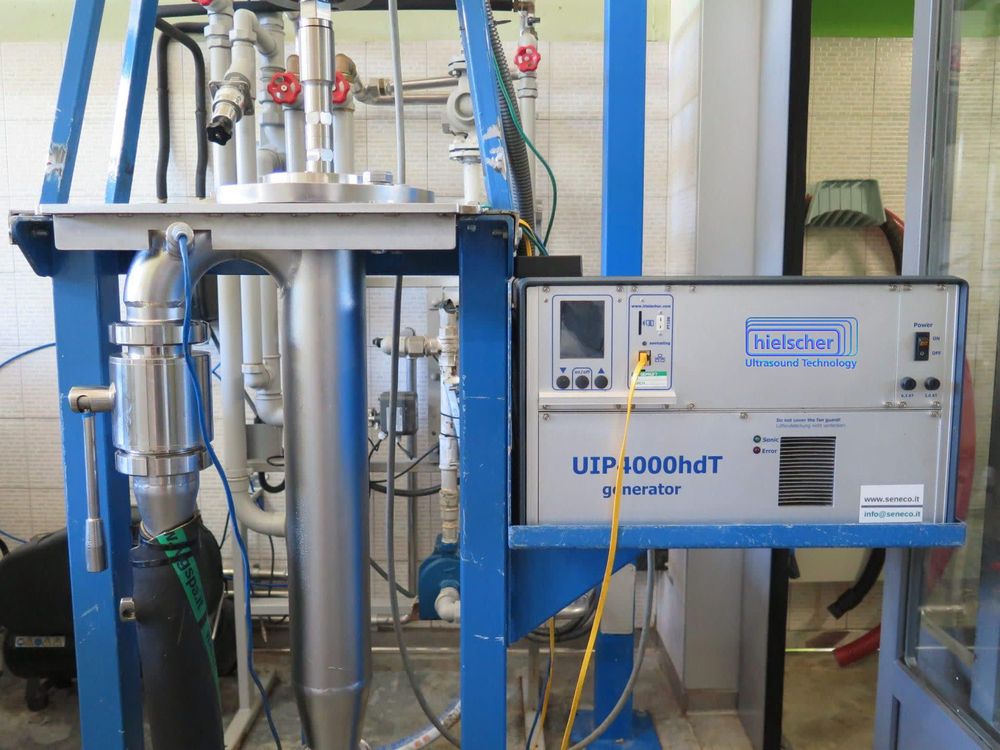
Inline sonikator UIP4000hdT Kuchaytirilgan kimyoviy reaksiyalar uchun oqim xujayrasi bilan
Nega Sonikatsiya Kimyoviy Reaktorlarni Kuchaytiradi
Sonikatsiyaning sanoat ahamiyati mikro- va mezo-o'lchamdagi kimyoviy va fizik transport hodisalariga ta'sir ko'rsatish qobiliyatida yotadi. An'anaviy aralashtirishdan farqli o'laroq, ultratovush faqat suyuqlikni harakatga keltirmaydi. U bosim to'lqinlarini, osilma harakatini, kavitatsiya pufakchalarini va mahalliy yuqori energiyali zonalarni hosil qiladi.
Akustik kavitatsiya pufakchalari hosil bo'lganda, o'sganda va portlaganda intensiv mikro-muhitlarni yaratadi. Ushbu hodisalar quyidagilarni hosil qilishi mumkin:
- yuqori mahalliy siljish kuchlari
- qattiq sirtlar yaqinida mikrojetlar
- shok to'lqinlari
- tez mikro-aralashma
- zarrachalarning yaxshilangan tarqalishi
- interfeys kontaktining yaxshilanishi
- massa va issiqlik uzatishining tezlashishi
- sirtni tozalash va katalizator faollashtirish effektlari
Bu hodisalar sonikatsiyani jarayonlarni kuchaytirish uchun juda qimmatli qiladi, ayniqsa reaksiyalar diffuziya, faza aloqasining yomonligi, katalizatorning ifloslanishi yoki yetarli aralashma yetarli bo'lmaganda cheklanganda.
Partiyali reaktorlarda sonikatsiya
Partiyali reaktorlar laboratoriyalarda, pilot zavodlarda va maxsus kimyoviy ishlab chiqarishda keng qo'llaniladi. Ular moslashuvchan, ishlatish oson va reaksiya skrining qilish, kichik hajmdagi sintez va yuqori qiymatli mahsulotlar uchun mos keladi.
Sonikatsiya partiya reaktorlariga qo'llanilganda, aralashtirish va reaksiya bir xilligini sezilarli darajada yaxshilaydi. Ultratovushli zondlar, oqim hujayralari yoki tashqi o'rnatilgan transduserlar akustik energiyani to'g'ridan-to'g'ri reaksiya muhitiga kiritishi mumkin.
Partiyali tizimlarda sonikatsiya ayniqsa:
- heterojen kataliz
- nanozarrachalar sintezi
- kristallanishni nazorat qilish
- emulsifikatsiya
- Ekstraksiya
- polimerizatsiya
- qattiq jismlarning erishi va dispersiyasi
Qattiq-suyuqlik reaksiyalari uchun ultratovush zarrachalarning bir-biriga yopishib qolishini oldini olishi va katalitik yoki reaktiv yuzalarga kirishni yaxshilashi mumkin. Suyuqlik-suyuqlik tizimlarida sonikatsiya mayda emulsiyalarni hosil qilishi va aralashmaydigan fazalar o‘rtasidagi yuzani oshirishi mumkin, bu esa ko‘pincha reaksiyaning tezroq o‘tishiga olib keladi.
Doimiy Sonokimyoviy Ishlov berish uchun Oqimli Reaktorlar
Oqimli reaktorlar sanoat sonikatsiyasi uchun eng muhim dizaynlardan biridir. Belgilangan hajmdagi suyuqlikni ishlov berish o‘rniga, reaksiya aralashmasi ultratovush reaktori kamerasidan uzluksiz oqib o‘tadi.
Ushbu dizaynni kattalashtirish uchun juda jozibador qiladigan jihati shundaki, u muhandislarga turar joy vaqti, oqim tezligi, harorat, bosim va ultratovush energiyasi kirishini yanada aniqlik bilan nazorat qilish imkonini beradi. Oqimli sonokimyoviy reaktorlar odatda barqaror mahsulot sifatini va uzluksiz ishlashni ta'minlash talab etilganda ishlatiladi.
Sonikatsiyadan o'tgan oqimli reaktorlarning asosiy afzalliklari quyidagilardan iborat:
- uzluksiz ishlab chiqarish qobiliyati
- jarayonning takrorlanuvchanligini yaxshilash
- haroratni yaxshiroq nazorat qilish
- turar vaqt taqsimotini nazorat qilish
- sanoat jarayon liniyalariga integratsiyani osonlashtirish
- miqyoslanadigan reaktor arxitekturasi
Bu tizimlarda ultratovushli oscillatsion oqim aralashmasi radial va aksial aralashishni oshirishi, kontsentratsiya gradentlarini kamaytirishi va reaktantlarning o'zaro ta'sirini yaxshilashi mumkin. Bu, ayniqsa, reaksiya samarasi tez fazali aloqaga yoki tez tarqalishga bog'liq bo‘lgan jarayonlarda juda qadrli.
Ultrasonik Oqim-Hujayrasi Kiritmasi MultiFazaliKavitator
 The MultiPhaseCavitator Insert-MPC48 is a specialized insert for Hielscher ultrasonic flow cell reactors designed to intensify liquid/liquid and liquid/gas processes directly in the ultrasonic cavitation zone. By injecting a second liquid phase or gas phase through 48 fine cannulas into the primary liquid stream, the MultiPhaseCavitator creates very small droplets or gas bubbles with a high specific interfacial area. This makes it especially efficient for ultrasonic emulsification, where immiscible phases are dispersed into fine emulsions, and for catalytic gas reactions, where the injected gas phase is rapidly dispersed and brought into intimate contact with the liquid phase, dissolved reactants, or suspended catalysts. The resulting cavitational shear, micro-mixing, and enhanced mass transfer can improve reaction kinetics, phase-boundary contact, and process efficiency in continuous or batch flow-through operation.

Sonicator UIP2000hdT kimyoviy partiyali reaktdor bilan
Kimyoviy reaktor dizaynlari va sonikatsiyaning foydalari
| Reaktor turi | Oddiy qo'llanilishi | Asosiy sonikatsiya ta'sirlari | Texnik ahamiyati |
|---|---|---|---|
| Slurry reaktorlar | Suyuq fazada osilgan qattiq katalizator zarralari bilan heterojen kataliz; gidrogenlashtirish, oksidlanish, biomassa aylanishi, Fischer-Tropsch turidagi jarayonlar, fotokataliz va oqava suvlarni tozalashda ishlatiladi. | Sonikatsiya katalizatorning tarqalishini yaxshilaydi, zarralarni aglomeratsiyadan chiqaradi, chegara qatlamini kamaytiradi, sirtni yangilaydi, suyuq-qattiq massani uzatishni yaxshilaydi, katalizator sirtini tozalaydi va ifloslanishni kamaytiradi. | Ayniqsa muhim, chunki ko'plab shlam fazali katalitik reaksiyalar reaktivlar faol saytlariga qanday samarali yetib borishiga bog'liq. Akustik kavitatsiya katalizator-suyuqlik interfeysida aloqani yaxshilaydi va reaktsiya kinetikasini oshirishi mumkin. |
| Doimiy aralashtiriladigan tank reaktorlari (CSTR) | Doimiy suyuqlik fazali reaksiyalar, emulsifikatsiya, katalitik reaksiyalar, cho'kma hosil bo'lishi, kristallanish, polimer reaksiyalari va qattiq-suyuqlik suspenziyalar. | Ultratovush mikro-aralashtirish, zarracha suspenziyasi, emulsifikatsiya, dispersiya va mahalliy energiya kiritilishini yaxshilaydi. Uni mexanik aralashtirish bilan birlashtirib, makro-aralashtirish va mikro-aralashtirishni yaxshilash mumkin. | Sonikatsiyalangan CSTRlar an'anaviy vinpellerlar o'lik zonalarni, yomon dispersiya yoki mahalliy massa uzatish cheklovlarini to'liq yo'q qila olmaganda foydalidir. Ultratovush reaksiya sharoitlarini yanada tenglashtiradi va jarayonni kuchaytirishni yaxshilaydi. |
| Qattiq yotoqli reaktorlar | Vodorodlash, oksidlash, atrof-muhit kataliz, neft-kimyoviy qayta ishlash va suyuq fazali geterogen katalizda ishlatiladigan statsionar katalizator yotoqlari. | Sonikatsiya katalizatorning namlanishi, suyuqlik harakati, chegara qatlamining qisqarishi, sirtni tozalash, ifloslanishni kamaytirish va massani katalitik joylarga uzatishni yaxshilashi mumkin. | Doimiy yotoq samaradorligi ko'pincha kanallash bilan cheklanadi, yomon namlanish, diffuziyaga chidamlilik va kon hosil bo'lishi. Ultratovushli jarayonni kuchaytirish katalizatordan foydalanishni va reaksiya bir xilligini yaxshilashi mumkin. |
| Fluidized Bed Reaktorlar | Kataliz, zarrachalarni qayta ishlash, qoplama, polimerizatsiya, quritish va qattiq-suyuqlik reaksiyalarida ishlatiladigan osilgan zarrachalarning dinamik qatlamlari. | Ultrasonik eksitatsiya zarrachalarning tarqalishini yaxshilashi, aglomeratsiyani kamaytirishi, suyuqlik-qattiq muloqotni yaxshilashi, suspenziyalarni barqarorlashtirishi va katalizator yuzasiga kirishni yaxshilashi mumkin. | Sonikatsiya ayniqsa suyuq-qattiq suyuqliklangan qatlamlarda samarali bo'lib, kavitatsiya samarali hosil bo'lishi mumkin. Gazga boy tizimlarda kavitatsiya kamroq samarali bo'lib, ultratovush suyuqlik asosidagi reaktor ilovalari uchun ko'proq mos keladi. |
| Membrana reaktorlari | Selektiv mahsulotni olib tashlash, reaktantlarni dozalash, katalitik membrana jarayonlari va filtratsiya yordamida reaksiyalar uchun integratsiyalashgan reaksiya-ajratish tizimlari. | Ultratovush membrana ifloslanishini kamaytirishi, permeat oqimini yaxshilashi, sirt tozalashni kuchaytirishi, konsentratsiya polyarizatsiyasini kamaytirishi va membrana interfeysi yaqinida aralashishni yaxshilashi mumkin. | Sonikatsiya reaktsiya muhandisligini ajratish faniga bog'laydi. Bu, ayniqsa, membrana reaktorining ishlashini cheklovchi ifloslanish, massa o‘tish qarshiligi yoki zaif reaktsiya-ajratish bog‘lanishi bo‘lgan hollarda juda muhimdir. |
Ultrasonik reaktor intensivlashtirish mexanizmlari
Kimyoviy reaktorlardagi sonikatsiya afzalliklari bir nechta o‘zaro ta'sir qiluvchi mexanizmlarga asoslangan.
- Akustik kavitatsiya eng muhim mexanizm hisoblanadi. Bu yuqori intensivlikdagi ultratovushga duchor bo‘lgan suyuqlikda mikroskopik pufakchalar hosil bo‘lishi, o‘sishi va qulashi bilan bog‘liq. Pufakchalarning qulashi mahalliy energiya ajralishini va kuchli mexanik kuchlarni hosil qiladi.
- Akustik oqim ultratovush to‘lqinlari tomonidan yuzaga kelgan barqaror suyuqlik harakati yaratadi. Bu mexanik aralashtirish kuchsiz bo‘lishi mumkin bo‘lgan zonalarda aralashish va transportni yaxshilaydi.
- Oqimli aralashish ultratovush tebranishi suyuqlikning tez oldinga-orqaga harakatlanishiga sabab bo‘lganda sodir bo‘ladi. Reaktor tizimlarida taxminan 10 dan 200 µm gacha bo‘lgan amplitudalar juda samarali aralashtirish va massa uzatilishini yaxshilashga olib kelishi mumkin.
- Mikrojetlash va zarba to‘lqinlari ayniqsa qattiq sirtlarga yaqin joylashgan tushayotgan kavitatsiya pufakchalari atrofida sodir bo‘ladi. Bu ta’sirlar katalizator yuzalarini tozalashi, chegaraviy qatlamlarni buzishi va suyuqlikning faol joylarga kirishini yaxshilashi mumkin.
- Interfeys sohasini yaxshilash suyuq-suyuqlik tizimlarida ayniqsa muhimdir. Ultratovush mayda tomchilar va barqaror dispersiyalarni hosil qilib, reaksiya yoki massa uzatish maydonini oshiradi.
Ushbu mexanizmlar birgalikda sonikatsiyani kimyoviy reaktorlarni kuchaytirish uchun kuchli vositaga aylantiradi.
Sonokimyoviy reaktor dizaynining sanoatdagi ahamiyati
Sonikalangan reaktorlarning sanoatdagi ahamiyati tezroq aralashtirishdan tashqariga yetadi. Sonikatsiya an'anaviy uskunalar osonlik bilan yetib bora olmaydigan miqyosda reaksiya muhitlarini boshqarish imkonini beradi.
Kimyo muhandisligida reaktor cheklovlari ichki reaksiya tezliklaridan ko'ra transport hodisalaridan kelib chiqadi. Reaktorlar katalitik joylarga yetarlicha tez yetib bormasligi mumkin. Aralashmaydigan suyuqliklarda yetarli kontakt maydoni bo'lmasligi mumkin. Qattiq jismlar birlashishi mumkin. Membranalar bo'lishi mumkin. Katalizator yuzalari to'sib qolishi mumkin.
Sonikatsiya reaktor ichidagi fizik sharoitlarni to'g'ridan-to'g'ri yaxshilash orqali ushbu cheklovlarni hal qiladi. Bu uni bir nechta tadqiqot va sanoat ustuvor yo'nalishlari uchun dolzarb qiladi:
- kimyoviy qayta ishlashni yaxshilash
- energiya va erituvchi talabining pasayishi
- katalizatorning samaradorligini yaxshilash
- yuqori reaksiya selektivligi
- jarayonlarni tezroq rivojlantirish
- uzluksiz ishlab chiqarish
- modulli reaktor tizimlarini kuchaytirish
- ilg'or materiallar sintezi
- biomassa va chiqindi oqimlarini barqaror o'zgartirish
Tadqiqotchilar uchun sonikatsiya akustik energiya kirishi, kavitatsiya xatti-harakati, transportni kuchaytirish va kimyoviy samaradorlik o'rtasidagi bog'liqlikni o'rganish uchun nazoratli usul hisoblanadi. Sanoat uchun bu ixcham, samarali va kengaytiriladigan reaktor tizimlariga amaliy yo'l taklif qiladi.

Ultrasonik homogenizator UIP2000hdT oqim-reaktorda kimyoviy reaksiyalar uchun
Kimyoviy reaktorlarda sonikatsiyaning afzalliklari
Reaktor dizayniga ultratovush integratsiyasi bir qator operatsion va ilmiy afzalliklarga ega:
- massa uzatishni yaxshilash orqali tezroq reaksiya tezligi
- ko'p fazali tizimlarda yaxshiroq aralashma
- qattiq jismlar va tomchilarning tarqalishini yaxshilash
- katalizatordan foydalanishni yaxshilash
- diffuziya cheklovlarini kamaytirish
- tozalagich katalizator va membrana yuzalari
- oqim tizimlarida jarayon takrorlanishini yaxshilash
- temperatura, bosim yoki reaktsiya vaqtini kamaytirish imkoniyati
- partiyaviy va uzluksiz ishlashga mosligi
- geterojen kataliz va ikki fazali reaksiyalar uchun kuchli dolzarbligi
Ushbu afzalliklar ultratovush reaktor texnologiyasini nozik kimyoviy moddalar, maxsus kimyoviy moddalar, kataliz, nanomateriallar, yashil kimyo va jarayon intensivlashuvi uchun ayniqsa jozibador qiladi.

Ultrasonik shisha oqim xujayrasi
Hielscher Sonikatorlari bilan kimyoviy reaktoringizni intensivlashtiring!
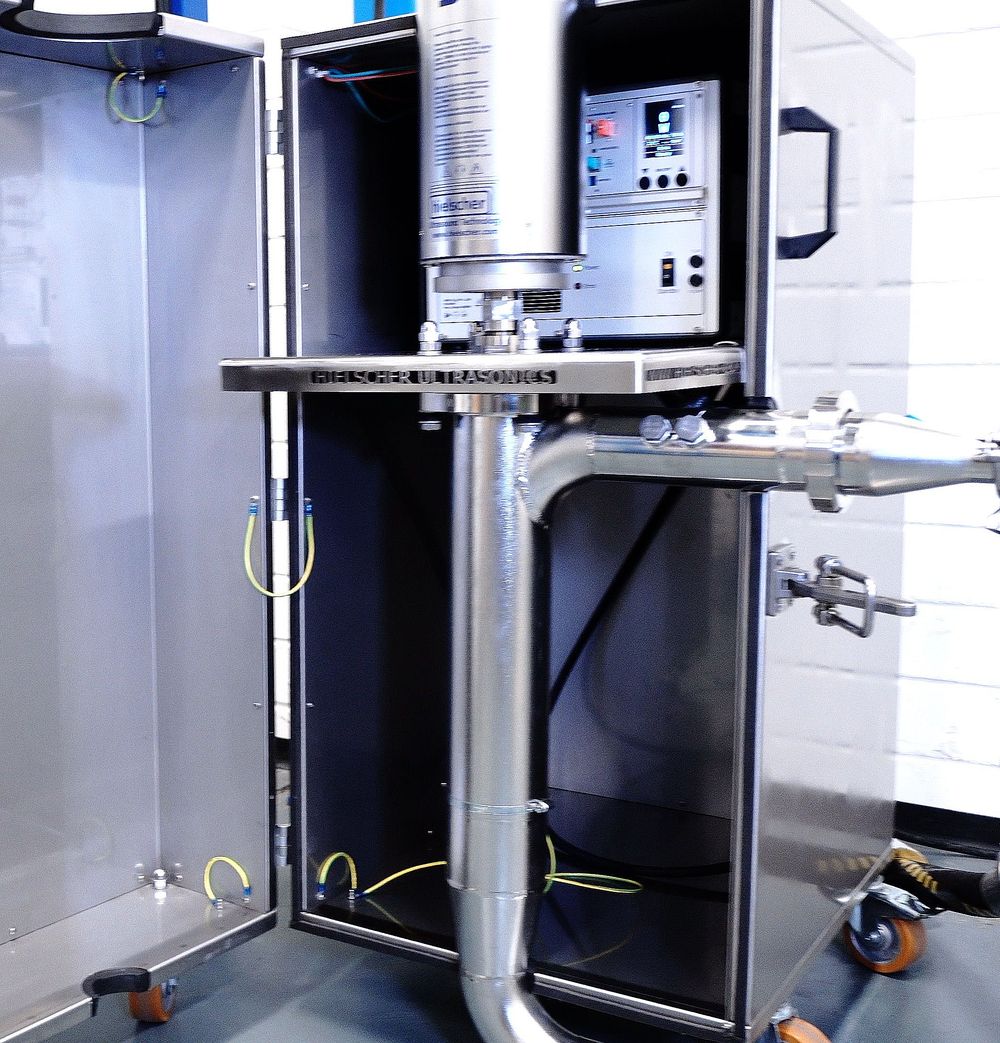 Hielscher sonicators are well suited for customized integration into chemical reactors because they are available as robust, high-power ultrasonic systems with adaptable sonotrodes, flow cells, reactor inserts, and process-specific accessories. Depending on the reaction setup, Hielscher ultrasonic processors can be installed in batch reactors, continuously stirred tank reactors, inline flow reactors, recirculation loops, pressurized systems, and pilot or production-scale plants. This flexibility allows ultrasound to be applied exactly where cavitation is most effective: at the liquid-solid, liquid-liquid, or liquid-gas interface. Hielscher Ultrasonics also offers various types of ultrasonic batch and inline reactors, enabling controlled sonochemical processing, emulsification, dispersion, catalyst activation, surface cleaning, mass-transfer intensification, and reaction acceleration. With precise control of amplitude, power input, temperature, pressure, flow rate, and residence time, Hielscher sonicators can be tailored to the specific requirements of laboratory research, process development, scale-up, and industrial chemical production.
Quyidagi jadvalda ultrasonikatorlarimizning taxminiy qayta ishlash quvvati ko'rsatilgan:
| To'plam hajmi | Oqim darajasi | Tavsiya etilgan qurilmalar |
|---|---|---|
| 1 dan 500 ml gacha | 10 dan 200 ml / min | UP100H |
| 10 dan 2000 ml gacha | 20 dan 400 ml / min | UP200Ht, UP400St |
| 0.1 dan 20 L gacha | 0.2 dan 4L/min gacha | UIP2000hdT |
| 10 dan 100 l gacha | 2 dan 10 l / min | UIP4000hdT |
| 15 dan 150 litrgacha | 3 dan 15 l / min | UIP6000hdT |
| na | 10 dan 100 l / min | UIP16000hdT |
| na | kattaroq | ning klasteri UIP16000hdT |
Dizayn, ishlab chiqarish va konsalting – Germaniyada ishlab chiqarilgan sifat
Hielscher ultrasonikatorlari eng yuqori sifat va dizayn standartlari bilan mashhur. Mustahkamlik va qulay foydalanish ultratovush qurilmalarimizni sanoat ob'ektlariga silliq integratsiya qilish imkonini beradi. Qo'pol sharoitlar va talabchan muhit Hielscher ultrasonikatorlari tomonidan osonlik bilan hal qilinadi.
Hielscher Ultrasonics ISO sertifikatiga ega kompaniya bo'lib, eng zamonaviy texnologiya va foydalanuvchilarga qulaylik bilan ajralib turadigan yuqori samarali ultratovush apparatlariga alohida e'tibor beradi. Albatta, Hielscher ultrasonikatorlari Idoralar talablariga javob beradi va UL, CSA va RoHs talablariga javob beradi.

Ultrasonik gomogenizator UIP1500hdT Sonicatsiya paytida jarayon haroratini nazorat qilish uchun sovutish qopqog'i bilan jihozlangan oqim reaktori bilan.
tez-tez so'raladigan savollar
Kimyoviy reaktorlar nima?
Kimyoviy reaktorlar — bu kimyoviy reaksiyalar nazorat ostida, masalan, harorat kabi nazorat ostida amalga oshiriladigan muhandislik idishlari yoki tizimlaridir, bosim, aralashma, qolish vaqti va reaktiv moddalar konsentratsiyasi. Ularning maqsadi xomashyoni aniq quvvat, selektivlik va jarayon samaradorligiga ega bo'lgan istalgan mahsulotlarga aylantirishdir.
Kimyoviy reaktorlarning asosiy turlari qaysilar?
Kimyoviy reaktorlardagi asosiy turlar orasida partiyaviy reaktorlar, doimiy aralashadigan tank reaktorlar, plagin oqimli reaktorlar, qat'iy yotoq reaktorlar, suyuqlashtirilgan yotoq reaktorlar, shlamli reaktorlar, membranali reaktorlar va fotokimyoviy yoki elektroximik reaktorlar mavjud. Har bir reaktor turi oqim xatti-harakati, aralashish rejimi, issiqlik va massa uzatish xususiyatlari, shuningdek, gomogen yoki gomogen bo'lmagan reaksiyalar uchun mosligi bo‘yicha farq qiladi.
Suyuqlashtirilgan yotoq reaktori va qat'iy yotoq reaktori o'rtasidagi farq nima?
In a fixed bed reactor, solid catalyst particles remain stationary while reactants flow through the packed catalyst bed. In a fluidized bed reactor, an upward-flowing fluid suspends and moves the solid particles, creating a dynamic bed with strong mixing, improved heat transfer, and better particle-fluid contact. Fixed beds are simpler and mechanically stable, while fluidized beds provide higher mixing and heat-transfer efficiency but require more complex flow control.
What is a Catalyst Bed?
Katalizator yotog‘i - reaktor ichida joylashtirilgan qattiq katalizator zarralarining belgilangan hajmi. U kimyoviy reaksiyalar sodir bo‘ladigan faol yuzani taqdim etadi. Katalizator yotoqlari stasionar bo‘lishi mumkin, masalan, qattiq yotoqli reaktorlarda, yoki dinamik ravishda osib turadigan bo‘lishi mumkin, masalan, suyuqlashtirilgan yotoqli reaktorlarda. Ularning samaradorligi katalizator faolligi, zarracha o‘lchami, teshikchanlik, yuzaning maydoni, oqim taqsimoti, issiqlik uzatish va massa uzatishdan kelib chiqadi.
Adabiyot / Adabiyotlar
- Yu, Hang Gao, Jing; Zhong, Qili; Guo, Yahui; Xie, Yunfei; Yao, Weirong; Zhou, Weibiao (2018): Acoustic pressure and temperature distribution in a novel continuous ultrasonic tank reactor: a simulation study. IOP Conference Series: Materials Science and Engineering 2018.
- Francisco J. Navarro-Brull; Andrew R. Teixeira; Jisong Zhang; Roberto Gómez; Klavs F. Jensen (2018): Reduction of Dispersion in Ultrasonically-Enhanced Micropacked Beds. Industrial & Engineering Chemistry Research 57, 1; 2018. 122–128.
- M. Ajmal, S. Rusli, G. Fieg (2016): Modeling and experimental validation of hydrodynamics in an ultrasonic batch reactor. Ultrasonics Sonochemistry, Volume 28, 2016. 218-229.
- L. Castrillón, E. Marañón, Y. Fernández-Nava, P. Ormaechea, G. Quiroga (2013): Thermophilic co-digestion of cattle manure and food waste supplemented with crude glycerin in induced bed reactor (IBR). Bioresource Technology, Volume 136, 2013. 73-77.
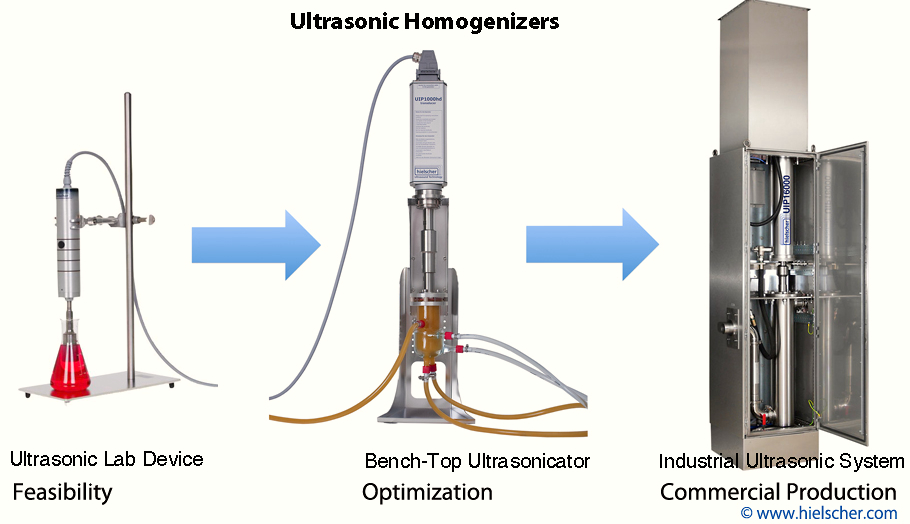
Hielscher Ultrasonics kompaniyasi yuqori samarali ultratovushli homogenizatorlarni ishlab chiqaradi laboratoriya uchun sanoat hajmi.