Хемијски реактори побољшани соникацијом – Типови, дизајни и механизми
Хемијски реактори су језгро индустријске хемије, синтезе материјала, фине хемијске производње, фармацеутске производње и прераде животне средине. Како индустрије траже брже, чистије и енергетски ефикасније процесе, ултразвучност, позната и као ултразвучна обрада, постала је све релевантнија метода за интензивирање реактора. Технологија ултразвучног реактора преобликује хемијску обраду побољшањем мешања, преноса масе, кинетике реакције и хетерогене катализе у серијским и континуираним реакторским системима.
Како Соницатион побољшава хемијске реакторе
By introducing high-power ultrasound into a chemical reactor, engineers can generate ultrasonic oscillatory flow mixing and acoustic cavitation inside the reaction medium. These mechanisms improve contact between reactants, accelerate mass transfer and can enhance reaction rates, selectivity and yield. Sonication is especially effective in solid-liquid systems, such as heterogeneous catalysis, and liquid-liquid systems, such as emulsification, extraction and biphasic reactions. It is used less frequently in gas-liquid mixtures because acoustic cavitation is generated less efficiently in liquids with high gas contents.
У модерном дизајну сонохемијских реактора, флуиди се мешају ултразвучним осцилацијама и кавитацијом, обично користећи амплитуде у опсегу од 10 до 200 µм. Ово омогућава снажне микроскопске ефекте мешања који се тешко постижу само конвенционалним механичким мешањем.
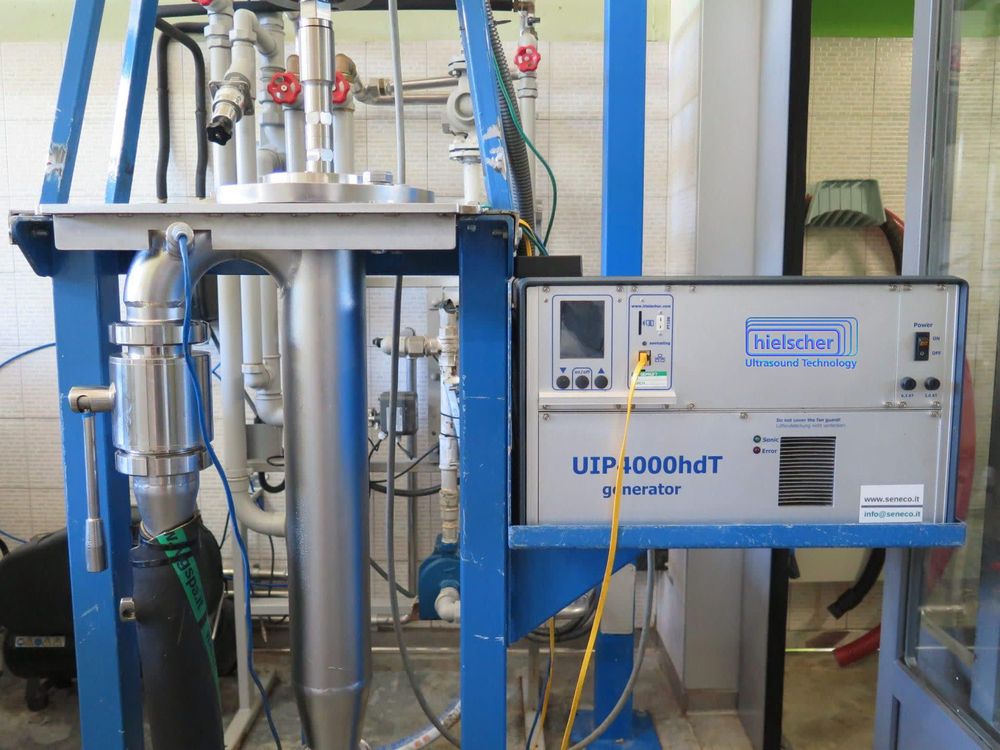
Инлине соницатор UIP4000hdT са проточном ћелијом за појачане хемијске реакције
Зашто соникација појачава хемијске реакторе
Industrijska relevantnost sonikacije leži u njenoj sposobnosti da utiče na hemijske i fizičke transportne pojave na mikro- i mezo-skali. Za razliku od konvencionalnog mešanja, ultrazvuk ne pomera samo ukupnu tečnost. On generiše talase pritiska, oscilatorno kretanje, mehuriće kavitacije i lokalizovane zone sa visokom energijom.
Kada se formiraju, rastu i kolabiraju mehurići akustične kavitacije, oni stvaraju intenzivne mikro-okoline. Ovi događaji mogu proizvesti:
- visoke lokalne sile smicanja
- mikro-mlazove u blizini čvrstih površina
- udarne talase
- brzo mikro-mešanje
- poboljšanu disperziju čestica
- poboljšan međufazni kontakt
- ubrzani prenos mase i toplote
- efekte čišćenja površina i aktivacije katalizatora
Ovi fenomeni čine sonikaciju izuzetno vrednom za intenziviranje procesa, posebno kada su reakcije ograničene difuzijom, lošim kontaktom faza, otvrdnjavanjem katalizatora ili nedovoljnom mešanjem.
Sonikacija u serijskim reaktorima
Serijski reaktori se široko koriste u laboratorijama, pilot postrojenjima i proizvodnji specijalnih hemikalija. Oni su fleksibilni, laki za rukovanje i pogodni za ispitivanje reakcija, sintezu u malom obimu i proizvode visoke vrednosti.
Kada se sonikacija primeni u serijskim reaktorima, ona može značajno poboljšati mešanje i uniformnost reakcije. Ultrazvučne sonde, protok ćelije ili spolja montirani transduceri mogu direktno uneti akustičnu energiju u reaktorski medijum.
U serijskim sistemima, sonikacija je posebno korisna za:
- хетерогена катализа
- синтеза наночестица
- kontrolu kristalizacije
- емулговање
- Екстракција
- полимеризација
- rastvaranje i disperziju čvrstih materija
За реакције чврсто-течно, ултразвук може спречити агломерацију честица и побољшати приступ каталитичким или реактивним површинама. У течним-течним системима, соникација може створити фине емулзије и повећати међузонску површину између неизмешивих фаза, што често доводи до бржих стопа реакције.
Реактори са протоком за континуирану сонохемијску обраду
Реактори са протоком спадају међу најважније дизајне за индустријску соникацију. Уместо обраде фиксног волумена течности, реакциона смеша континуирано пролази кроз ултразвучну реакторску комору.
Овај дизајн је веома атрактиван за скалирање јер омогућава инжењерима прецизнију контролу времена задржавања, протока, температуре, притиска и ултразвучног уноса енергије. Реактори са протоком кроз сонокемијски систем се често користе када је потребан конзистентан квалитет производа и континуirani рад.
Главне предности сондикираних реактора са протоком кроз систем укључују:
- капацитет континуirane производње
- побољшана репродуктивност процеса
- боља контрола температуре
- контролисана дистрибуција времена задржавања
- лакша интеграција у индустријске производне линије
- скалирајућа архитектура реактора
У овим системима, ултразвучно мешање осцилаторног протока може побољшати радијално и аксијално мешање, смањити градијенте концентрације и побољшати интеракцију реактаната. Ово је посебно вредно у процесима у којима перформансе реакције зависи од брзог фазног контакта или брзе дисперзије.
Ултразвучни проток-ћелија Инсерт МултиПхасеЦавитатор
 The MultiPhaseCavitator Insert-MPC48 is a specialized insert for Hielscher ultrasonic flow cell reactors designed to intensify liquid/liquid and liquid/gas processes directly in the ultrasonic cavitation zone. By injecting a second liquid phase or gas phase through 48 fine cannulas into the primary liquid stream, the MultiPhaseCavitator creates very small droplets or gas bubbles with a high specific interfacial area. This makes it especially efficient for ultrasonic emulsification, where immiscible phases are dispersed into fine emulsions, and for catalytic gas reactions, where the injected gas phase is rapidly dispersed and brought into intimate contact with the liquid phase, dissolved reactants, or suspended catalysts. The resulting cavitational shear, micro-mixing, and enhanced mass transfer can improve reaction kinetics, phase-boundary contact, and process efficiency in continuous or batch flow-through operation.

Соницатор УИП2000хдТ with chemical batch reactor
Chemical Reactor Designs and the Benefits of Sonication
| Reactor Type | Typical Application | Main Sonication Effects | Technical Relevance |
|---|---|---|---|
| Slurry Reactors | Heterogeneous catalysis with suspended solid catalyst particles in a liquid phase; used in hydrogenation, oxidation, biomass conversion, Fischer-Tropsch-type processes, photocatalysis and wastewater treatment. | Sonication improves catalyst dispersion, particle deagglomeration, boundary layer reduction, surface renewal, liquid-solid mass transfer, catalyst surface cleaning and fouling reduction. | Particularly relevant because many slurry-phase catalytic reactions are limited by how efficiently reactants reach active sites. Acoustic cavitation enhances contact at the catalyst-liquid interface and can improve reaction kinetics. |
| Continuously Stirred Tank Reactors (CSTRs) | Continuous liquid-phase reactions, emulsification, catalytic reactions, precipitation, crystallization, polymer reactions and solid-liquid suspensions. | Ultrasound enhances micro-mixing, particle suspension, emulsification, dispersion and local energy input. It can be combined with mechanical stirring to improve both macro-mixing and micro-mixing. | Соницирани CSTR-ови су корисни када конвенционални импелери не могу у потпуности елиминисати мртве зоне, лошу дисперзију или локална ограничења масеног преноса. Ултразвук подржава равномерније реакционе услове и побољшану интензификацију процеса. |
| Реактори са фиксном постељом | Стационарни каталитички слојеви се користе у хидрогенизацији, оксидацији, еколошкој катализи, преради петрохемијских производа и хетерогеној катализи у течном фазону. | Соникација може побољшати навлаживање катализатора, кретање течности кроз слој, смањење граничног слоја, чишћење површине, ублажавање накупљања и масени пренос до каталитичких места. | Перформансе фиксног слоја често су ограничене канализацијом, лошим навлаживањем, отпорношћу дифузије и формирањем наслага. Ултразвучна интензификација процеса може побољшати искоришћење катализатора и равномерност реакције. |
| Реактори са флуидизованом постељом | Динамички слојеви суспендованих честица које се користе у катализи, обради честица, премазивање, полимеризација, сушење и чврсто-течне реакције. | Ултразвучна побуда може побољшати дисперзију честица, смањити агломерацију, побољшати течно-чврсти контакт, стабилизовати суспензије и побољшати доступност површине катализатора. | Соницатион је посебно ефикасан у течно-чврстим флуидизованим креветима, где се кавитација може ефикасно генерисати. У системима богатим гасом, кавитација је мање ефикасна, чинећи ултразвук погоднијим за реакторске апликације на бази течности. |
| Мембрански реактори | Интегрисани системи за раздвајање реакција који се користе за селективно уклањање производа, дозирање реактанта, каталитичке мембране процесе и реакције уз помоћ филтрације. | Ултразвук може смањити запрљање мембране, побољшати проток пермеата, побољшати чишћење површине, смањити поларизацију концентрације и побољшати мешање у близини интерфејса мембране. | Соникација повезује реакцијско инжењерство са науком о сепарацији. Она је посебно вредна тамо где запрљање, отпор на масени пренос или слаба повезаност реакције и сепарације ограничавају перформансе мембранских реактора. |
Механизми интензификације ултразвучног реактора
Предности соникације у хемијским реакторима засноване су на неколико интерактивних механизама.
- Акустична кавитација је најважнији механизам. Она подразумева формирање, раст и колапс микроскопских мехурића у течности изложеној ултразвуку високе интензитет. Колапс мехурића генерише локализовано ослобађање енергије и јаке механичке силе.
- Акустично струјање ствара стабилно кретање течности изазвано ултразвучним таласима. Ово побољшава мешање и транспорт у зонама где механичко мешање може бити слабо.
- Мешање осцилаторним током се јавља када ултразвучна вибрација изазове брзо напред-назад кретање течности. У реакторским системима амплитуде од око 10 до 200 µm могу произвести веома ефикасно мешање и побољшати масовни пренос.
- Микроджет и ударни таласи се јављају у близини колабирајућих кавитационих мехурића, посебно близу чврстих површина. Ови ефекти могу очистити површине катализатора, пореметити граничне слојеве и побољшати приступ течности активним местима.
- Повећање интерфејсне површине је нарочито важно у системима течност–течност. Ултразвук може да створи фине капљице и стабилне дисперзије, повећавајући површину доступну за реакцију или масовни пренос.
Заједно, ови механизми чине соникацију моћним алатом за интензификацију хемијских реактора.
Индустријска релевантност дизајна сохемијских реактора
Индустријски значај соникованих реактора прелази границе бржег мешања. Соникација пружа начин за манипулацију реакционим окружењима на скалама које конвенционална опрема тешко може да достигне.
У хемијском инжењерингу, многе ограничења реактора проистичу више из феномена транспорта него из унутрашњих реакционих стопа. Реактанти можда не досежу каталитичка места довољно брзо. Немешиви течности можда имају недовољну површину контакта. Чврсте супстанце могу се агрегирати. Мембране могу бити запрљане. Површине катализатора могу бити блокиране.
Соникација се бави овим ограничењима директним побољшањем физичких услова унутар реактора. Ово је релевантно за неколико истраживачких и индустријских приоритета:
- зеленија хемијска обрада
- нижа потрошња енергије и растварача
- побољшана ефикасност катализатора
- већа селективност реакције
- бржи развој процеса
- континуирана производња
- интензивирани модуларни реакторски системи
- синтеза напредних материјала
- одржива конверзија биомасе и токова отпада
За истраживаче, соникација нуди контролисан метод за проучавање односа између уложене акустичне енергије, понашања кавитације, побољшања транспорта и хемијских перформанси. За индустрију, она нуди практичан пут ка компактним, ефикасним и скалабилним системима реактора.

Ултразвучни хомогенизатор UIP2000hdT за хемијске реакције у проточном реактору
Предности соникације у хемијским реакторима
Интеграција ултразвука у дизајн реактора нуди неколико оперативних и научних предности:
- брже стопе реакције кроз побољшан масени пренос
- боље мешање у вишефазним системима
- побољшана дисперзија чврстих материја и капљица
- побољшано коришћење катализатора
- смањена ограничења дифузије
- чистије површине катализатора и мембране
- побољшана репродуктивност процеса у проточним системима
- потенцијално смањење температуре, притиска или времена реакције
- компатибилност са серијском и континуираном производњом
- снажна релевантност за хетерогену катализу и бипхазне реакције
Ове предности чине технологију ултразвучних реактора посебно атрактивном за фину хемију, специјалну хемију, катализу, наноматеријале, зелену хемију и интензификацију процеса.

Ултразвучна стаклена проточна ћелија
Интензивирајте ваш хемијски реактор са Хиелсцхер соникаторима!
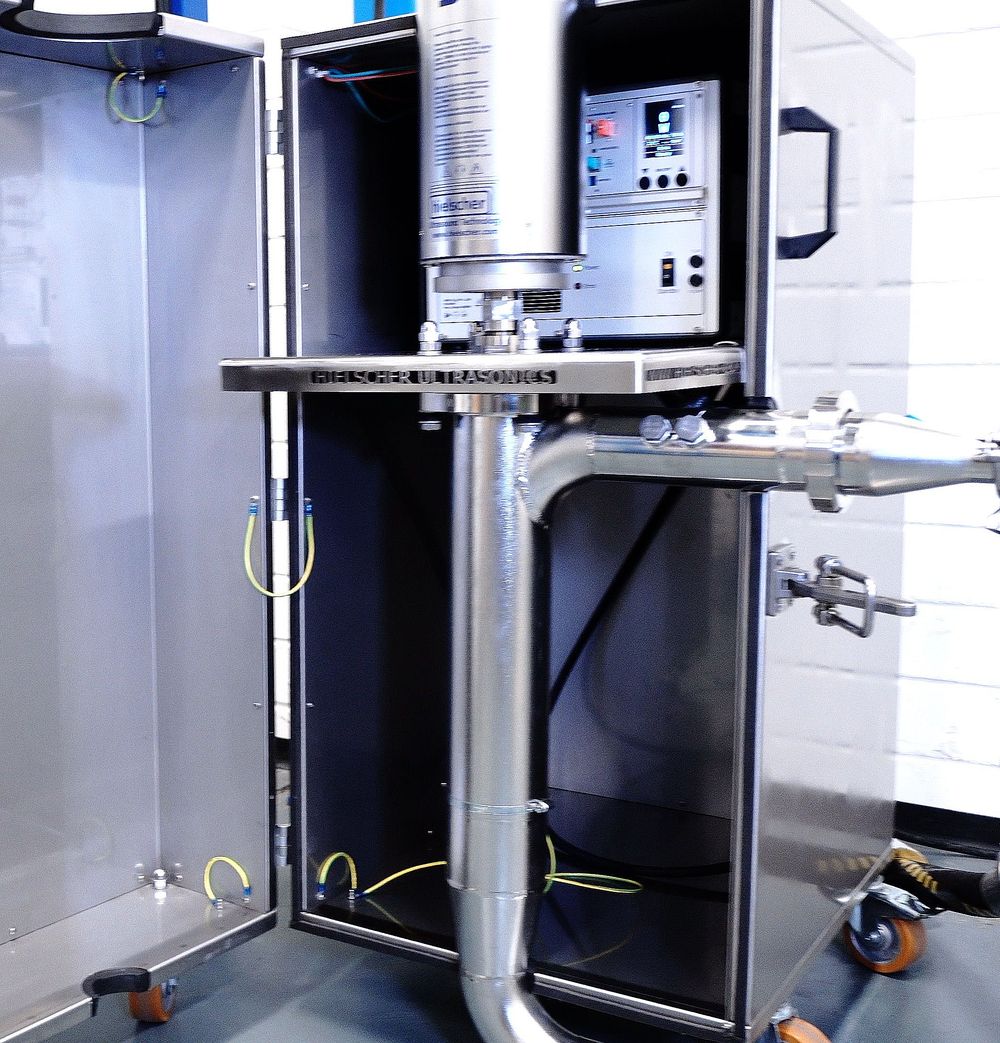 Hielscher sonicators are well suited for customized integration into chemical reactors because they are available as robust, high-power ultrasonic systems with adaptable sonotrodes, flow cells, reactor inserts, and process-specific accessories. Depending on the reaction setup, Hielscher ultrasonic processors can be installed in batch reactors, continuously stirred tank reactors, inline flow reactors, recirculation loops, pressurized systems, and pilot or production-scale plants. This flexibility allows ultrasound to be applied exactly where cavitation is most effective: at the liquid-solid, liquid-liquid, or liquid-gas interface. Hielscher Ultrasonics also offers various types of ultrasonic batch and inline reactors, enabling controlled sonochemical processing, emulsification, dispersion, catalyst activation, surface cleaning, mass-transfer intensification, and reaction acceleration. With precise control of amplitude, power input, temperature, pressure, flow rate, and residence time, Hielscher sonicators can be tailored to the specific requirements of laboratory research, process development, scale-up, and industrial chemical production.
Табела у наставку даје вам индикацију приближних капацитета обраде наших ултразвучних апарата:
| Батцх Волуме | Проток | Препоручени уређаји |
|---|---|---|
| 1 до 500 мл | 10 до 200 мл/мин | УП100Х |
| 10 до 2000 мл | 20 до 400 мл/мин | УП200Хт, УП400Ст |
| 0.1 до 20Л | 0.2 до 4Л/мин | УИП2000хдТ |
| 10 до 100 л | 2 до 10 л/мин | УИП4000хдТ |
| 15 до 150Л | 3 до 15 л/мин | УИП6000хдТ |
| на | 10 до 100 л/мин | УИП16000хдТ |
| на | већи | кластер оф УИП16000хдТ |
Дизајн, производња и консалтинг – Квалитет Маде ин Германи
Хиелсцхер ултрасоникатори су познати по свом највишем квалитету и стандардима дизајна. Робусност и једноставан рад омогућавају несметану интеграцију наших ултразвучних апарата у индустријске објекте. Хиелсцхер ултрасоникатори се лако носе са тешким условима и захтевним окружењима.
Хиелсцхер Ултрасоницс је ИСО сертификована компанија и ставља посебан нагласак на ултрасоникаторе високих перформанси са најсавременијом технологијом и једноставношћу за коришћење. Наравно, Хиелсцхер ултрасоникатори су усаглашени са ЦЕ и испуњавају захтеве УЛ, ЦСА и РоХ.

Ултразвучни хомогенизатор УИП1500хдТ са проточним реактором опремљеним хладним кожухом за контролу температуре процеса током сондирања.
Често постављана питања
Шта су хемијски реактори?
Хемијски реактори су инжењерска посуда или системи у којима се хемијске реакције изводе под контролисаним условима као што су температура, притисак, мешање, време задржавања и концентрација реагената. Њихова сврха је да претворе сировине у жељене производе са одређеним приносом, селективношћу и ефикасношћу процеса.
Које су главне врсте хемијских реактора?
Главни типови хемијских реактора укључују шаржне реакторе, континуирано мешане резервоарске реакторе, реакторе са протоком чепова, реакторе са фиксним слојем, реакторе са флуидизованим слојем, реакторе са суспензија, мембранске реакторе и фотохемијске или електрохемијске реакторе. Сваки тип реактора се разликује у понашању протока, режиму мешања, карактеристикама преноса топлоте и масе и погодности за хомогене или хетерогене реакције.
Која је разлика између флуидизованог реактора и реактора са фиксним слојем?
In a fixed bed reactor, solid catalyst particles remain stationary while reactants flow through the packed catalyst bed. In a fluidized bed reactor, an upward-flowing fluid suspends and moves the solid particles, creating a dynamic bed with strong mixing, improved heat transfer, and better particle-fluid contact. Fixed beds are simpler and mechanically stable, while fluidized beds provide higher mixing and heat-transfer efficiency but require more complex flow control.
What is a Catalyst Bed?
Ležište katalizatora je definisan volumen čvrstih čestica katalizatora raspoređenih unutar reaktora. Ono pruža aktivnu površinu na kojoj se odvijaju hemijske reakcije. Ležišta katalizatora mogu biti stacionarna, kao u reaktorima sa fiksnim slojem, ili dinamički suspendovana, kao u reaktorima sa fluidizovanim slojem. Njihova efikasnost zavisi od aktivnosti katalizatora, veličine čestica, poroznosti, površine, raspodele protoka, prenosa toplote i prenosa mase.
Литература / Референце
- Yu, Hang Gao, Jing; Zhong, Qili; Guo, Yahui; Xie, Yunfei; Yao, Weirong; Zhou, Weibiao (2018): Acoustic pressure and temperature distribution in a novel continuous ultrasonic tank reactor: a simulation study. IOP Conference Series: Materials Science and Engineering 2018.
- Francisco J. Navarro-Brull; Andrew R. Teixeira; Jisong Zhang; Roberto Gómez; Klavs F. Jensen (2018): Reduction of Dispersion in Ultrasonically-Enhanced Micropacked Beds. Industrial & Engineering Chemistry Research 57, 1; 2018. 122–128.
- M. Ajmal, S. Rusli, G. Fieg (2016): Modeling and experimental validation of hydrodynamics in an ultrasonic batch reactor. Ultrasonics Sonochemistry, Volume 28, 2016. 218-229.
- L. Castrillón, E. Marañón, Y. Fernández-Nava, P. Ormaechea, G. Quiroga (2013): Thermophilic co-digestion of cattle manure and food waste supplemented with crude glycerin in induced bed reactor (IBR). Bioresource Technology, Volume 136, 2013. 73-77.
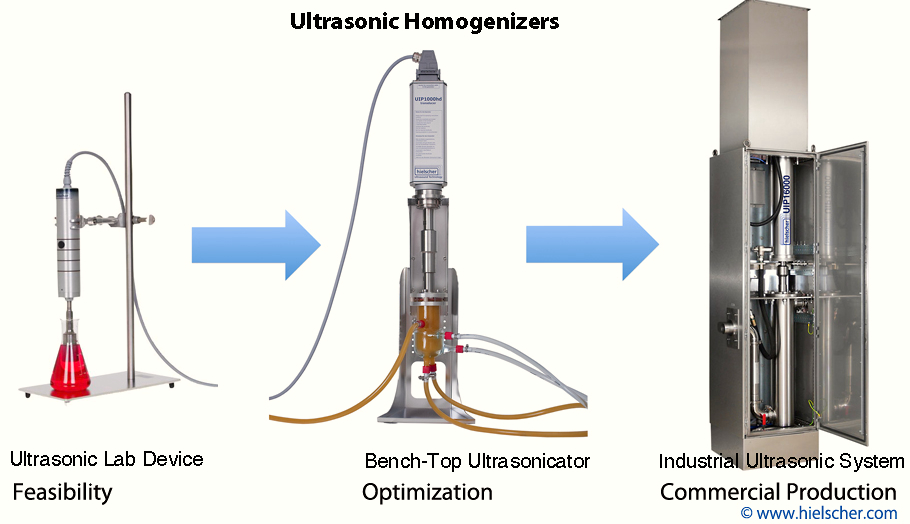
Хиелсцхер Ултрасоницс производи ултразвучне хомогенизаторе високих перформанси од лаб до индустријска величина.