Sonochemesch Reduktioun vu Palladium Nanopartikelen
Palladium (Pd) is well known for its catalytic properties and is also widely used in materials research, electronics manufacturing, medicine, hydrogen purification, and various chemical applications. Using a sonochemical route, the size and morphology of palladium particles can be controlled by adjusting the PVP/Pd ratio. This enables the ultrasonic synthesis of either very fine, monodisperse nanoparticles or larger palladium aggregates, allowing particle dimensions to be tailored for optimal catalytic performance.
Ultraschallproduktioun vu Palladium Nanopartikelen
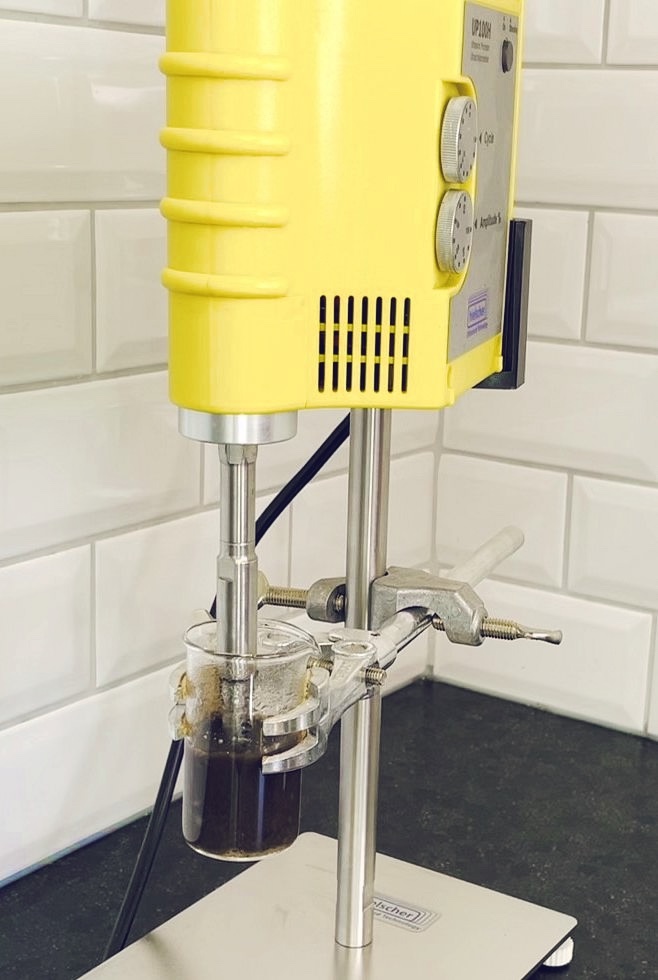 Ultrasonic palladium nanoparticle reduction offers a fast, reagent-efficient route to Pd(0) nanoparticles by using acoustic cavitation to generate localized high-energy conditions and reducing radicals in solution, enabling palladium ions to be reduced without conventional high-temperature processing.
A key advantage is process control: sonication time and stabilizer concentration, such as the PVP/Pd ratio, can influence whether the product forms as well-dispersed, rounded nanoparticles around 5 nm or as larger aggregates around 20 nm, which is industrially relevant because palladium performance in catalysis depends strongly on particle size, morphology, dispersion, and surface area. Since palladium nanoparticles are widely valuable as heterogeneous catalysts, electrocatalysts, and functional materials, ultrasonic reduction is attractive for producing finely dispersed Pd catalysts under comparatively mild liquid-phase conditions, with potential benefits for chemical synthesis, environmental catalysis, fuel-cell technologies, and other processes where high catalytic activity and efficient noble-metal utilization are economically important.

Industrial nanoparticle processing mat dem Sonicator UIP2000hdT
Sample Preparation Procedure
D'Proben goufen als folgend virbereet:
Fir d'Proben, Mëschunge vun 30mL EG an 5·10-6mol of PVP were preprared by magnetic stirring for 15 min. For the different samples, different amount of Pd(NO₃)₂ solution, 1.5mL and 2mL, were added. The sample mixtures were prepared with the ratio of 2·10-3mol Pd(NO₃)₂ in sample (a) and 2.66·10-3mol Pd(NO₃)₂ in sample (b). Both mixtures were sonicated in a 20mL vial using a probe-type ultrasonicator. Samples were taken after sonication times of 30, 60, 90, 120, 150, and 180 min.
D'Analyse vun den experimentellen Resultater weist datt:
- 1. Déi sonochemesch Reduktioun vu Pd (II) an Pd (0) hänkt vun der Sonikatiounszäit of.
- 2. Den héije PVP / Pd (II) molar Verhältnis féiert zu der Bildung vu monodisperséierten Palladiumpartikelen mat enger gerundeter Form an engem mëttleren Duerchmiesser vu ronn 5nm.
- 3. Wéi och ëmmer, de nidderegen PVP / Pd (II) molar Verhältnis beinhalt d'Erhalen vun Aggregaten Palladium Nanopartikel mat enger grousser Gréisst Verdeelung zentréiert op 20nm.
De sonochemesche Wee fir Palladium (II) Ionen ze reduzéieren Pd(II) zu Palladiumatome Pd(0) kann als folgend ugeholl ginn:
- (1) Water pyrolysis: H₂O → •OH+•H
- (2) Radical formation: RH (Reducing agent) + •OH(•H) → •R + H₂O(H₂)
- (3) Ionenreduktioun: Pd(II) + Reduzéierungsradikaler (•H, •R) → Pd(0) + R•CHO + H+
- (4) Partikelbildung: NPd(0) → Pdn
Resultat: Ofhängeg vum PVP/Pd(II) Verhältnis, verspreet oder aggregéiert PdN kritt goufen.
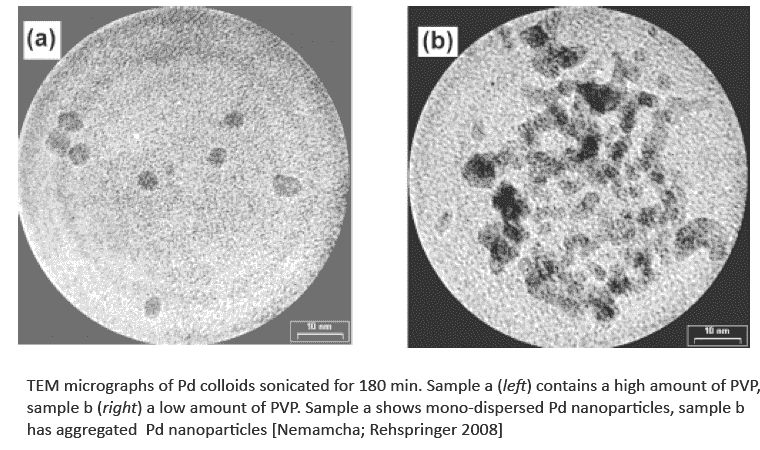
Sonochemical reduction of Palladium: sample a (left) contains a high amount of PVP, sample b (right) a low amount of PVP. Sonication time with UP100H: 180 min. Sample a shows mono dispersed Pd nano particles, sample b aggregated Pd nano particles.
Images and study: ©Nemamcha and Rehspringer, 2008
Analyse a Resultater
D'UV-sichtbar Absorptiounsanalysen bestätegen d'Relatioun tëscht der sonochemescher Reduktioun vu Palladium (II) Ionen op Palladium (0) Atomer an der Retentiounszäit am Ultraschallfeld. D'Reduktioun vu Palladium (II) Ionen op Palladium (0) Atomer fortgeet a ka komplett mat der Erhéijung vun der Sonikatiounszäit erreecht ginn. D'Mikrographe vun der Transmissiounselektronenmikroskopie (TEM) weisen datt:
- When a high amount of PVP is added, the sonochemical reduction of palladium ions leads to the formation of monodispersed palladium particles with spherical shape and a mean diameter of approx. 5nm.
- The use of a small quantity of PVP involves the obtaining of aggregates palladium nanoparticles. The dynamic light scattering (DLS) measurements reveal that the palladium nanoparticles aggregates have a large size distribution centered at 20nm.

The lab sonicator UP100H has been used for the preparation of palladium nano-particles.

Palladium (Pd) Nano-Partikel kënnen duerch Sonikatioun virbereet ginn
Design, Fabrikatioun a Berodung – Qualitéit Made in Germany
Hielscher Ultraschaller si bekannt fir hir héchst Qualitéit an Designnormen. Robustheet an einfach Operatioun erlaben déi glat Integratioun vun eisen Ultraschaller an industriellen Ariichtungen. Rau Konditiounen an erfuerderlech Ëmfeld ginn einfach vun Hielscher Ultraschaller gehandhabt.
Hielscher Ultrasonics ass eng ISO zertifizéiert Firma a setzt spezielle Wäert op High-Performance Ultrasonicatoren mat modernste Technologie a Benotzerfrëndlechkeet. Natierlech sinn Hielscher Ultraschaller CE konform an entspriechen d'Ufuerderunge vun UL, CSA a RoHs.
Literatur / Referenzen
- Nemamcha, A.; Rehspringer, J. L. (2008): Morphology of dispersed and aggregated PVV-Pd nanoparticles prepared by ultrasonic irradiation of Pd(NO₃)₂ solution in ethylene glycol. Rev. Adv. Mater. Sci. 18;2008. 685-688.
- Prekob, Á., Muránszky, G., Kocserha, I. et al. (2020): Sonochemical Deposition of Palladium Nanoparticles Onto the Surface of N-Doped Carbon Nanotubes: A Simplified One-Step Catalyst Production Method. Catalysis Letters 150, 2020. 505–513.
- Haitao Zheng, Mphoma S. Matseke, Tshimangadzo S. Munonde (2019): The unique Pd@Pt/C core-shell nanoparticles as methanol-tolerant catalysts using sonochemical synthesis. Ultrasonics Sonochemistry, Volume 57, 2019. 166-171.
Fakten Worth Wëssen
What is Palladium?
Palladium is a rare, silvery-white precious metal with the chemical symbol Pd and atomic number 46. It belongs to the platinum-group metals and is valued because it is chemically stable, conducts electricity, absorbs hydrogen, and acts as an excellent catalyst. Finely divided palladium is especially effective for hydrogenation and dehydrogenation reactions, and heated palladium can allow hydrogen to diffuse through it, which makes it useful for hydrogen separation and purification.
What are Palladium Nanoparticles Used for?
Palladium nanoparticles are used mainly as high-surface-area catalysts. Because nanoparticles expose far more active surface area than bulk palladium, they can improve catalyst efficiency and reduce the amount of expensive noble metal required. Typical applications include chemical synthesis, hydrogenation reactions, carbon–carbon coupling reactions, electrocatalysis, fuel-cell research, hydrogen sensing and storage, environmental catalysis, and some biomedical research areas such as antimicrobial, photothermal, and anticancer systems. Palladium catalytic behavior depends strongly on particle size, morphology, and dispersion.
Palladium nanoparticles are also used to dope other particles in order to achieve catalytic functionalities. Lies méi iwwer de ultraschall Wee fir Pd/N-BCNT als Fischer-Tropsch Katalysator ze synthetiséieren!
Ass Palladium giftg?
Elemental metallic palladium is generally considered to have low toxicity and no known biological role, but palladium compounds, salts, dusts, and nanoscale forms should be handled carefully. Occupational or laboratory exposure can cause irritation or sensitization depending on the compound and route of exposure, and palladium chloride solutions, for example, may irritate mucous membranes. For industrial handling, the practical answer is: bulk metallic palladium is relatively low-risk, but palladium powders, soluble palladium salts, and palladium nanoparticles should be treated as potentially hazardous materials, with dust control, ventilation, gloves, eye protection, and proper waste handling.