Ultrasonically Intensified Fixed Bed Reactors
Sonikasi dapat meningkatkan reaksi katalitik dalam reaktor lapisan tetap, terutama dengan memperkuat perpindahan massa di sekitar dan di dalam lapisan katalis yang dipadatkan. Selain itu, sonikasi menghilangkan lapisan pasivasi dan lapisan pengotoran dari permukaan katalis, sehingga katalis dapat terus-menerus diregenerasi.
Bagaimana Sonikasi Meningkatkan Katalisis Tempat Tetap
Dalam reaktor lapisan tetap, partikel katalis tetap diam sementara reaktan cair, gas, atau multifase mengalir melalui lapisan tersebut. Kinerja reaksi sering kali dibatasi oleh transfer massa eksternal, difusi pori, fenomena channeling, pengendapan, dan gradien perpindahan panas. Ultrasonik dapat mengurangi beberapa keterbatasan tersebut dengan menghasilkan kavitasi akustik, aliran mikro, gaya geser, dan osilasi tekanan.

Sonicator UIP2000hdT diintegrasikan ke dalam reaktor tempat tidur tetap
Efek Utama Reaksi Tempat Tetap yang Diperkuat dengan Ultrasonik
- Peningkatan transfer massa eksternal: Aliran mikro ultrasonik mengurangi lapisan batas stagnan di sekitar partikel katalis, sehingga reaktan dapat mencapai situs aktif dengan lebih efisien.
- Peningkatan aksesibilitas pori: Fluktuasi tekanan dan pergerakan cairan yang disebabkan oleh kavitasi dapat meningkatkan penetrasi reaktan ke dalam pori-pori katalis serta pengeluaran produk dari pori-pori tersebut.
- Pengurangan pengendapan dan pasivasi: Sonikasi dapat membantu menghilangkan endapan, lapisan polimer, prekursor kokas, atau lapisan pasivasi lainnya dari permukaan katalis, sehingga aktivitas katalitik dapat dipertahankan lebih lama.
- Penurunan fenomena channeling pada lapisan padat: Dalam penelitian mengenai lapisan padat mikro, ultrasonik telah terbukti dapat mengubah perilaku aliran dan mengurangi dispersi, sehingga membantu reaktor mendekati perilaku aliran plug yang lebih ideal.
- Perpindahan Panas yang Ditingkatkan: Aliran akustik dan turbulensi meningkatkan pembuangan panas secara lokal, sehingga mengurangi titik panas atau zona dingin di lapisan katalis.
- Tingkat konversi dan hasil yang lebih tinggi: Dengan meningkatkan transfer massa dan aksesibilitas katalis, sonikasi dapat meningkatkan laju reaksi, konversi, dan hasil produk, terutama apabila reaksi tersebut dibatasi oleh faktor transportasi, bukan semata-mata oleh faktor kinetika.
Peningkatan kontak cairan-padatan: Ultrasonik meningkatkan pembasahan partikel katalis, yang sangat berguna terutama pada sistem trickle-bed, sistem dengan umpan slurry, atau sistem fixed-bed fase cair.
Bagaimana Sonikasi Dapat Meningkatkan Katalisis Tempat Tetap?
Mekanisme utamanya adalah kavitasi akustik: gelombang ultrasonik menciptakan gelembung-gelembung mikroskopis yang membesar dan runtuh dengan dahsyat. Runtuhnya gelembung-gelembung tersebut menghasilkan geseran lokal, mikrojet, gelombang kejut, dan pencampuran yang intens. Di dekat permukaan katalis, efek-efek ini dapat membersihkan, mengaktifkan, dan menyegarkan antarmuka padat-cair. Tinjauan mengenai sonokatalisis menggambarkan hal ini sebagai sinergi antara ultrasonik dan katalis padat, yang melibatkan peningkatan perpindahan panas, perpindahan massa, serta efek-efek lokal pada permukaan katalis.
Sonikasi paling bermanfaat ketika reaksi lapisan tetap mengalami:
- difusi yang lambat ke dalam pori-pori katalis,
- pembasahan partikel katalis yang buruk,
- penumpukan produk di dalam pori-pori,
- pengendapan kotoran atau pasivasi permukaan,
- kinetika yang dibatasi oleh transfer massa,
- distribusi yang tidak merata pada aliran multifase,
- aliran melalui lapisan padat.
Katalis Tempat Tidur Tetap
Tempat tidur tetap (kadang-kadang juga disebut tempat tidur yang dikemas) biasanya diisi dengan pelet katalis, yang biasanya berupa butiran dengan diameter 1-5mm. Mereka dapat dimuat ke dalam reaktor dalam bentuk sebagai tempat tidur tunggal, sebagai cangkang terpisah, atau dalam tabung. Katalis sebagian besar didasarkan pada logam seperti nikel, tembaga, osmium, platinum, dan rhodium.
Pengaruh ultrasonik berdaya tinggi terhadap reaksi kimia heterogen sudah dikenal luas dan banyak diterapkan dalam proses katalitik industri. Reaksi katalitik dalam reaktor unggun tetap juga memperoleh manfaat dari perlakuan sonikasi. Penyinaran ultrasonik pada katalis lapisan tetap menghasilkan permukaan yang sangat reaktif, meningkatkan transportasi massa antara fase cair (reaktan) dan katalis, serta menghilangkan lapisan pasivasi (misalnya lapisan oksida) dari permukaan.
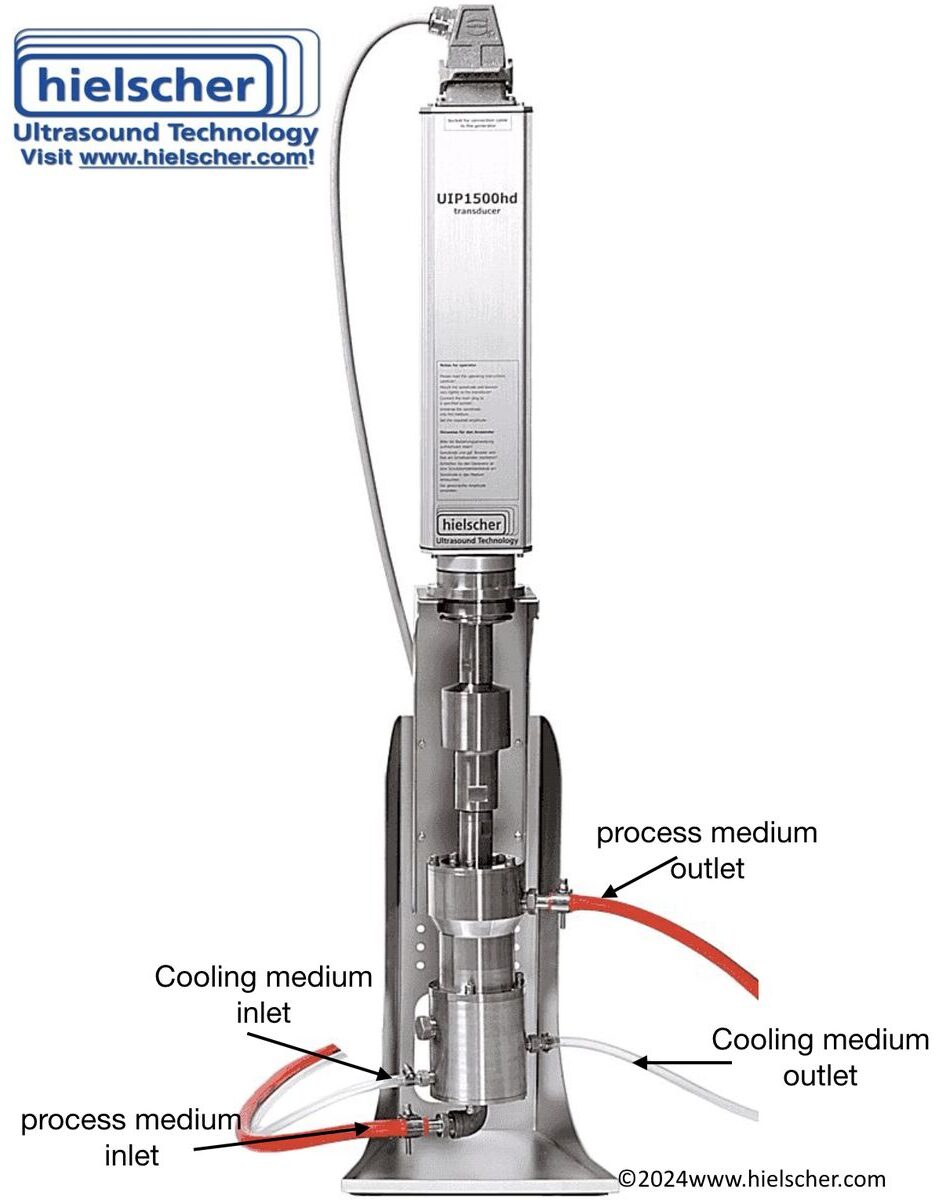
Sonicator UIP1500hdT dengan sel aliran untuk reaktivasi dan daur ulang katalis bekas
- Peningkatan efisiensi
- Peningkatan reaktivitas
- Peningkatan tingkat konversi
- hasil yang lebih tinggi
- Daur ulang katalis
Intensifikasi Ultrasonik Reaksi Katalitik
Pencampuran dan agitasi ultrasonik meningkatkan kontak antara partikel reaktan dan katalis, menciptakan permukaan yang sangat reaktif dan memulai dan/atau meningkatkan reaksi kimia.
Persiapan katalis ultrasonik dapat menyebabkan perubahan perilaku kristalisasi, dispersi / deaglomerasi dan sifat permukaan. Selanjutnya, karakteristik katalis yang telah dibentuk sebelumnya dapat dipengaruhi dengan menghilangkan lapisan permukaan pasif, dispersi yang lebih baik, meningkatkan perpindahan massa.
Contoh Reaksi yang Ditingkatkan dengan Ultrasonik
- Pra-perlakuan ultrasonik katalis Ni untuk reaksi hidrogenasi
- Katalis Raney Ni yang disonikasi dengan asam tartarat menghasilkan enansioselektivitas yang sangat tinggi
- Katalis Fischer-Tropsch yang disintesis dengan metode ultrasonik
- Katalis bubuk amorf yang diolah secara sonokimia untuk meningkatkan reaktivitas
- Sono-sintesis bubuk logam amorf
Pemulihan Katalis Ultrasonik
Katalis padat dalam reaktor lapisan tetap umumnya digunakan dalam bentuk butiran bulat, pelet, ekstrudat, atau partikel silinder. Selama reaksi kimia berlangsung, permukaan katalis dapat mengalami pasivasi akibat lapisan pengotor, yang mengakibatkan hilangnya aktivitas katalitik dan/atau selektivitas secara bertahap seiring berjalannya waktu.
Lamanya waktu deaktivasi katalis sangat bervariasi. Sebagai contoh, deaktivasi katalis cracking dapat terjadi dalam hitungan detik, sedangkan katalis besi yang digunakan dalam sintesis amonia dapat tetap aktif selama 5–10 tahun. Meskipun demikian, deaktivasi katalis terjadi pada hampir semua proses katalitik. Meskipun mekanisme deaktivasi yang berbeda dapat terjadi – termasuk degradasi kimia, mekanis, dan termal – Penumpukan endapan merupakan salah satu penyebab paling umum dari penurunan kinerja katalis.
Fouling mengacu pada pengendapan fisik zat-zat dari fase cair ke permukaan katalis dan di dalam pori-porinya. Endapan ini menyumbat situs reaktif, membatasi aksesibilitas pori, dan mengurangi kontak antara reaktan dan permukaan katalis yang aktif. Fouling katalis akibat endapan kokas atau endapan karbon seringkali merupakan proses yang cepat; namun, dalam banyak kasus, hal ini dapat dibalikkan sebagian atau sepenuhnya melalui regenerasi ultrasonik.
Kavitasi ultrasonik merupakan metode yang efektif untuk menghilangkan lapisan kerak pasivasi dari permukaan katalis. Selama proses sonikasi, gelombang ultrasonik berintensitas tinggi menghasilkan gelembung kavitasi dalam medium cair. Keruntuhan gelembung-gelembung tersebut menghasilkan gaya geser lokal, mikrojet, gelombang kejut, dan pencampuran mikro yang intens. Efek-efek ini membantu melepaskan residu pengotoran dari permukaan katalis, membuka kembali pori-pori yang tersumbat, dan memulihkan akses ke situs aktif.
Pemulihan katalis dengan ultrasonik biasanya dilakukan dengan mendispersikan partikel katalis dalam cairan, seperti air deionisasi atau pelarut yang sesuai, dan memaparkan suspensi tersebut pada perlakuan ultrasonik yang terkendali. Proses ini dapat menghilangkan residu pengotoran dari berbagai bahan katalis, termasuk katalis serat platinum/silika, katalis nikel, dan katalis logam berbahan pendukung lainnya. Hasilnya, sonikasi dapat berkontribusi pada regenerasi katalis, perpanjangan masa pakai katalis, dan peningkatan keberlanjutan proses.
Alat Sonicasi untuk Diintegrasikan ke dalam Reaktor Kimia
 Hielscher Ultrasonics menawarkan berbagai prosesor ultrasonik dan variasi untuk integrasi ultrasound daya ke dalam reaktor tempat tidur tetap. Berbagai sistem ultrasonik tersedia untuk dipasang ke dalam reaktor tempat tidur tetap. Untuk jenis reaktor yang lebih kompleks, kami menawarkan Ultrasonik yang disesuaikan Solusi.
Pelajari bagaimana sonikasi meningkatkan reaksi kimia pada berbagai desain reaktor!
Untuk menguji pengaruh sonikasi terhadap reaksi kimia Anda, silakan kunjungi laboratorium proses ultrasonik dan pusat teknis kami di Teltow!
Hubungi kami hari ini! Kami senang mendiskusikan intensifikasi ultrasonik proses kimia Anda dengan Anda!
Tabel di bawah ini memberi Anda indikasi perkiraan kapasitas pemrosesan sonikator Hielscher:

Sistem aliran ultrasonik
- Hidrogenasi
- Alsilasi
- Sianasi
- eterifikasi
- esterifikasi
- Polimerisasi
- Alilasi
- Brominasi
(misalnya katalis Ziegler-Natta, metalosen)
Literatur / Referensi
- Francisco J. Navarro-Brull; Andrew R. Teixeira; Jisong Zhang; Roberto Gómez; Klavs F. Jensen (2018): Reduction of Dispersion in Ultrasonically-Enhanced Micropacked Beds. Industrial & Engineering Chemistry Research 57, 1; 2018. 122–128.
- Yasuo Tanaka (2002): A dual purpose packed-bed reactor for biogas scrubbing and methane-dependent water quality improvement applying to a wastewater treatment system consisting of UASB reactor and trickling filter. Bioresource Technology, Volume 84, Issue 1, 2002. 21-28.
- Argyle, M.D.; Bartholomew, C.H. (2015): Heterogeneous Catalyst Deactivation and Regeneration: A Review. Catalysts 2015, 5, 145-269.
- Oza, R.; Patel, S. (2012): Recovery of Nickel from Spent Ni/Al2O3 Catalysts using Acid Leaching, Chelation and Ultrasonication. Research Journal of Recent Sciences Vol. 1; 2012. 434-443.
- Sana, S.; Rajanna, K.Ch.; Reddy, K.R.; Bhooshan, M.; Venkateswarlu, M.; Kumar, M.S.; Uppalaiah, K. (2012): Ultrasonically Assisted Regioselective Nitration of Aromatic Compounds in Presence of Certain Group V and VI Metal Salts. Green and Sustainable Chemistry, 2012, 2, 97-111.
- Suslick, K. S.; Skrabalak, S. E. (2008): “Sonocatalysis” In: Handbook of Heterogeneous Catalysis, vol. 4; Ertl, G.; Knözinger, H.; Schüth, F.; Weitkamp, J., (Eds.). Wiley-VCH: Weinheim, 2008. 2006-2017.
Fakta-fakta yang Patut Diketahui
Apa itu Kavitasi ultrasonik?
Kavitasi ultrasonik adalah proses pembentukan, pertumbuhan, dan keruntuhan yang dahsyat dari gelembung uap atau gas mikroskopis dalam cairan yang terpapar gelombang ultrasonik berintensitas tinggi. Selama keruntuhan gelembung, kondisi lokal yang ekstrem dapat terjadi dalam waktu yang sangat singkat, termasuk suhu tinggi, tekanan tinggi, gelombang kejut, mikrojet, dan gaya geser yang intens.
Apa itu Sonokimia?
Sonokimia adalah pemanfaatan efek kavitasi ultrasonik ini untuk memicu, mempercepat, atau memodifikasi proses kimia dan fisiko-kimia. Hal ini sangat relevan dalam sistem fase cair karena kavitasi meningkatkan proses pencampuran, perpindahan massa, emulsifikasi, dispersi partikel, pembersihan permukaan katalis, dan, dalam beberapa kasus, pembentukan radikal. Akibatnya, sonokimia digunakan untuk mengintensifkan reaksi seperti katalisis heterogen, oksidasi, ekstraksi, polimerisasi, kristalisasi, dan sintesis nanomaterial.
Apa itu Reaksi Katalitik Heterogen?
Dalam kimia, katalisis heterogen mengacu pada jenis reaksi katalitik di mana fase katalis dan reaktan berbeda satu sama lain. Dalam konteks kimia heterogen, fase tidak hanya digunakan untuk membedakan antara padat, cair, dan gas, tetapi juga mengacu pada cairan yang tidak dapat bercampur, misalnya minyak dan air.
Selama reaksi heterogen, satu atau lebih reaktan mengalami perubahan kimia pada antarmuka, misalnya pada permukaan katalis padat.
Laju reaksi tergantung pada konsentrasi reaktan, ukuran partikel, suhu, katalis, dan faktor lebih lanjut.
Konsentrasi reaktan: Secara umum, peningkatan konsentrasi reaktan meningkatkan laju reaksi karena antarmuka yang lebih besar dan dengan demikian transfer fase yang lebih besar antara partikel reaktan.
Ukuran partikel: Ketika salah satu reaktan adalah partikel padat, maka tidak dapat ditampilkan dalam persamaan laju, karena persamaan laju hanya menunjukkan konsentrasi dan padatan tidak dapat memiliki konsentrasi karena berada dalam fase yang berbeda. Namun, ukuran partikel padatan mempengaruhi laju reaksi karena luas permukaan yang tersedia untuk transfer fase.
Suhu reaksi: Suhu terkait dengan konstanta laju melalui persamaan Arrhenius: k = Ae-Ea/RT
Di mana Ea adalah energi aktivasi, R adalah konstanta gas universal dan T adalah suhu absolut dalam Kelvin. A adalah faktor Arrhenius (frekuensi). e-Ea/RT memberikan jumlah partikel di bawah kurva yang memiliki energi lebih besar dari energi aktivasi, Ea.
Katalisator: Dalam kebanyakan kasus, reaksi terjadi lebih cepat dengan katalis karena membutuhkan lebih sedikit energi aktivasi. Katalis heterogen menyediakan permukaan cetakan di mana reaksi terjadi, sedangkan katalis homogen membentuk produk perantara yang melepaskan katalis selama langkah mekanisme selanjutnya.
Faktor lain: Faktor lain seperti cahaya dapat mempengaruhi reaksi tertentu (fotokimia).
Apa saja jenis-jenis deaktivasi katalis?
- Keracunan katalis adalah istilah untuk chemisorption yang kuat dari spesies di situs katalitik yang memblokir situs untuk reaksi katalitik. Keracunan bisa reversibel atau ireversibel.
- Pengotoran mengacu pada degradasi mekanis katalis, di mana spesies dari fase fluida mengendap ke permukaan katalitik dan di pori-pori katalis.
- Degradasi termal dan sintering mengakibatkan hilangnya luas permukaan katalitik, area pendukung, dan reaksi pendukung fase aktif.
- Pembentukan uap berarti bentuk degradasi kimia, di mana fase gas bereaksi dengan fase katalis untuk menghasilkan senyawa yang mudah menguap.
- Reaksi uap-padat dan padat-padat menghasilkan penonaktifan kimia katalis. Uap, pendukung, atau promotor bereaksi dengan katalis sehingga menghasilkan fase tidak aktif.
- Gesekan atau penghancuran partikel katalis mengakibatkan hilangnya bahan katalitik karena abrasi mekanis. Luas permukaan internal katalis hilang karena penghancuran partikel katalis yang diinduksi secara mekanis.
Baca selengkapnya tentang bagaimana sonikasi dapat mengaktifkan kembali katalis yang sudah habis masa pakainya!
Apa itu Substitusi Nukleofilik?
Substitusi nukleofilik merupakan kelas reaksi mendasar dalam kimia organik (dan anorganik), di mana suatu nukleofil secara selektif membentuk ikatan dalam bentuk basa Lewis (sebagai donor pasangan elektron) dengan suatu kompleks organik yang memiliki muatan positif atau sebagian positif (+) dari suatu atom atau gugus atom untuk menggantikan gugus yang terlepas. Atom bermuatan positif atau sebagian positif tersebut, yang bertindak sebagai akseptor pasangan elektron, disebut elektrofil. Keseluruhan entitas molekul yang terdiri dari elektrofil dan gugus yang terlepas biasanya disebut substrat.
Substitusi nukleofilik dapat diamati sebagai dua jalur yang berbeda – Sn1 dan Sn2 reaksi. Bentuk mekanisme reaksi yang mana – Sn1 atau Sn2 – terjadi, tergantung pada struktur senyawa kimia, jenis nukleofil dan pelarut.