احیای سونوشیمیایی نانوذرات پالادیوم
پالادیوم (Pd) به خاطر خواص کاتالیزوری اش شناخته شده است و همچنین در تحقیقات مواد، تولید الکترونیک، پزشکی، تصفیه هیدروژن و کاربردهای شیمیایی مختلف به طور گسترده استفاده می شود. با استفاده از مسیر سونوشیمیایی، اندازه و مورفولوژی ذرات پالادیوم را می توان با تنظیم نسبت PVP/Pd کنترل کرد. این امکان سنتز اولتراسونیک نانوذرات بسیار ریز مونودیسپرز یا تجمعات بزرگ تر پالادیوم را فراهم می کند و امکان تنظیم ابعاد ذرات برای عملکرد کاتالیتیکی بهینه را فراهم می کند.
تولید التراسونیک نانوذرات پالادیوم
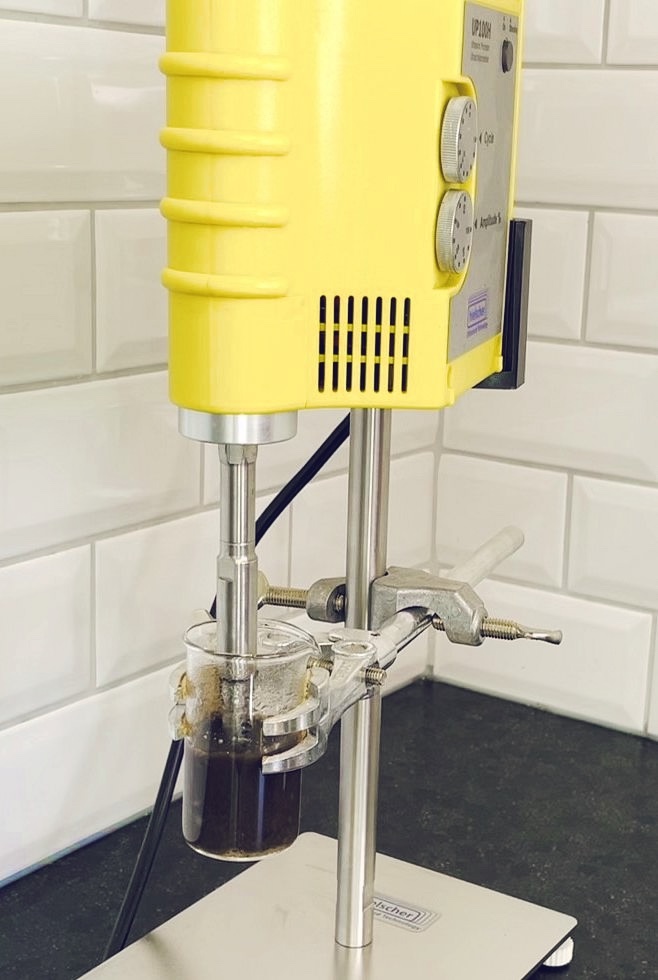 Ultrasonic palladium nanoparticle reduction offers a fast, reagent-efficient route to Pd(0) nanoparticles by using acoustic cavitation to generate localized high-energy conditions and reducing radicals in solution, enabling palladium ions to be reduced without conventional high-temperature processing.
A key advantage is process control: sonication time and stabilizer concentration, such as the PVP/Pd ratio, can influence whether the product forms as well-dispersed, rounded nanoparticles around 5 nm or as larger aggregates around 20 nm, which is industrially relevant because palladium performance in catalysis depends strongly on particle size, morphology, dispersion, and surface area. Since palladium nanoparticles are widely valuable as heterogeneous catalysts, electrocatalysts, and functional materials, ultrasonic reduction is attractive for producing finely dispersed Pd catalysts under comparatively mild liquid-phase conditions, with potential benefits for chemical synthesis, environmental catalysis, fuel-cell technologies, and other processes where high catalytic activity and efficient noble-metal utilization are economically important.

Industrial nanoparticle processing با سونیکاتور UIP2000hdT
Sample Preparation Procedure
نمونه ها به شرح زیر تهیه شدند:
برای نمونه ها، مخلوطی از 30 میلی لیتر EG و 5·10-6mol of PVP were preprared by magnetic stirring for 15 min. For the different samples, different amount of Pd(NO₃)₂ solution, 1.5mL and 2mL, were added. The sample mixtures were prepared with the ratio of 2·10-3mol Pd(NO₃)₂ in sample (a) and 2.66·10-3mol Pd(NO₃)₂ in sample (b). Both mixtures were sonicated in a 20mL vial using a probe-type ultrasonicator. Samples were taken after sonication times of 30, 60, 90, 120, 150, and 180 min.
تجزیه و تحلیل نتایج تجربی نشان می دهد که:
- 1. کاهش سونوشیمیایی Pd (II) به Pd (0) بستگی به زمان فراصوت دارد.
- 2. نسبت مولی بالای PVP/Pd(II) منجر به تشکیل ذرات پالادیوم تک پراکنده با شکل گرد و قطر متوسط حدود 5 نانومتر می شود.
- 3. با این حال، نسبت مولی PVP/Pd(II) پایین شامل به دست آوردن نانوذرات پالادیوم سنگدانه با توزیع اندازه بزرگ در مرکز 20 نانومتر است.
مسیر سونوشیمیایی کاهش یون های پالادیوم (II) Pd(II) به اتم های پالادیوم Pd(0) می توان موارد زیر را فرض کرد:
- (1) Water pyrolysis: H₂O → •OH+•H
- (2) Radical formation: RH (Reducing agent) + •OH(•H) → •R + H₂O(H₂)
- (3) کاهش یون: Pd(II) + رادیکال های کاهنده (•H، •R) → Pd(0) + R•CHO + H+
- (4) تشکیل ذرات: NPd(0) → Pdn
نتیجه: بسته به نسبت PVP/Pd(II)، Pd پراکنده یا انباشته شدهN به دست آمد.
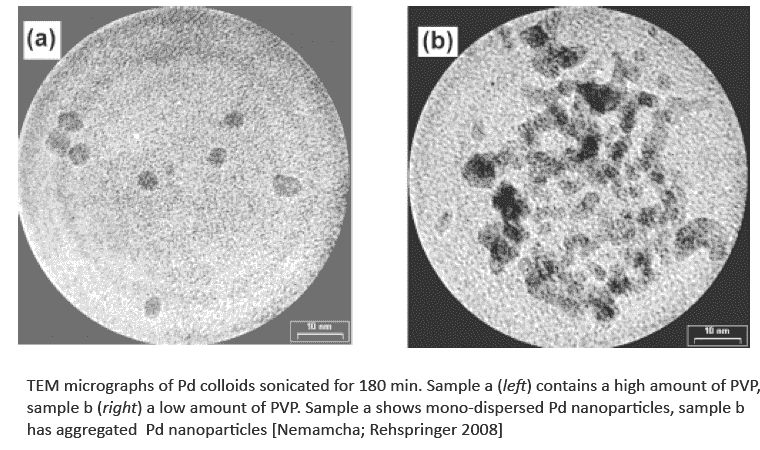
Sonochemical reduction of Palladium: sample a (left) contains a high amount of PVP, sample b (right) a low amount of PVP. Sonication time with UP100H: 180 min. Sample a shows mono dispersed Pd nano particles, sample b aggregated Pd nano particles.
Images and study: ©Nemamcha and Rehspringer, 2008
تجزیه و تحلیل و نتایج
تجزیه و تحلیل جذب قابل مشاهده UV تأیید رابطه بین کاهش سونوشیمیایی یون های پالادیوم (II) به اتم های پالادیوم (0) و زمان ماندگاری در میدان اولتراسونیک است. کاهش یون های پالادیوم (II) به اتم های پالادیوم (0) پیشرفت می کند و می تواند به طور کامل با افزایش زمان فراصوت به دست آورد. میکروگراف های میکروسکوپ الکترونی عبوری (TEM) نشان می دهد که:
- زمانی که مقدار زیادی PVP اضافه شود، کاهش سونوشیمیایی یونهای پالادیم منجر به تشکیل ذرات پالادیم مونوذرهای با شکل کروی و قطر متوسط تقریباً ۵ نانومتر میشود.
- استفاده از مقدار کمی PVP منجر به بهدست آوردن نانوذرات پالادیم به صورت تودهای میشود. اندازهگیریهای پراکندگی نور دینامیکی (DLS) نشان میدهد که تودههای نانوذرات پالادیم دارای توزیع اندازه بزرگی هستند که مرکز آن حدود ۲۰ نانومتر است.

سونیکاتور آزمایشگاهی UP100H برای تهیه نانوذرات پالادیم استفاده شده است.

پالادیوم (Pd) نانو ذرات را می توان با فراصوت تهیه
طراحی، ساخت و مشاوره – کیفیت ساخت آلمان
مافوق صوت Hielscher به خوبی برای بالاترین کیفیت و استانداردهای طراحی خود را شناخته شده. استحکام و بهره برداری آسان اجازه می دهد تا ادغام صاف از ultrasonicators ما به امکانات صنعتی. شرایط خشن و محیط های خواستار به راحتی توسط مافوق صوت Hielscher رسیده.
Hielscher اولتراسونیک یک شرکت دارای گواهینامه ISO است و تاکید ویژه ای بر مافوق صوت با کارایی بالا با ویژگی های دولت از هنر فن آوری و کاربر پسند قرار داده است. البته، مافوق صوت Hielscher مطابق با CE و دیدار با الزامات UL، CSA و RoHs.
ادبیات/منابع
- Nemamcha, A.; Rehspringer, J. L. (2008): Morphology of dispersed and aggregated PVV-Pd nanoparticles prepared by ultrasonic irradiation of Pd(NO₃)₂ solution in ethylene glycol. Rev. Adv. Mater. Sci. 18;2008. 685-688.
- Prekob, Á., Muránszky, G., Kocserha, I. et al. (2020): Sonochemical Deposition of Palladium Nanoparticles Onto the Surface of N-Doped Carbon Nanotubes: A Simplified One-Step Catalyst Production Method. Catalysis Letters 150, 2020. 505–513.
- Haitao Zheng, Mphoma S. Matseke, Tshimangadzo S. Munonde (2019): The unique Pd@Pt/C core-shell nanoparticles as methanol-tolerant catalysts using sonochemical synthesis. Ultrasonics Sonochemistry, Volume 57, 2019. 166-171.
حقایقی که ارزش دانستن دارند
پالادیم چیست؟
پالادیم یک فلز گرانبهای کمیاب و سفید نقرهای با نماد شیمیایی Pd و عدد اتمی ۴۶ است. این فلز به گروه فلزات پلاتین تعلق دارد و به دلیل پایداری شیمیایی، رسانایی الکتریسیته، جذب هیدروژن و عملکرد بهعنوان یک کاتالیزور عالی ارزشمند است. پالادیم خرد شده بهویژه برای واکنشهای هیدروژناسیون و دهیدروژناسیون مؤثر است و پالادیم حرارت داده شده میتواند اجازه دهد هیدروژن از آن عبور کند که این ویژگی آن را برای جداسازی و تصفیه هیدروژن مفید میسازد.
نانومواد پالادیم برای چه استفاده میشوند؟
Palladium nanoparticles are used mainly as high-surface-area catalysts. Because nanoparticles expose far more active surface area than bulk palladium, they can improve catalyst efficiency and reduce the amount of expensive noble metal required. Typical applications include chemical synthesis, hydrogenation reactions, carbon–carbon coupling reactions, electrocatalysis, fuel-cell research, hydrogen sensing and storage, environmental catalysis, and some biomedical research areas such as antimicrobial, photothermal, and anticancer systems. Palladium catalytic behavior depends strongly on particle size, morphology, and dispersion.
Palladium nanoparticles are also used to dope other particles in order to achieve catalytic functionalities. بیشتر بخوانید درباره مسیر اولتراسونیک برای سنتز Pd/N-BCNT به عنوان کاتالیست فیشر-تراپش!
آیا پالادیوم سمی است؟
Elemental metallic palladium is generally considered to have low toxicity and no known biological role, but palladium compounds, salts, dusts, and nanoscale forms should be handled carefully. Occupational or laboratory exposure can cause irritation or sensitization depending on the compound and route of exposure, and palladium chloride solutions, for example, may irritate mucous membranes. For industrial handling, the practical answer is: bulk metallic palladium is relatively low-risk, but palladium powders, soluble palladium salts, and palladium nanoparticles should be treated as potentially hazardous materials, with dust control, ventilation, gloves, eye protection, and proper waste handling.