Ultrazvočno intenzivirani reaktorji s fiksno plastjo
Ultrazvok lahko izboljša katalitične reakcije v reaktorjih s fiksnim ležiščem predvsem s pospešitvijo prenosa mase okoli in znotraj ležišča pakiranega katalizatorja. Poleg tega ultrazvok odstrani pasivacijske in obloge s površine katalizatorja, s čimer katalizator neprekinjeno regenerira.
Kako ultrazvok izboljša katalizo v fiksnem sloju
V reaktorju s fiksnim ležiščem ostanejo delci katalizatorja na mestu, medtem ko skozi ležišče tečejo tekoči, plinasti ali večfazni reaktanti. Učinkovitost reakcije pogosto omejujejo zunanji prenos mase, difuzija skozi pore, kanalizacija, obloge in gradienti prenosa toplote. Ultrazvok lahko zmanjša več teh omejitev z ustvarjanjem akustične kavitacije, mikrotovora, strižnih sil in nihanj tlaka.

Sonicator UIP2000hdT vgrajen v reaktor s fiksnim ležiščem
Ključni učinki reakcij v fiksnem ležišču, okrepljenih z ultrazvokom
- Izboljšan zunanji prenos mase: Ultrazvočno mikropretok zmanjša zastojni mejni sloj okoli katalitičnih delcev, kar omogoča, da reaktanti učinkoviteje dosežejo aktivna mesta.
- Izboljšana dostopnost por: Nihanja tlaka in gibanje tekočine, ki jih povzroča kavitacija, lahko izboljšajo prodiranje reaktantov v pore katalizatorja in odstranjevanje produktov iz por.
- Zmanjšanje oblog in pasivacija: Ultrazvok lahko pomaga pri odstranjevanju usedlin, polimernih filmov, predhodnikov koksiranja ali drugih pasivnih plasti s površin katalizatorjev, s čimer se katalitična aktivnost ohrani dlje časa.
- Zmanjšano kanaliziranje v nabitih slojih: V raziskavah z mikropakiranim ležiščem se je pokazalo, da ultrazvok spreminja lastnosti toka in zmanjšuje disperzijo, s čimer reaktorju pomaga doseči bolj idealno obnašanje v obliki čepnega toka.
- Izboljšan prenos toplote: Akustično pretakanje in turbulenca izboljšujeta lokalno odvajanje toplote, s čimer se zmanjšujejo vroče točke ali hladne cone v katalitski postelji.
- Višja stopnja konverzije in donos: Z izboljšanjem prenosa snovi in dostopnosti katalizatorja lahko ultrazvok poveča reakcijsko hitrost, stopnjo pretvorbe in izkoristek produkta, zlasti kadar je reakcija omejena s transportom in ne zgolj s kinetiko.
Izboljšan stik med tekočino in trdno snovjo: Ultrazvok omogoča boljše navlaževanje delcev katalizatorja, kar je še posebej koristno v sistemih s kapljalnim ležiščem, sistemih z dovajanjem suspenzije ali sistemih s fiksnim ležiščem v tekoči fazi.
Kako ultrazvok izboljša katalizo v fiksnem sloju?
Glavni mehanizem je akustična kavitacija: ultrazvočni valovi ustvarjajo mikroskopske mehurčke, ki se hitro večajo in nato nasilno razpadajo. Njihov razpad povzroča lokalno strižno silo, mikro curke, udarne valove in intenzivno mešanje. V bližini površin katalizatorjev lahko ti učinki očistijo, aktivirajo in osvežijo mejno ploskev med trdno snovjo in tekočino. V preglednih člankih o sonokatalizi to opisujejo kot sinergijo med ultrazvokom in trdnimi katalizatorji, ki vključuje izboljšani prenos toplote, prenos mase in lokalizirane učinke na katalitičnih površinah.
Ultrazvok je najbolj koristen, kadar pri reakciji v fiksnem ležišču pride do naslednjih težav:
- počasna difuzija v pore katalizatorja,
- slabo navlaževanje delcev katalizatorja,
- nalaganje izdelka v pore,
- nalaganje nečistoč ali pasiviranje površine,
- kinetika, omejena s prenosom mase,
- neenakomerna porazdelitev večfaznega toka,
- pretok skozi nabito ležišče.
Katalizatorji s fiksno plastjo
Fiksne plasti (včasih imenovane tudi pakirana postelja) so običajno obremenjene s katalizatorskimi peleti, ki so običajno granule s premerom od 1 do 5 mm. V reaktor se lahko naložijo v obliki ene postelje, kot ločene lupine ali v ceveh. Katalizatorji večinoma temeljijo na kovinah, kot so nikelj, baker, osmij, platina in rodij.
Učinki močnega ultrazvoka na heterogene kemijske reakcije so dobro znani in se pogosto uporabljajo v industrijskih katalitičnih procesih. Tudi katalitične reakcije v reaktorju s fiksnim ležiščem imajo koristi od obdelave z ultrazvokom. Ultrazvočno obsevanje katalizatorja s fiksnim ležiščem ustvarja visoko reaktivne površine, poveča prenos mase med tekočo fazo (reaktanti) in katalizatorjem ter odstrani pasivacijske prevleke (npr. oksidne plasti) s površine.
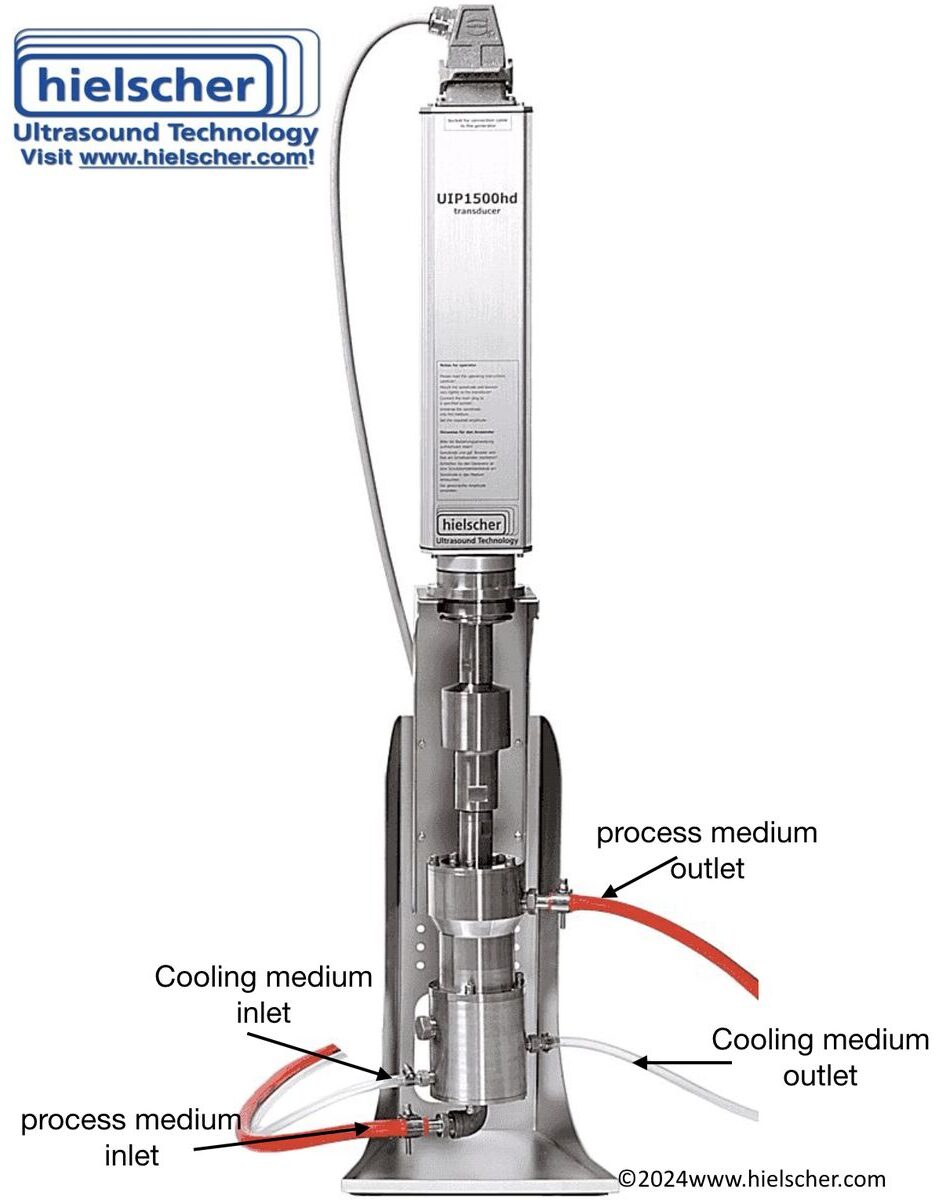
Sonicator UIP1500hdT s pretočno celico za reaktivacijo in recikliranje izrabljenih katalizatorjev
- Izboljšana učinkovitost
- Povečana reaktivnost
- Povečana stopnja konverzije
- Višji donos
- Recikliranje katalizatorja
Ultrazvočna intenzifikacija katalitičnih reakcij
Ultrazvočno mešanje in mešanje izboljšuje stik med delci reaktanta in katalizatorja, ustvarja visoko reaktivne površine in sproži in / ali izboljša kemično reakcijo.
Ultrazvočna priprava katalizatorja lahko povzroči spremembe v obnašanju kristalizacije, disperziji / deaglomeraciji in površinskih lastnostih. Poleg tega lahko na lastnosti predhodno oblikovanih katalizatorjev vpliva odstranjevanje pasivizirajočih površinskih plasti, boljša disperzija, povečanje prenosa mase.
Primeri reakcij, izboljšanih z ultrazvokom
- Ultrazvočna predobdelava Ni katalizatorja za reakcije hidrogeniranja
- Sonicated Raney Ni katalizator z vinsko kislino povzroči zelo visoko enantioselektivnost
- Ultrazvočno sintetizirani Fischer-Tropschovi katalizatorji
- Sonokemično obdelani amorfni praškasti katalizatorji za povečano reaktivnost
- Sonosinteza amorfnih kovinskih prahov
Ultrazvočno izterjava katalizatorja
Trdni katalizatorji v reaktorjih s fiksnim ležiščem se običajno uporabljajo v obliki kroglic, peletov, ekstrudatov ali cilindričnih delcev. Med kemijskimi reakcijami se lahko površina katalizatorja pasivira zaradi obloge, kar sčasoma povzroči postopno izgubo katalitične aktivnosti in/ali selektivnosti.
Časovni okvir deaktivacije katalizatorja se precej razlikuje. Na primer, deaktivacija katalizatorja za kreking se lahko zgodi v nekaj sekundah, medtem ko lahko železov katalizator, ki se uporablja pri sintezi amoniaka, ostane aktiven 5–10 let. Kljub temu se deaktivacija katalizatorja pojavlja praktično v vseh katalitičnih procesih. Čeprav lahko pride do različnih mehanizmov deaktivacije – vključno s kemičnim, mehanskim in toplotnim razpadom – nalaganje je eden najpogostejših vzrokov za izgubo učinkovitosti katalizatorja.
Zamašitev pomeni fizično odlaganje snovi iz tekoče faze na površino katalizatorja in v njegove pore. Ti usedlini blokirajo reaktivna mesta, omejujejo dostopnost por in zmanjšujejo stik med reaktanti in aktivno površino katalizatorja. Zamašitev katalizatorja s koksom ali ogljikovimi usedlinami je pogosto hiter proces; vendar jo je v mnogih primerih mogoče delno ali v celoti odpraviti z ultrazvočno regeneracijo.
Ultrazvočna kavitacija je učinkovita metoda za odstranjevanje pasivnih oblog iz površin katalizatorjev. Med ultrazvočno obdelavo visokointenzivni ultrazvok v tekočem mediju ustvarja kavitacijske mehurčke. Njihov kolaps povzroča lokalizirane strižne sile, mikrostruge, udarne valove in intenzivno mikromešanje. Ti učinki pomagajo odstraniti obloge s površine katalizatorja, ponovno odpreti zamašene pore in ponovno vzpostaviti dostop do aktivnih mest.
Ultrazvočna regeneracija katalizatorja se običajno izvaja tako, da se delci katalizatorja dispergirajo v tekočini, kot je deionizirana voda ali primerno topilo, in da se suspenzija izpostavi nadzorovani ultrazvočni obdelavi. S tem postopkom je mogoče odstraniti ostanke oblog z različnih katalizatorskih materialov, vključno s katalizatorji iz platine in silicijevih vlaken, nikljevimi katalizatorji ter drugimi katalizatorji na nosilcu. Posledično lahko ultrazvočna obdelava prispeva k regeneraciji katalizatorja, podaljšanju njegove življenjske dobe in izboljšanju trajnosti procesa.
Kliknite tukaj, da izveste več o ultrazvočni regeneraciji izrabljenih katalizatorjev!
Ultrazvočni generatorji za vgradnjo v kemijske reaktorje
 Hielscher Ultrasonics ponuja različne ultrazvočne procesorje in različice za integracijo ultrazvoka moči v reaktorje s fiksno posteljo. Na voljo so različni ultrazvočni sistemi za vgradnjo v reaktorje s fiksno posteljo. Za bolj kompleksne tipe reaktorjev ponujamo Prilagojena ultrazvočna Rešitve.
Preberite, kako ultrazvok izboljša kemijske reakcije v različnih tipih reaktorjev!
Če želite preizkusiti vpliv ultrazvoka na vašo kemijsko reakcijo, vas vabimo, da obiščete naš laboratorij za ultrazvočne procese in tehnični center v Teltowu!
Kontaktirajte nas še danes! Z veseljem se bomo z vami pogovorili o ultrazvočni intenzifikaciji vašega kemičnega procesa!
V spodnji tabeli je prikazana približna zmogljivost obdelave Hielscherjevih sonikatorjev:

Ultrazvočni pretočni sistem
- hidrogeniranje
- Alcylacija
- Cianina
- Eterifikacija
- esterifikacija
- polimerizacija
- Alilacija
- Bromacija
(npr. Ziegler-Nattovi katalizatorji, metaloceni)
Literatura / Reference
- Francisco J. Navarro-Brull; Andrew R. Teixeira; Jisong Zhang; Roberto Gómez; Klavs F. Jensen (2018): Reduction of Dispersion in Ultrasonically-Enhanced Micropacked Beds. Industrial & Engineering Chemistry Research 57, 1; 2018. 122–128.
- Yasuo Tanaka (2002): A dual purpose packed-bed reactor for biogas scrubbing and methane-dependent water quality improvement applying to a wastewater treatment system consisting of UASB reactor and trickling filter. Bioresource Technology, Volume 84, Issue 1, 2002. 21-28.
- Argyle, M.D.; Bartholomew, C.H. (2015): Heterogeneous Catalyst Deactivation and Regeneration: A Review. Catalysts 2015, 5, 145-269.
- Oza, R.; Patel, S. (2012): Recovery of Nickel from Spent Ni/Al2O3 Catalysts using Acid Leaching, Chelation and Ultrasonication. Research Journal of Recent Sciences Vol. 1; 2012. 434-443.
- Sana, S.; Rajanna, K.Ch.; Reddy, K.R.; Bhooshan, M.; Venkateswarlu, M.; Kumar, M.S.; Uppalaiah, K. (2012): Ultrasonically Assisted Regioselective Nitration of Aromatic Compounds in Presence of Certain Group V and VI Metal Salts. Green and Sustainable Chemistry, 2012, 2, 97-111.
- Suslick, K. S.; Skrabalak, S. E. (2008): “Sonocatalysis” In: Handbook of Heterogeneous Catalysis, vol. 4; Ertl, G.; Knözinger, H.; Schüth, F.; Weitkamp, J., (Eds.). Wiley-VCH: Weinheim, 2008. 2006-2017.
Dejstva, ki jih je vredno vedeti
Kaj je ultrazvočna kavitacija?
Ultrazvočna kavitacija je nastajanje, rast in nasilno razpadanje mikroskopskih mehurčkov pare ali plina v tekočini, izpostavljeni ultrazvoku visoke intenzivnosti. Med razpadanjem mehurčkov lahko za zelo kratek čas nastanejo ekstremne lokalne razmere, vključno z visoko temperaturo, visokim tlakom, udarnimi valovi, mikrostrugi in intenzivnimi strižnimi silami.
Kaj je sonokemija?
Sonokemija je uporaba teh ultrazvočnih kavitacijskih učinkov za sprožanje, pospeševanje ali spreminjanje kemijskih in fizikalno-kemijskih procesov. Zlasti je pomembna v sistemih v tekoči fazi, saj kavitacija izboljša mešanje, prenos mase, emulgacijo, disperzijo delcev, čiščenje površine katalizatorja in v nekaterih primerih tudi nastajanje radikalov. Zato se sonokemija uporablja za pospeševanje reakcij, kot so heterogena kataliza, oksidacija, ekstrakcija, polimerizacija, kristalizacija in sinteza nanomaterialov.
Kaj je heterogena katalitična reakcija?
V kemiji se heterogena kataliza nanaša na vrsto katalitične reakcije, kjer se faze katalizatorja in reaktantov med seboj razlikujejo. V kontekstu heterogene kemije se faza ne uporablja le za razlikovanje med trdno, tekočo in plinasto, ampak se nanaša tudi na tekočine, ki se ne mešajo, npr. olje in voda.
Med heterogeno reakcijo se eden ali več reaktantov kemično spremeni na vmesniku, npr. na površini trdnega katalizatorja.
Hitrost reakcije je odvisna od koncentracije reaktantov, velikosti delcev, temperature, katalizatorja in drugih dejavnikov.
Koncentracija reaktanta: Na splošno povečanje koncentracije reaktanta poveča hitrost reakcije zaradi večjega vmesnika in s tem večjega faznega prenosa med delci reaktanta.
Velikost delcev: Če je eden od reaktantov trdni delec, ga ni mogoče prikazati v enačbi hitrosti, saj enačba hitrosti prikazuje samo koncentracije, trdne snovi pa ne morejo imeti koncentracije, ker so v drugi fazi. Vendar pa velikost delcev trdne snovi vpliva na hitrost reakcije zaradi razpoložljive površine za prenos faze.
Reakcijska temperatura: Temperatura je povezana s konstanto hitrosti prek Arrheniusove enačbe: k = Ae-Ea/RT
Kjer je Ea aktivacijska energija, je R univerzalna plinska konstanta in T je absolutna temperatura v Kelvinih. A je Arrheniusov (frekvenčni) faktor. e-Ea/RT daje število delcev pod krivuljo, ki imajo energijo, večjo od aktivacijske energije, Ea.
Katalizator: V večini primerov se reakcije pojavijo hitreje s katalizatorjem, ker zahtevajo manj aktivacijske energije. Heterogeni katalizatorji zagotavljajo površino šablone, na kateri poteka reakcija, medtem ko homogeni katalizatorji tvorijo vmesne produkte, ki sproščajo katalizator v naslednjem koraku mehanizma.
Drugi dejavniki: Drugi dejavniki, kot je svetloba, lahko vplivajo na določene reakcije (fotokemija).
Kakšne so vrste deaktivacije katalizatorja?
- Zastrupitev s katalizatorjem je izraz za močno kemisorpcijo vrst na katalitičnih mestih, ki blokirajo mesta za katalitično reakcijo. Zastrupitev je lahko reverzibilna ali nepovratna.
- Obraščanje se nanaša na mehansko razgradnjo katalizatorja, kjer se vrste iz tekoče faze odlagajo na katalitično površino in v pore katalizatorja.
- Toplotna razgradnja in sintranje povzročita izgubo katalitske površine, podporne površine in aktivnih fazno-podpornih reakcij.
- Nastajanje hlapov pomeni kemično razgradno obliko, pri kateri plinska faza reagira s katalizatorsko fazo in nastane hlapne spojine.
- Reakcije para-trdna snov in trdna snov povzročijo kemično deaktivacijo katalizatorja. Para, podpora ali promotor reagirajo s katalizatorjem, tako da nastane neaktivna faza.
- Izčrpavanje ali drobljenje delcev katalizatorja povzroči izgubo katalitskega materiala zaradi mehanske obrabe. Notranja površina katalizatorja se izgubi zaradi mehansko povzročenega drobljenja delcev katalizatorja.
Preberite več o tem, kako lahko ultrazvok ponovno aktivira izrabljene katalizatorje!
Kaj je nukleofilna substitucija?
Nukleofilna substitucija je temeljna skupina reakcij v organski (in anorganski) kemiji, v kateri se nukleofil selektivno veže v obliki Lewisove baze (kot donator elektronskega para) z organskim kompleksom, ki ima pozitivni ali delno pozitivni (+) naboja atoma ali skupine atomov, da nadomesti odhajajočo skupino. Pozitivni ali delno pozitivni atom, ki je akceptor elektronskega para, se imenuje elektrofil. Celotna molekulska enota elektrofila in odhajajoče skupine se običajno imenuje substrat.
Nukleofilno substitucijo lahko opazimo kot dve različni poti – SN1 in SN2 reakcija. Katera oblika reakcijskega mehanizma – sN1 ali SN2 – poteka, je odvisno od strukture kemičnih spojin, vrste nukleofila in topila.