Sonochemische reductie van palladium nanodeeltjes
Palladium (Pd) staat bekend om zijn katalytische eigenschappen en wordt ook op grote schaal gebruikt in materiaalonderzoek, de elektronica-industrie, de geneeskunde, waterstofzuivering en diverse chemische toepassingen. Via een sonochemische methode kunnen de grootte en morfologie van palladiumdeeltjes worden geregeld door de PVP/Pd-verhouding aan te passen. Dit maakt de ultrasone synthese mogelijk van zowel zeer fijne, monodisperse nanodeeltjes als grotere palladiumaggregaten, waardoor de deeltjesafmetingen kunnen worden afgestemd op optimale katalytische prestaties.
Ultrasone productie van Palladium nanodeeltjes
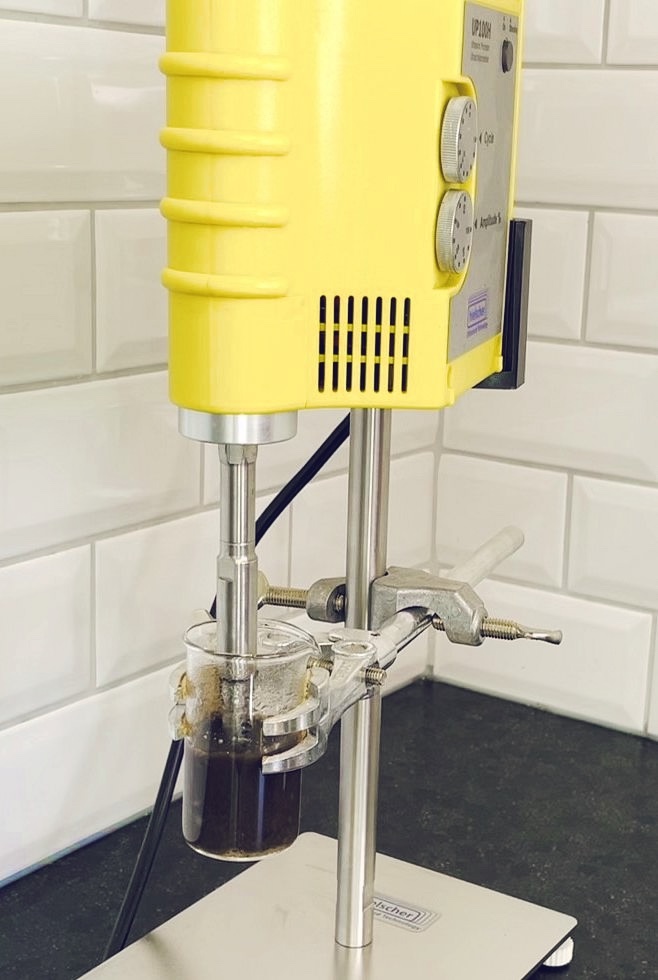 De reductie van palladium-nanodeeltjes met behulp van ultrasone golven biedt een snelle, reagenszuinige methode voor het verkrijgen van Pd(0)-nanodeeltjes, waarbij akoestische cavitatie wordt gebruikt om plaatselijk omstandigheden met hoge energie te creëren en radicalen in de oplossing te reduceren, waardoor palladiumionen kunnen worden gereduceerd zonder de gebruikelijke verwerking bij hoge temperaturen.
Een belangrijk voordeel is de procescontrole: de ultrasone bewerkingstijd en de stabilisatorconcentratie, zoals de PVP/Pd-verhouding, kunnen beïnvloeden of het product zich vormt als goed gedispergeerde, ronde nanodeeltjes van ongeveer 5 nm of als grotere aggregaten van ongeveer 20 nm. Dit is industrieel relevant omdat de prestaties van palladium bij katalyse sterk afhangen van de deeltjesgrootte, morfologie, dispersie en het oppervlak. Aangezien palladiumnanodeeltjes op grote schaal waardevol zijn als heterogene katalysatoren, elektrokatalysatoren en functionele materialen, is ultrasone reductie aantrekkelijk voor de productie van fijn gedispergeerde Pd-katalysatoren onder relatief milde vloeistoffaseomstandigheden, met potentiële voordelen voor chemische synthese, milieukatalyse, brandstofceltechnologieën en andere processen waarbij een hoge katalytische activiteit en efficiënt gebruik van edelmetalen economisch belangrijk zijn.

Industriële verwerking van nanodeeltjes met de sonicator UIP2000hdT
Procedure voor de voorbereiding van monsters
De monsters werden als volgt bereid:
Voor de monsters werden mengsels van 30 ml EG en 5-10 ml EG gebruikt.-6mol PVP werd bereid door 15 minuten lang magnetisch te roeren. Aan de verschillende monsters werden verschillende hoeveelheden Pd(NO₃)₂-oplossing toegevoegd, namelijk 1,5 mL en 2 mL. De monstermengsels werden bereid in een verhouding van 2·10-3mol Pd(NO₃)₂ in monster (a) en 2,66·10-3mol Pd(NO₃)₂ in monster (b). Beide mengsels werden in een flesje van 20 mL met behulp van een ultrasoonapparaat met sonde aan ultrasone trillingen blootgesteld. Er werden monsters genomen na een ultrasone behandeling van 30, 60, 90, 120, 150 en 180 min.
De analyse van de experimentele resultaten laat zien dat:
- 1. De sonochemische reductie van Pd(II) tot Pd(0) hangt af van de sonificatietijd.
- 2. De hoge molaire verhouding PVP/Pd(II) leidt tot de vorming van monodisperse palladiumdeeltjes met een afgeronde vorm en een gemiddelde diameter van ongeveer 5 nm.
- 3. Echter, de lage PVP/Pd(II) molaire verhouding brengt het verkrijgen van aggregaten palladium nanodeeltjes met een grote grootteverdeling gecentreerd op 20nm.
De sonochemische route van het reduceren van palladium (II) ionen Pd(II) aan palladiumatomen Pd(0) kan als volgt worden aangenomen:
- (1) Pyrolyse van water: H₂O → •OH + •H
- (2) Vorming van radicalen: RH (reductiemiddel) + •OH(•H) → •R + H₂O(H₂)
- (3) Vermindering van ionen: Pd(II) + reducerende radicalen (-H, -R) → Pd(0) + R-CHO + H+
- (4) Deeltjesvorming: NPd(0) → Pdn
Resultaat: Afhankelijk van de verhouding PVP/Pd(II), gedispergeerd of geaggregeerd PdN werden verkregen.
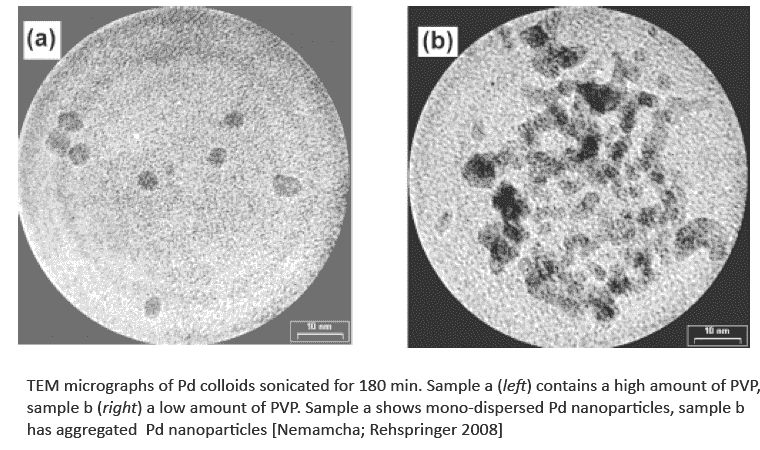
Sonochemische reductie van palladium: monster a (links) bevat een hoge hoeveelheid PVP, monster b (rechts) een lage hoeveelheid PVP. Ultrasone behandelingstijd met de UP100H: 180 min. Monster a vertoont monodisperse Pd-nanodeeltjes, monster b geaggregeerde Pd-nanodeeltjes.
Afbeeldingen en onderzoek: ©Nemamcha en Rehspringer, 2008
Analyse en resultaten
De UV-zichtbaarheidsabsorptieanalyses bevestigen het verband tussen de sonochemische reductie van palladium(II)-ionen tot palladium(0)-atomen en de retentietijd in het ultrasone veld. De reductie van palladium(II)ionen tot palladium(0)atomen vordert en kan volledig worden bereikt met toenemende sonificatietijd. De microfoto's van transmissie-elektronenmicroscopie (TEM) laten zien dat:
- Wanneer een grote hoeveelheid PVP wordt toegevoegd, leidt de sonochemische reductie van palladiumionen tot de vorming van monodisperse palladiumdeeltjes met een bolvorm en een gemiddelde diameter van ongeveer 5 nm.
- Door het gebruik van een kleine hoeveelheid PVP ontstaan aggregaten van palladium-nanodeeltjes. Uit metingen met dynamische lichtverstrooiing (DLS) blijkt dat de aggregaten van palladium-nanodeeltjes een brede grootteverdeling hebben met een piek bij 20 nm.

De laboratorium-sonicator UP100H is gebruikt voor de bereiding van palladiumnanodeeltjes.

Palladium (Pd) nanodeeltjes kunnen worden bereid door sonicatie
Ontwerp, productie en advies – Kwaliteit Made in Germany
Hielscher ultrasone machines staan bekend om hun hoge kwaliteit en ontwerpnormen. Robuustheid en eenvoudige bediening zorgen voor een soepele integratie van onze ultrasoonapparatuur in industriële faciliteiten. Ruwe omstandigheden en veeleisende omgevingen worden gemakkelijk door Hielscher ultrasoontoestellen aangepakt.
Hielscher Ultrasonics is een ISO-gecertificeerd bedrijf en legt speciale nadruk op hoogwaardige ultrasone apparaten met state-of-the-art technologie en gebruiksvriendelijkheid. Uiteraard zijn de Hielscher ultrasoonapparaten CE-conform en voldoen ze aan de eisen van UL, CSA en RoHs.
Literatuur/referenties
- Nemamcha, A.; Rehspringer, J. L. (2008): Morphology of dispersed and aggregated PVV-Pd nanoparticles prepared by ultrasonic irradiation of Pd(NO₃)₂ solution in ethylene glycol. Rev. Adv. Mater. Sci. 18;2008. 685-688.
- Prekob, Á., Muránszky, G., Kocserha, I. et al. (2020): Sonochemical Deposition of Palladium Nanoparticles Onto the Surface of N-Doped Carbon Nanotubes: A Simplified One-Step Catalyst Production Method. Catalysis Letters 150, 2020. 505–513.
- Haitao Zheng, Mphoma S. Matseke, Tshimangadzo S. Munonde (2019): The unique Pd@Pt/C core-shell nanoparticles as methanol-tolerant catalysts using sonochemical synthesis. Ultrasonics Sonochemistry, Volume 57, 2019. 166-171.
Wetenswaardigheden
Wat is palladium?
Palladium is een zeldzaam, zilverwit edelmetaal met het chemisch symbool Pd en atoomnummer 46. Het behoort tot de platinagroepmetalen en wordt gewaardeerd vanwege zijn chemische stabiliteit, zijn elektrische geleidbaarheid, zijn vermogen om waterstof te absorberen en zijn uitstekende katalytische eigenschappen. Fijn verdeeld palladium is bijzonder effectief bij hydrogenerings- en dehydrogeneringsreacties, en wanneer palladium wordt verwarmd, kan waterstof erdoorheen diffunderen, waardoor het bruikbaar is voor de scheiding en zuivering van waterstof.
Waarvoor worden palladiumnanodeeltjes gebruikt?
Palladium-nanodeeltjes worden voornamelijk gebruikt als katalysatoren met een groot oppervlak. Omdat nanodeeltjes een veel groter actief oppervlak hebben dan palladium in bulkvorm, kunnen ze de efficiëntie van de katalysator verbeteren en de benodigde hoeveelheid duur edelmetaal verminderen. Typische toepassingen zijn onder meer chemische synthese, hydrogeneringsreacties, koolstof-koolstof-koppelingsreacties, elektrokatalyse, onderzoek naar brandstofcellen, waterstofdetectie en -opslag, milieukatalyse en bepaalde biomedische onderzoeksgebieden, zoals antimicrobiële, fotothermische en antikankersystemen. Het katalytische gedrag van palladium hangt sterk af van de deeltjesgrootte, morfologie en dispersie.
Palladium-nanodeeltjes worden ook gebruikt om andere deeltjes te doteren, teneinde katalytische eigenschappen te verkrijgen. Lees meer over de ultrasone methode voor de synthese van Pd/N-BCNT als Fischer-Tropsch-katalysator!
Is palladium giftig?
Elementair metallisch palladium wordt over het algemeen beschouwd als weinig giftig en zonder bekende biologische functie, maar met palladiumverbindingen, zouten, stof en vormen op nanoschaal moet voorzichtig worden omgegaan. Blootstelling op het werk of in het laboratorium kan, afhankelijk van de verbinding en de blootstellingsroute, irritatie of sensibilisatie veroorzaken; zo kunnen bijvoorbeeld palladiumchlorideoplossingen de slijmvliezen irriteren. Voor industriële verwerking luidt het praktische antwoord: metallisch palladium in bulk vormt een relatief laag risico, maar palladiumpoeders, oplosbare palladiumzouten en palladiumnanodeeltjes moeten worden behandeld als potentieel gevaarlijke stoffen, met stofbeheersing, ventilatie, handschoenen, oogbescherming en een juiste afvalverwerking.