Reduksi Sonokimia Nanopartikel Paladium
Palladium (Pd) terkenal karena sifat katalitiknya dan juga banyak digunakan dalam penelitian material, manufaktur elektronik, kedokteran, pemurnian hidrogen, serta berbagai aplikasi kimia. Dengan menggunakan metode sonokimia, ukuran dan morfologi partikel palladium dapat dikendalikan melalui penyesuaian rasio PVP/Pd. Hal ini memungkinkan sintesis ultrasonik baik nanopartikel yang sangat halus dan monodisperse maupun agregat palladium yang lebih besar, sehingga dimensi partikel dapat disesuaikan untuk kinerja katalitik yang optimal.
Produksi Ultrasonik Nanopartikel Paladium
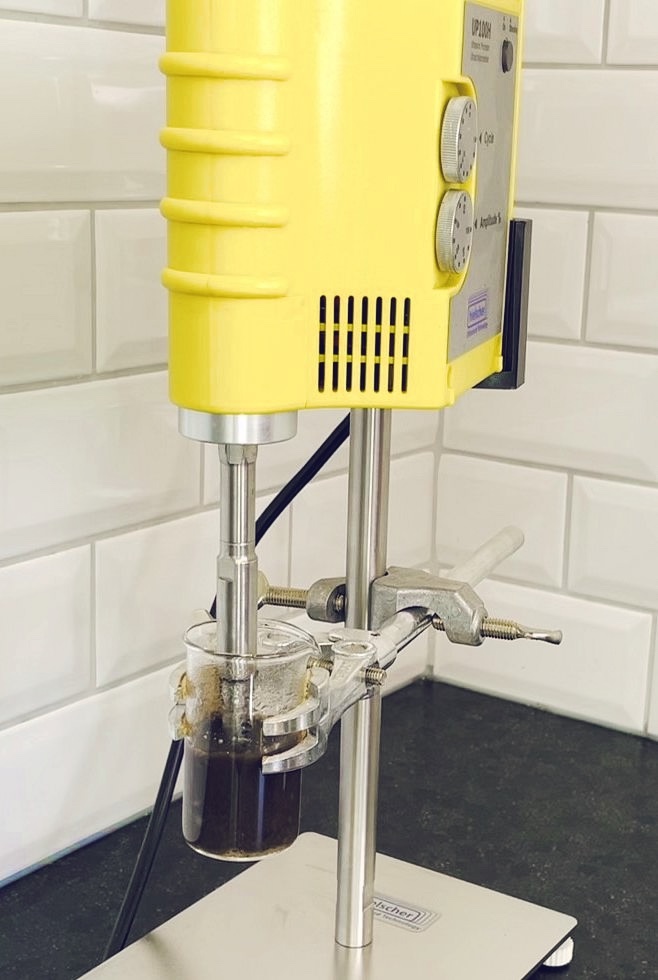 Reduksi nanopartikel paladium dengan ultrasonik menawarkan cara yang cepat dan hemat reagen untuk menghasilkan nanopartikel Pd(0) dengan memanfaatkan kavitasi akustik guna menciptakan kondisi berenergi tinggi yang terlokalisasi serta radikal reduksi dalam larutan, sehingga memungkinkan ion paladium direduksi tanpa perlu proses suhu tinggi konvensional.
Salah satu keunggulan utamanya adalah pengendalian proses: waktu sonikasi dan konsentrasi penstabil, seperti rasio PVP/Pd, dapat memengaruhi apakah produk akan terbentuk sebagai nanopartikel bulat yang terdispersi dengan baik berukuran sekitar 5 nm atau sebagai agregat yang lebih besar berukuran sekitar 20 nm, yang relevan secara industri karena kinerja paladium dalam katalisis sangat bergantung pada ukuran partikel, morfologi, dispersi, dan luas permukaan. Karena nanopartikel paladium sangat berharga sebagai katalis heterogen, elektrokatalis, dan bahan fungsional, reduksi ultrasonik menjadi metode yang menarik untuk memproduksi katalis Pd yang terdispersi halus dalam kondisi fase cair yang relatif ringan, dengan manfaat potensial bagi sintesis kimia, katalisis lingkungan, teknologi sel bahan bakar, serta proses lain di mana aktivitas katalitik tinggi dan pemanfaatan logam mulia yang efisien memiliki nilai ekonomi yang signifikan.

Pengolahan nanopartikel untuk keperluan industri dengan sonikator UIP2000hdT
Prosedur Persiapan Sampel
Sampel disiapkan sebagai berikut:
Untuk sampel, campuran 30mL EG dan 5·10-6mol PVP disiapkan melalui pengadukan magnetik selama 15 menit. Untuk sampel yang berbeda, ditambahkan larutan Pd(NO₃)₂ dalam jumlah yang berbeda, yaitu 1,5 mL dan 2 mL. Campuran sampel disiapkan dengan perbandingan 2·10-3mol Pd(NO₃)₂ dalam sampel (a) dan 2,66·10-3mol Pd(NO₃)₂ dalam sampel (b). Kedua campuran tersebut disonikasi dalam tabung berukuran 20 mL menggunakan alat sonikasi tipe probe. Sampel diambil setelah waktu sonikasi selama 30, 60, 90, 120, 150, dan 180 menit.
Analisis hasil eksperimen menunjukkan bahwa:
- 1. Reduksi sonokimia Pd (II) menjadi Pd (0) tergantung pada waktu sonikasi.
- 2. Rasio molar PVP/Pd (II) yang tinggi menyebabkan pembentukan partikel paladium monodispersi yang memiliki bentuk bulat dan diameter rata-rata sekitar 5nm.
- 3. Namun, rasio molar PVP/Pd (II) yang rendah melibatkan perolehan nanopartikel paladium agregat dengan distribusi ukuran besar yang berpusat pada 20nm.
Rute sonokimia untuk mereduksi ion paladium (II) PD(II) kepada atom paladium PD(0) dapat diasumsikan sebagai berikut:
- (1) Pirolisis air: H₂O → •OH + •H
- (2) Pembentukan radikal: RH (zat pereduksi) + •OH(•H) → •R + H₂O(H₂)
- (3) Reduksi ion: Pd (II) + radikal pereduksi (• H, • R) → Pd (0) + R • CHO + H +
- (4) Pembentukan partikel: nPd(0) → Pdn
Hasil: Tergantung pada rasio PVP/Pd (II), Pd terdispersi atau agregatn .
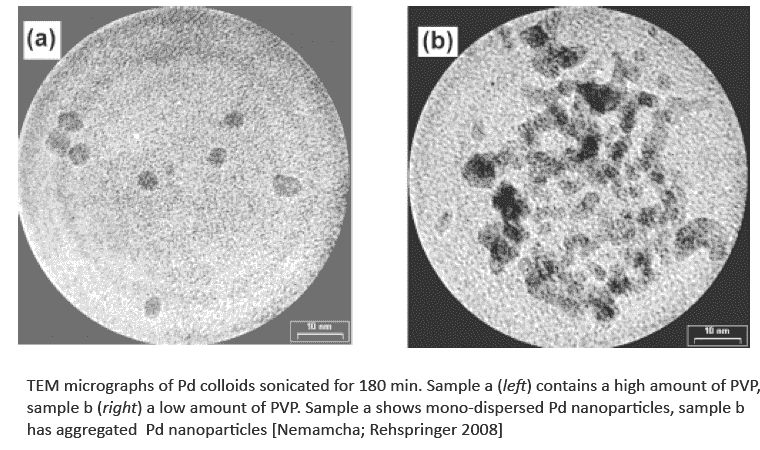
Reduksi sonokimia palladium: sampel a (kiri) mengandung PVP dalam jumlah tinggi, sedangkan sampel b (kanan) mengandung PVP dalam jumlah rendah. Waktu sonikasi dengan UP100H: 180 menit. Sampel a menunjukkan partikel nano Pd yang terdispersi secara monodispersi, sedangkan sampel b menunjukkan partikel nano Pd yang teragregasi.
Gambar dan penelitian: ©Nemamcha dan Rehspringer, 2008
Analisis dan Hasil
Analisis penyerapan UV-terlihat mengkonfirmasi hubungan antara reduksi sonokimia ion paladium (II) ke atom paladium (0) dan waktu retensi di medan ultrasonik. Pengurangan ion paladium (II) menjadi atom paladium (0) berkembang dan dapat dicapai sepenuhnya dengan peningkatan waktu sonikasi. Mikrograf mikroskop elektron transmisi (TEM) menunjukkan bahwa:
- Ketika ditambahkan PVP dalam jumlah besar, reaksi reduksi sonokimia terhadap ion paladium menghasilkan partikel paladium monodispers dengan bentuk bulat dan diameter rata-rata sekitar 5 nm.
- Penggunaan PVP dalam jumlah kecil menghasilkan agregat nanopartikel paladium. Pengukuran dinamik light scattering (DLS) menunjukkan bahwa agregat nanopartikel paladium tersebut memiliki distribusi ukuran yang luas dengan nilai tengah sebesar 20 nm.

Alat sonikasi laboratorium UP100H telah digunakan untuk pembuatan nanopartikel paladium.

Partikel nano paladium (Pd) dapat dibuat dengan sonikasi
Desain, Manufaktur, dan Konsultasi – Kualitas Buatan Jerman
Ultrasonicators Hielscher terkenal dengan kualitas dan standar desainnya yang tertinggi. Ketahanan dan pengoperasian yang mudah memungkinkan integrasi ultrasonicator kami ke dalam fasilitas industri. Kondisi kasar dan lingkungan yang menuntut mudah ditangani oleh ultrasonicator Hielscher.
Hielscher Ultrasonics adalah perusahaan bersertifikat ISO dan memberikan penekanan khusus pada ultrasonicators berkinerja tinggi yang menampilkan teknologi canggih dan keramahan pengguna. Tentu saja, ultrasonicators Hielscher sesuai dengan CE dan memenuhi persyaratan UL, CSA dan RoHs.
Literatur / Referensi
- Nemamcha, A.; Rehspringer, J. L. (2008): Morphology of dispersed and aggregated PVV-Pd nanoparticles prepared by ultrasonic irradiation of Pd(NO₃)₂ solution in ethylene glycol. Rev. Adv. Mater. Sci. 18;2008. 685-688.
- Prekob, Á., Muránszky, G., Kocserha, I. et al. (2020): Sonochemical Deposition of Palladium Nanoparticles Onto the Surface of N-Doped Carbon Nanotubes: A Simplified One-Step Catalyst Production Method. Catalysis Letters 150, 2020. 505–513.
- Haitao Zheng, Mphoma S. Matseke, Tshimangadzo S. Munonde (2019): The unique Pd@Pt/C core-shell nanoparticles as methanol-tolerant catalysts using sonochemical synthesis. Ultrasonics Sonochemistry, Volume 57, 2019. 166-171.
Fakta-fakta yang Patut Diketahui
Apa itu Palladium?
Palladium adalah logam mulia langka berwarna putih keperakan dengan simbol kimia Pd dan nomor atom 46. Logam ini termasuk dalam kelompok logam platinum dan sangat dihargai karena sifatnya yang stabil secara kimia, dapat menghantarkan listrik, menyerap hidrogen, serta berfungsi sebagai katalis yang sangat baik. Palladium yang dihaluskan sangat efektif untuk reaksi hidrogenasi dan dehidrogenasi, dan palladium yang dipanaskan dapat memungkinkan hidrogen berdifusi melaluinya, sehingga berguna untuk pemisahan dan pemurnian hidrogen.
Untuk apa nanopartikel paladium digunakan?
Nanopartikel paladium terutama digunakan sebagai katalis dengan luas permukaan tinggi. Karena nanopartikel memiliki luas permukaan aktif yang jauh lebih besar daripada paladium dalam bentuk padat, nanopartikel ini dapat meningkatkan efisiensi katalis dan mengurangi jumlah logam mulia mahal yang dibutuhkan. Aplikasi umum meliputi sintesis kimia, reaksi hidrogenasi, reaksi kopling karbon-karbon, elektrokatalisis, penelitian sel bahan bakar, pendeteksian dan penyimpanan hidrogen, katalisis lingkungan, serta beberapa bidang penelitian biomedis seperti sistem antimikroba, fototermal, dan antikanker. Perilaku katalitik palladium sangat bergantung pada ukuran partikel, morfologi, dan dispersi.
Nanopartikel paladium juga digunakan untuk mendoping partikel lain guna memperoleh fungsi katalitik. Baca selengkapnya tentang metode ultrasonik untuk mensintesis Pd/N-BCNT sebagai katalis Fischer-Tropsch!
Apakah Palladium Beracun?
Palladium logam murni umumnya dianggap memiliki toksisitas rendah dan tidak memiliki peran biologis yang diketahui, namun senyawa palladium, garam, debu, dan bentuk berskala nano harus ditangani dengan hati-hati. Paparan di tempat kerja atau laboratorium dapat menyebabkan iritasi atau sensitisasi tergantung pada senyawa dan rute paparan, dan larutan klorida paladium, misalnya, dapat mengiritasi selaput lendir. Untuk penanganan industri, jawaban praktisnya adalah: palladium logam dalam bentuk curah relatif berisiko rendah, tetapi bubuk palladium, garam palladium yang larut, dan nanopartikel palladium harus diperlakukan sebagai bahan yang berpotensi berbahaya, dengan pengendalian debu, ventilasi, sarung tangan, pelindung mata, dan penanganan limbah yang tepat.