Produksi Biolubrikasi: Intensifikasi Proses dengan Sonikasi
Industri pelumas sedang memasuki fase krusial dalam inovasi formulasi. Seiring dengan peralihan pengguna industri, sektor mobilitas, operator maritim, dan aplikasi yang memperhatikan lingkungan ke alternatif pelumas yang dapat terurai secara hayati dan terbarukan, produsen pelumas menghadapi tekanan yang semakin besar untuk menghadirkan biopelumas berkinerja tinggi tanpa mengorbankan pengendalian viskositas, stabilitas oksidatif, perlindungan terhadap keausan, atau stabilitas penyimpanan jangka panjang. Analis pasar melaporkan pertumbuhan berkelanjutan untuk pelumas hayati, didorong oleh permintaan akan solusi pelumas yang dapat terurai secara hayati, beremisi rendah, dan berkelanjutan di berbagai aplikasi transportasi dan industri.
Produksi Biolubrikasi dengan Ultrasonik: Intensifikasi Proses untuk Pelumas yang Berkelanjutan
Dengan latar belakang ini, pemrosesan ultrasonik, yang juga dikenal sebagai sonikasi, semakin relevan secara industri sebagai teknologi produksi serbaguna untuk pembuatan pelumas hayati. Ultrasonik berdaya tinggi dapat digunakan untuk dispersi ultrasonik, transesterifikasi sonokimia, emulsifikasi, dan persiapan partikel mikrogel, sehingga memberikan para formulator alat yang andal untuk meningkatkan baik konversi kimia maupun kualitas formulasi fisik. Hal ini menjadikan sonikasi sebagai teknik pemrosesan yang sangat efisien yang digunakan dalam minyak pelumas hayati, gemuk pelumas hayati, pelumas hayati berbasis air, dan pelumas kelas makanan.

Homogeniser ultrasonik UIP2000hdT untuk produksi industri pelumas hayati
Mengapa Pengolahan Ultrasonik Penting bagi Produsen Biolubrikasi
Pelumas hayati sering kali bergantung pada sistem bahan baku yang kompleks: minyak nabati, ester sintetis, polimer berbasis hayati, turunan selulosa, aditif fungsional, antioksidan, penghambat korosi, agen anti-aus, pengubah gesekan, serta fase berbasis air atau tipe emulsi. Bahan-bahan ini dapat sangat bervariasi dalam hal polaritas, viskositas, ukuran partikel, kelarutan, dan perilaku antarmuka. Pengaduk konvensional, sistem rotor-stator, atau pengadukan batch yang lama mungkin tidak selalu memberikan kepadatan energi yang cukup untuk menghasilkan dispersi yang halus dan stabil atau reaksi antarmuka yang cepat.
Sonikasi mengatasi tantangan-tantangan ini melalui kavitasi akustik. Ketika ultrasonik berintensitas tinggi dimasukkan ke dalam cairan, gelembung kavitasi mikroskopis terbentuk, membesar, dan runtuh. Hal ini menghasilkan geser tinggi yang terlokalisasi, pencampuran mikro yang intens, turbulensi, deaglomerasi partikel, serta zona reaktif yang dapat mempercepat transfer massa dan reaksi kimia. Dalam penelitian transesterifikasi, ultrasonik telah banyak diteliti sebagai cara untuk mengatasi kinetika reaksi yang lambat dan kontak yang tidak efisien antara fase minyak dan alkohol.
Bagi produsen pelumas, hal ini berarti ultrasonik bukan sekadar metode homogenisasi di laboratorium. Teknologi ini merupakan teknologi intensifikasi proses yang dapat mendukung produksi formulasi pelumas berbasis bio yang lebih stabil, lebih seragam, dan lebih efisien.
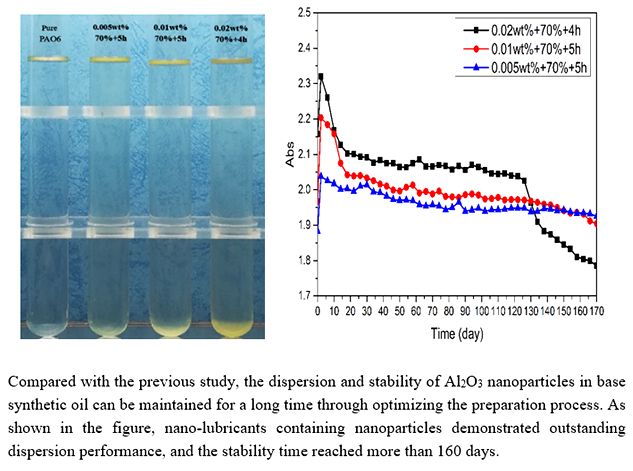
Disperser tipe probe ultrasonik menghasilkan pelumas hayati berkinerja tinggi.
(Penelitian dan gambar: Liu dkk., 2020)
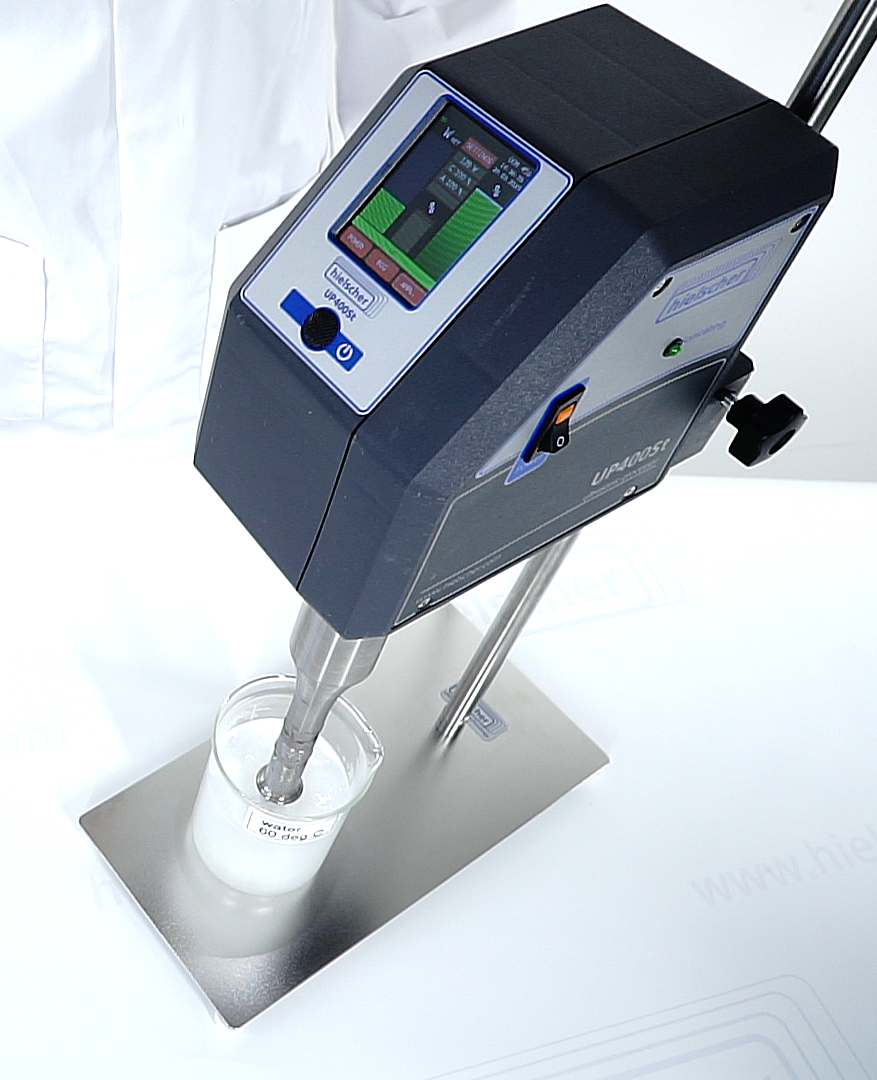
Emulsifikasi ultrasonik formulasi pelumas hayati
Dispersi Ultrasonik Aditif Pelumas Berbahan Dasar Hayati
Salah satu tantangan utama dalam formulasi pelumas hayati adalah penggabungan aditif berbasis hayati secara homogen. Bahan-bahan seperti karboksimetil selulosa, serat nano selulosa, biopolimer, getah alami, turunan lignin, pengental berbasis bio, dan nanopartikel fungsional dapat sangat memengaruhi viskositas, pelumasan, kinerja anti-aus, pembentukan lapisan, dan stabilitas suspensi. Namun, bahan-bahan ini sering kali cenderung menggumpal, terhidrasi secara lambat, atau membentuk struktur gel yang tidak seragam.
Dispersi ultrasonik membantu produsen mengurangi penggumpalan dan mendistribusikan aditif secara lebih merata di seluruh matriks pelumas. Hal ini sangat bermanfaat terutama untuk pelumas berbasis air, nanopelumas, sistem mirip gemuk, dan biopelumas berbasis emulsi. Penelitian terbaru mengenai sistem berbasis selulosa menunjukkan bahwa sonikasi dapat secara signifikan memengaruhi perilaku dispersi, reologi, dan struktur jaringan, sehingga menjadikannya alat pemrosesan yang berguna untuk menyesuaikan formulasi yang mengandung selulosa.
Bagi produsen pelumas, dispersi yang lebih baik dapat berarti:
- Viskositas dan perilaku reologi yang lebih konsisten
- Peningkatan efisiensi aditif pada tingkat dosis yang lebih rendah
- Penurunan sedimentasi, pemisahan fasa, atau partikel padat yang mengapung
- Kinerja tribologi yang lebih dapat direproduksi
- Waktu pemrosesan yang lebih singkat dibandingkan dengan pengadukan mekanis yang lebih lama
Karboximetil selulosa sangat relevan karena bahan ini banyak digunakan sebagai turunan selulosa yang memiliki sifat viskositas, sifat permukaan, dan sifat pembentuk lapisan yang bermanfaat. Dalam sistem pelumas, sonikasi dapat membantu mengintegrasikan CMC dan biopolimer lainnya ke dalam formulasi berbasis air atau emulsi yang stabil, sehingga mendukung pengembangan pelumas yang lebih ramah lingkungan dengan perilaku aliran yang terkendali dan stabilitas formulasi yang ditingkatkan.
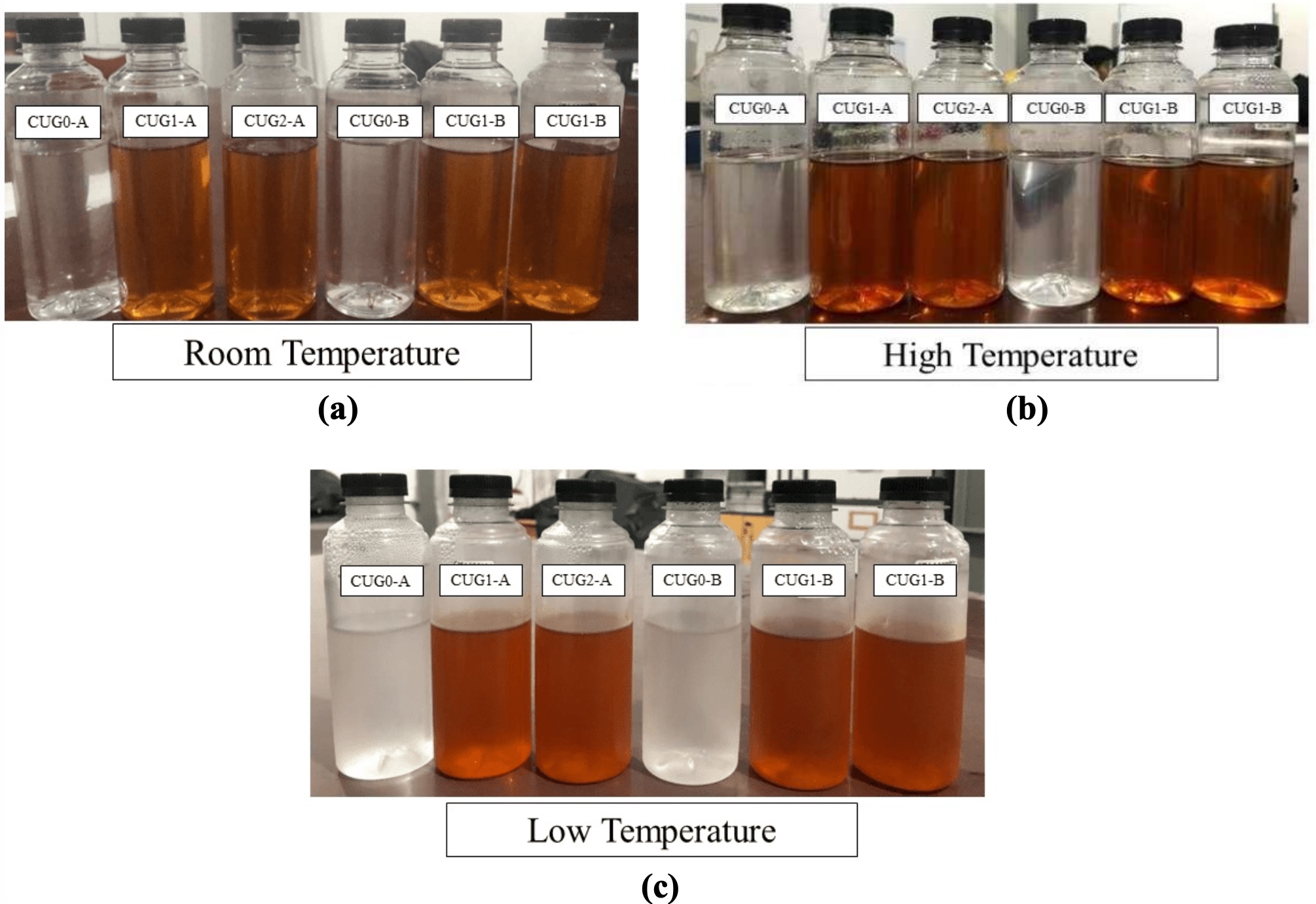
Biopelumas dengan karboksimetil selulosa yang didispersikan secara ultrasonik. Dispersi ultrasonik menghasilkan biopelumas nano yang stabil dalam jangka panjang
Penelitian dan gambar: ©Rahmadiawan dkk., 2022
Transesterifikasi Sonokimia untuk Pelumas Hayati Berbasis Diester dan Ester
Ester termasuk di antara cairan dasar terpenting untuk pelumas hayati berkinerja tinggi. Ester dapat memberikan daya pelumasan yang baik, indeks viskositas tinggi, sifat biodegradabilitas, serta perilaku yang baik pada suhu rendah, tergantung pada bahan baku dan struktur molekulnya. Diester dan poliol ester sangat penting untuk aplikasi seperti cairan hidraulik, oli kompresor, cairan pemrosesan logam, oli gergaji mesin, pelumas kelautan, dan pelumas industri khusus.
Salah satu aplikasi ultrasonik yang menjanjikan adalah sintesis sonokimia ester melalui proses transesterifikasi. Dalam transesterifikasi konvensional, reaktan yang tidak dapat bercampur seperti minyak dan alkohol sering kali memerlukan pencampuran intensif, suhu tinggi, katalis, serta waktu reaksi yang lama. Ultrasonik meningkatkan transfer massa dengan menciptakan emulsi halus antara fase-fase reaktan dan secara terus-menerus memperbarui antarmuka tempat reaksi terjadi.
Transesterifikasi dengan bantuan sonikasi merupakan teknik yang telah mapan dan terbukti memberikan berbagai keunggulan, seperti laju reaksi yang lebih cepat, kontak fase yang lebih baik, waktu pemisahan yang lebih singkat, hasil yang tinggi, serta pengurangan pembentukan limbah dalam kondisi yang sesuai. Produsen pelumas menggunakan metode transesterifikasi ultrasonik untuk memproduksi komponen biopelumas berbasis ester, termasuk diester dan struktur ester fungsional lainnya.
Proses transesterifikasi ultrasonik membantu para produsen:
- Meningkatkan interaksi antara fase minyak, alkohol, dan katalis
- Mengurangi waktu reaksi dengan meningkatkan transfer massa antarmuka
- Mendukung rentang suhu pemrosesan yang lebih rendah atau yang lebih hemat energi
- Meningkatkan konsistensi konversi dalam produksi batch atau produksi berkelanjutan
- Mewujudkan desain reaktor kompak untuk produksi ester yang dapat ditingkatkan skalanya
Bagi perusahaan yang memproduksi bahan dasar pelumas hayati, ultrasonik menawarkan cara untuk mempercepat proses esterifikasi dan transesterifikasi sekaligus mendukung proses produksi yang lebih ramah lingkungan dan efisien.
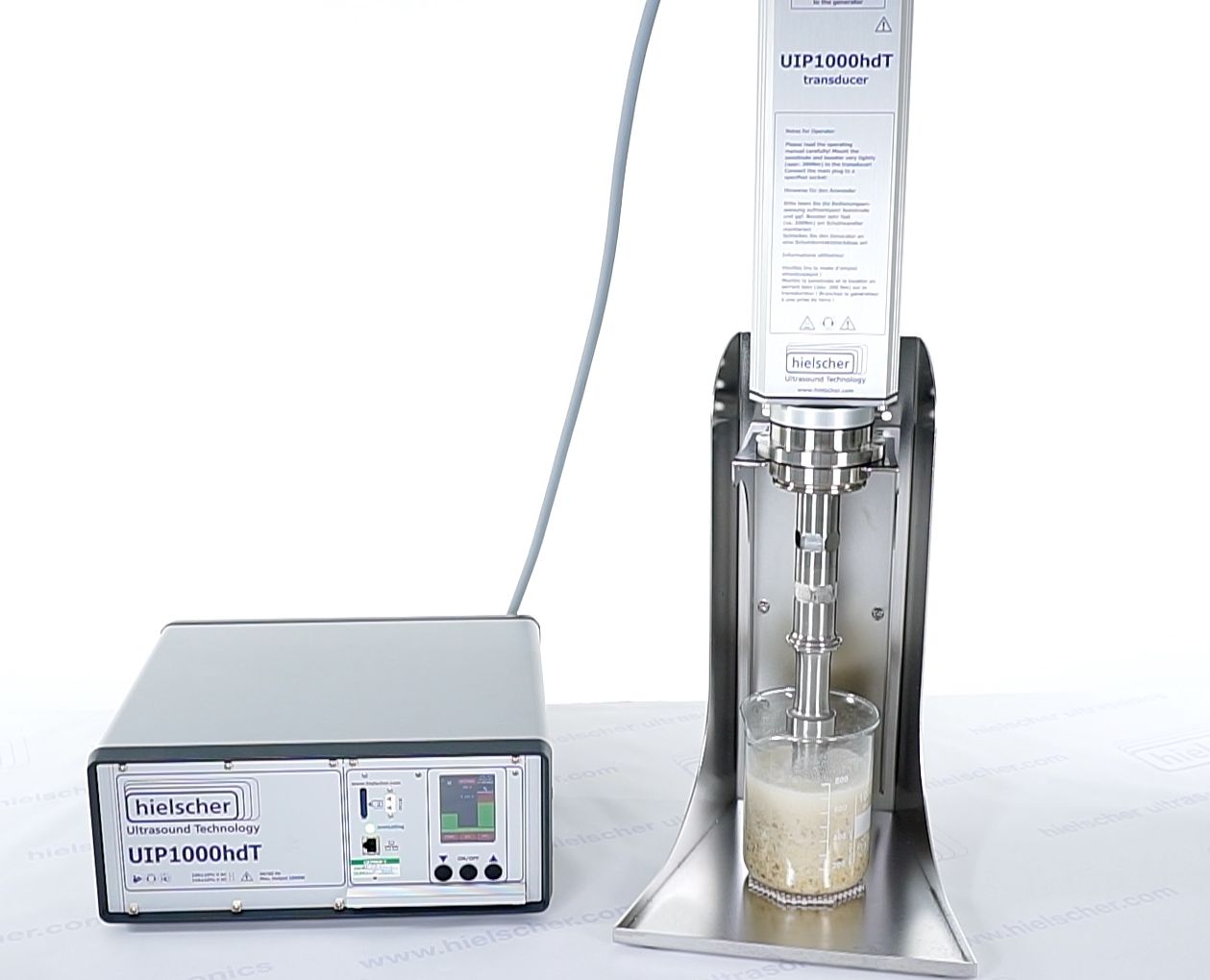
Sonicator UIP1000hdT berdaya 1000 watt
menjembatani kesenjangan antara penelitian laboratorium dan produksi
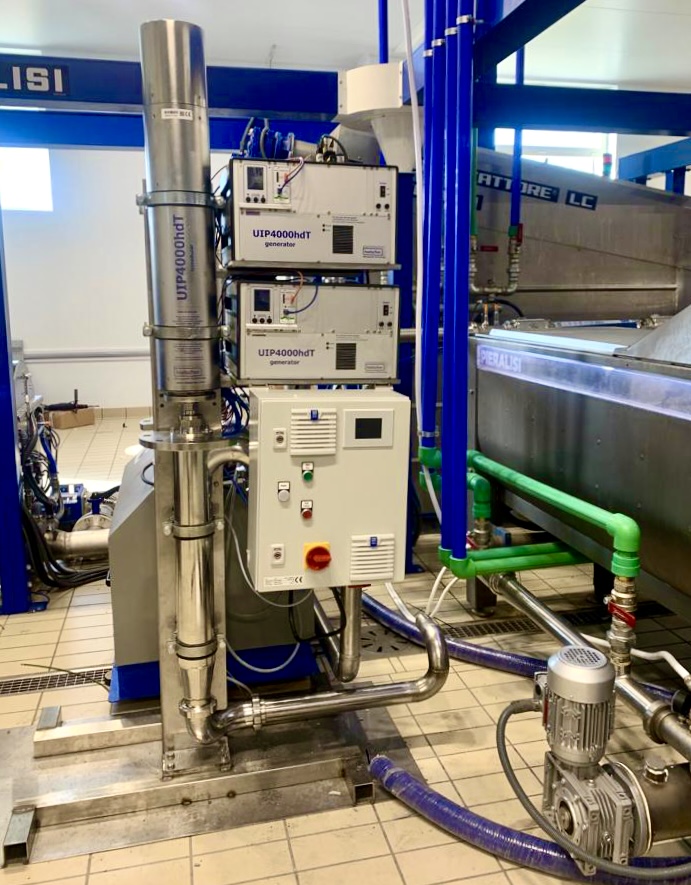
Kekuatan Ultrasound – Kelompok yang terdiri dari 2x Sonicator UIP4000hdT dilengkapi sel aliran untuk pengoperasian inline secara berkelanjutan
Emulsifikasi Ultrasonik pada Formulasi Pelumas
 Banyak pelumas hayati modern bukanlah sekadar minyak fase tunggal. Pelumas tersebut dapat berupa emulsi air-dalam-minyak, emulsi minyak-dalam-air, konsentrat aditif, dispersi lilin, sistem yang dimodifikasi polimer, atau campuran multifase yang kompleks. Kualitas emulsi-emulsi ini memiliki dampak langsung terhadap stabilitas penyimpanan, daya pelumasan, kinerja pendinginan, perlindungan terhadap korosi, dan perilaku aplikasi.
Emulsifikasi ultrasonik sangat efektif karena kavitasi menghasilkan gaya geser lokal yang sangat kuat, yang memecah tetesan menjadi ukuran yang lebih kecil dan menghasilkan distribusi ukuran tetesan yang sempit. Dalam produksi pelumas, metode ini dapat digunakan untuk mengemulsikan minyak berbasis hayati, fase ester, fase air, surfaktan, stabilisator polimer, dan aditif fungsional menjadi formulasi yang stabil.
Hal ini sangat relevan bagi:
- pelumas hayati berbahan dasar air
- Cairan pengolahan logam dan cairan pemotongan
- Cairan hidraulik yang mengandung bahan-bahan terbarukan
- Pelumas jenis emulsi dan pelumas semi-padat
- Konsentrat aditif dan pra-dispersi
- Sistem pelumas yang mengandung biopolimer atau turunan selulosa
Emulsifikasi yang baik meningkatkan stabilitas fisik formulasi pelumas dan dapat mengurangi kebutuhan akan penggunaan surfaktan yang berlebihan. Bagi produsen, hal ini memberikan keuntungan baik dari segi kinerja maupun biaya: stabilitas yang lebih baik, penggunaan aditif yang lebih efisien, serta fleksibilitas formulasi yang lebih besar.
Sonikasi untuk Partikel Mikrogel Emulsi
Bidang lain yang sedang berkembang adalah produksi partikel mikrogel emulsi untuk formulasi pelumas canggih. Mikrogel dapat berfungsi sebagai pengubah reologi, pembawa bahan aktif, pengubah gesekan, atau agen pembentuk struktur responsif. Dalam sistem pelumas berbasis bio, partikel mikrogel dapat diproduksi dari polimer alami, selulosa yang dimodifikasi, polisakarida, protein, atau sistem polimer terbarukan lainnya.
Pemrosesan ultrasonik mendukung persiapan mikrogel dengan memungkinkan emulsifikasi terkendali, pengurangan ukuran tetesan, dispersi polimer, dan pembentukan struktur fase. Mekanisme yang didorong oleh kavitasi—yang sama yang menghasilkan emulsi halus—juga dapat membantu menciptakan tetesan prekursor yang kecil dan seragam atau domain polimer terdispersi yang kemudian digel, diikat silang, atau distabilkan.
Optimalkan Produksi Biolubrikant Anda dengan Sonikasi
 Salah satu pertanyaan terpenting bagi produsen pelumas adalah apakah pemrosesan ultrasonik dapat diintegrasikan secara andal ke dalam lini produksi. Dengan sonikator Hielscher, jawabannya jelas ya. Sonicator berkinerja tinggi dari Hielscher dirancang untuk operasi berkelanjutan, pemrosesan inline, dan integrasi yang mulus ke dalam lini produksi yang sudah ada, menjadikannya solusi yang kuat dan andal untuk produksi pelumas hayati skala industri.
Dalam pengaturan industri pada umumnya, campuran pelumas siap pakai, suspensi aditif, campuran reaksi minyak-alkohol, atau bahan baku emulsi dipompa melalui sel aliran ultrasonik, di mana bahan-bahan tersebut terpapar energi ultrasonik yang dikendalikan secara presisi. Parameter proses utama seperti amplitudo, tekanan, suhu, laju aliran, waktu tinggal, dan masukan energi spesifik dapat disesuaikan dan dipantau secara akurat, serta didokumentasikan secara otomatis. Tingkat kontrol yang tinggi ini memberikan produsen pelumas jaminan proses yang diperlukan untuk kualitas formulasi yang dapat direproduksi, protokol produksi yang tervalidasi, dan peningkatan skala yang konsisten dari R&Uji coba D untuk produksi percontohan dan kapasitas produksi industri penuh.
Bagi produsen pelumas hayati, skalabilitas ini sangat penting karena persyaratan formulasi semakin ketat. Pelanggan mengharapkan produk yang berkelanjutan, namun mereka juga mengharapkan kinerja yang sama atau bahkan lebih baik daripada pelumas konvensional berbasis minyak bumi. Sonicator Hielscher membantu produsen menjembatani kesenjangan ini dengan menggabungkan daya, keandalan, kemudahan pengendalian, dan skalabilitas linier dalam satu platform ultrasonik yang tangguh. Keunggulan-keunggulan ini menjadikan sonicator Hielscher sebagai pilihan utama bagi perusahaan yang membutuhkan sonikasi kelas industri untuk formulasi pelumas berbasis bio berkualitas tinggi.
Tabel di bawah ini memberi Anda indikasi perkiraan kapasitas pemrosesan ultrasonikator kami:
| Batch Volume | Flow Rate | Direkomendasikan perangkat |
|---|---|---|
| 1 hingga 500mL | 10-200mL/min | UP100H |
| 10-2000mL | 20 hingga 400mL/min | UP200Ht, UP400St |
| 0.1 hingga 20L | 0.2 sampai 4L/min | UIP2000hdT |
| 10 sampai 100L | 2-10L/min | UIP4000hdT |
| 15 hingga 150L | 3 hingga 15L / mnt | UIP6000hdT |
| n.a. | 10 sampai 100L/menit | UIP16000hdT |
| n.a. | kristal yang lebbig | cluster UIP16000hdT |
Desain, Manufaktur, dan Konsultasi – Kualitas Buatan Jerman
Ultrasonicators Hielscher terkenal dengan kualitas dan standar desainnya yang tertinggi. Ketahanan dan pengoperasian yang mudah memungkinkan integrasi ultrasonicator kami ke dalam fasilitas industri. Kondisi kasar dan lingkungan yang menuntut mudah ditangani oleh ultrasonicator Hielscher.
Hielscher Ultrasonics adalah perusahaan bersertifikat ISO dan memberikan penekanan khusus pada ultrasonicators berkinerja tinggi yang menampilkan teknologi canggih dan keramahan pengguna. Tentu saja, ultrasonicators Hielscher sesuai dengan CE dan memenuhi persyaratan UL, CSA dan RoHs.

Ultrasonicator UIP6000hdT untuk dispersi inline bahan nano dalam pelumas
Pertanyaan yang Sering Diajukan
Apa itu Biolubrikasi?
Biopelumas adalah pelumas yang diformulasikan dari bahan baku terbarukan atau berbasis hayati, seperti minyak nabati, lemak hewani, ester sintetis, atau bahan baku biodegradable lainnya. Pelumas ini dirancang untuk mengurangi gesekan, keausan, dan panas di antara permukaan yang bergerak, sekaligus menawarkan biodegradabilitas yang lebih baik, toksisitas yang lebih rendah, dan dampak lingkungan yang lebih kecil dibandingkan dengan banyak pelumas berbasis minyak bumi.
Apa saja bahan dasar yang paling umum digunakan dalam formulasi pelumas hayati?
Bahan baku yang paling umum untuk pelumas hayati adalah minyak nabati, ester sintetis, dan minyak berbasis hayati yang dimodifikasi secara kimiawi. Bahan baku yang sering digunakan antara lain minyak rapeseed, minyak kedelai, minyak bunga matahari, minyak kelapa sawit, minyak jarak, minyak kelapa, dan minyak jatropha. Ester sintetis, seperti diester dan ester poliol, banyak digunakan karena menawarkan stabilitas oksidatif yang lebih baik, kinerja pada suhu rendah, pengendalian viskositas, dan stabilitas hidrolitik yang lebih baik dibandingkan dengan banyak minyak alami yang belum diolah.
Bahan Berbasis Hayati Apa Saja yang Digunakan sebagai Aditif Nano dalam Pelumas Hayati?
Bahan berbasis hayati yang digunakan sebagai aditif nano dalam pelumas hayati terutama meliputi naniselulosa, terutama kristal nano selulosa dan serat nano selulosa, serta nanopartikel lignin, nanopartikel kitosan, nanopartikel berbasis pati, partikel berbasis alginat, nanopartikel berbasis protein, biochar, dan nanopartikel karbon lain yang berasal dari biomassa. Di antara bahan-bahan tersebut, nanocellulose merupakan salah satu yang paling banyak diteliti karena bersifat terbarukan, dapat terurai secara hayati, kokoh secara mekanis, serta mampu meningkatkan pengurangan gesekan, sifat anti-aus, modifikasi viskositas, dan pembentukan tribofilm dalam sistem pelumas berbasis minyak nabati dan sistem pelumas ramah lingkungan lainnya.
Nanomaterial konvensional apa saja yang digunakan sebagai aditif dalam pelumas hayati?
Nanopartikel berbasis karbon seperti grafen, grafit, tabung nano karbon, dan titik karbon, serta Al₂O₃, TiO₂, SiO₂, ZnO, MoS₂, atau WS₂ dapat digunakan sebagai aditif peningkat kinerja dalam pelumas hayati.Demikian pula, nanopartikel anorganik seperti Al₂O₃ semakin banyak diteliti sebagai aditif fungsional dalam pelumas hayati. Ketika terdispersi secara halus, aditif nano ini dapat meningkatkan pengurangan gesekan, perlindungan terhadap keausan, kapasitas penahan beban, dan stabilitas formulasi.
Kinerja sangat bergantung pada dispersi yang stabil. Nanopartikel yang dispersi-nya buruk dapat menggumpal, mengendap, atau bahkan meningkatkan keausan abrasif. Inilah tepatnya mengapa dispersi ultrasonik sangat relevan, karena sonikasi membantu memecah gumpalan nanopartikel dan mendistribusikannya secara merata dalam minyak berbasis bio, ester, emulsi, atau sistem pelumas yang dimodifikasi polimer.
Baca lebih lanjut tentang pendispersi nanoaditif dalam pelumas!
Apa Perbedaan antara Pelumas Berbahan Dasar Hayati dan Pelumas yang Dapat Terurai Secara Hayati?
Pelumas berbasis bio adalah pelumas yang mengandung fraksi karbon terbarukan atau fraksi yang berasal dari bahan hayati dalam jumlah yang signifikan.
Pelumas hayati yang dapat terurai secara hayati berarti formulasi jadi atau komponen-komponennya memenuhi kriteria biodegradabilitas, yang sering dinilai melalui uji seperti OECD 301.
Literatur / Referensi
- Arumugam, S., Chengareddy, P., Tamilarasan, A. et al. (2019): RSM and Crow Search Algorithm-Based Optimization of Ultrasonicated Transesterification Process Parameters on Synthesis of Polyol Ester-Based Biolubricant. Arabian Journal for Science and Engineering 44, 2019. 5535–5548.
- László Vanyorek, Dávid Kiss, Ádám Prekob, Béla Fiser, Attila Potyka, Géza Németh, László Kuzsela, Dirk Drees, Attila Trohák, Béla Viskolcz (2019): Application of nitrogen doped bamboo-like carbon nanotube for development of electrically conductive lubricants. Journal of Materials Research and Technology, Volume 8, Issue 3, 2019. 3244-3250.
- Kałużny Jarosł, Waligórski M, Szymański GM, Merkisz J, Różański J, Nowicki M, Al Karawi M, Kempa K. (2020): Reducing friction and engine vibrations with trace amounts of carbon nanotubes in the lubricating oil. Tribology International 2020.
- Mosleh, Mohsen; Atnafu, Neway; Belk, John; Nobles, Orval (2009): Modification of sheet metal forming fluids with dispersed nanoparticles for improved lubrication. Wear 267, 2009. 1220-1225.
- Li J, Du C, Delgado MA, et al. (2026): The application of nanocellulose in eco-friendly lubricants: A review. Friction, 2026.

Homogenizer ultrasonik UIP1000hdT, sonicator kuat 1000 watt untuk formulasi pelumas hayati
- efisiensi yang sangat tinggi
- Teknologi canggih
- handal & sangat kuat
- kontrol proses yang dapat disesuaikan dan tepat
- Batch & inline
- untuk volume apa pun
- Perangkat Lunak Cerdas
- fitur pintar (misalnya, dapat diprogram, protokol data, kendali jarak jauh)
- Mudah dan aman dioperasikan
- biaya pemeliharaan yang rendah
- CIP (bersihkan di tempat)
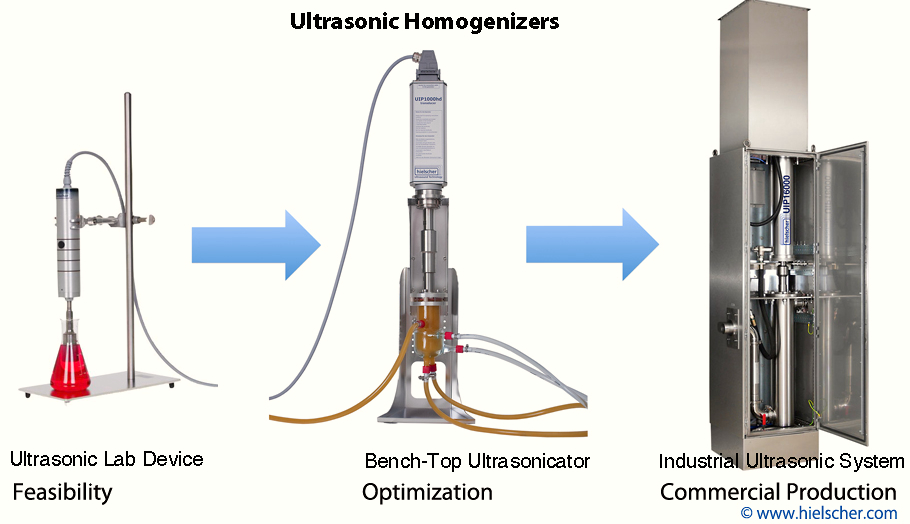
Hielscher Ultrasonics memproduksi homogenizer ultrasonik berkinerja tinggi dari laboratorium hingga ukuran industri.