Соно-озонација: Синергије сонохемије и озонације за напредну оксидацију
Соно -Озонатион је напредни процес оксидације који комбинује ултразвук са озонирањем у једном систему третмана. Иако су обе технологије ефикасне саме по себи, њихова истовремена примена често производи јачи ефекат од било које методе сама. Ова синергија је посебно драгоцена у апликацијама за заштиту животне средине, где се постојани органски загађивачи, микроорганизми, боје, фармацеутски производи, пестициди, индустријске хемикалије и други загађивачи морају ефикасно деградирати. Интегрисањем акустичне кавитације са хемијом озона, соно-озонирање побољшава генерисање радикала, побољшава пренос масе и убрзава оксидативне реакције у течним медијима.
Како Соницатион побољшава озонирање?
The principle of sono-ozonation is based on the interaction between ultrasonic cavitation and ozone decomposition. When high-intensity ultrasound is introduced into a liquid, alternating compression and rarefaction cycles generate microscopic cavitation bubbles. These bubbles grow and violently collapse, producing localized hot spots with extremely high temperatures and pressures for very short periods of time. Under these extreme conditions, water molecules can dissociate into highly reactive hydroxyl radicals. These radicals are among the most powerful non-selective oxidants in aqueous systems and are able to attack a broad range of organic compounds.
Добијте препоруку за процес
Реците нам свој циљни резултат, проток или запремину серије и жељени начин обраде. Помоћи ћемо вам да изаберете прави соникатор и конфигурацију за ваш напредни процес оксидације.
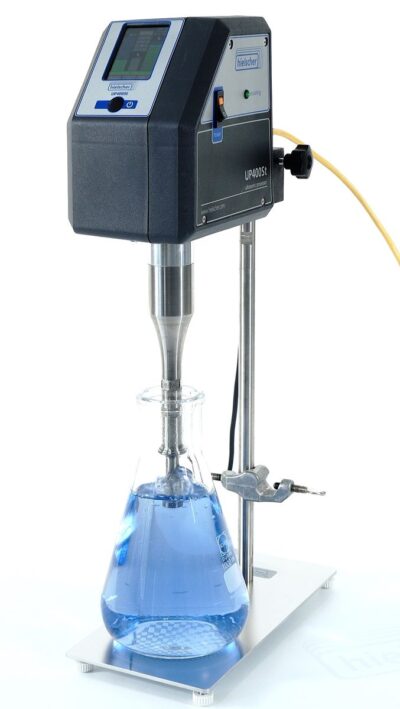
Соникатор типа сонде УП400Ст
Предности ултразвучно потпомогнуте озонације
Ozone is also a strong oxidizing agent and is widely used for water and wastewater treatment. It can react directly with certain contaminants or decompose in water to form secondary oxidants such as hydroxyl radicals. However, ozonation can be limited by gas-liquid mass transfer, ozone solubility, and the selectivity of direct ozone reactions. Ultrasound helps overcome these limitations. Cavitation improves the dispersion of ozone gas in the liquid, reduces bubble size, renews the gas-liquid interface, and promotes turbulent micro-mixing. As a result, ozone dissolves more effectively and decomposes more readily into reactive radical species.
The combined effect is a more efficient oxidative environment. In sono-ozonation, ozone molecules may enter cavitation bubbles or concentrate near bubble interfaces, where they are exposed to intense thermal and mechanical conditions during collapse. This accelerates ozone decomposition and increases the formation of hydroxyl radicals and other reactive oxygen species. The process therefore improves the degradation rate of organic pollutants and can reduce treatment time compared with conventional ozonation. In many applications, sono-ozonation also improves mineralization, meaning that organic molecules are not only transformed into intermediate compounds but are further oxidized toward carbon dioxide, water, and inorganic ions.
One of the most important advantages of sono-ozonation is its ability to treat compounds that are resistant to conventional oxidation. Many environmental contaminants, including dyes, phenolic compounds, endocrine-disrupting chemicals, pharmaceutical residues, and surfactants, can be difficult to remove completely. Ozone may react selectively with electron-rich groups, while ultrasound-induced radicals can attack less selective molecular sites. The combination expands the range of oxidation pathways and improves the probability of contaminant breakdown. This makes sono-ozonation attractive for wastewater treatment, drinking water polishing, leachate treatment, process water recycling, and remediation of contaminated aqueous streams.
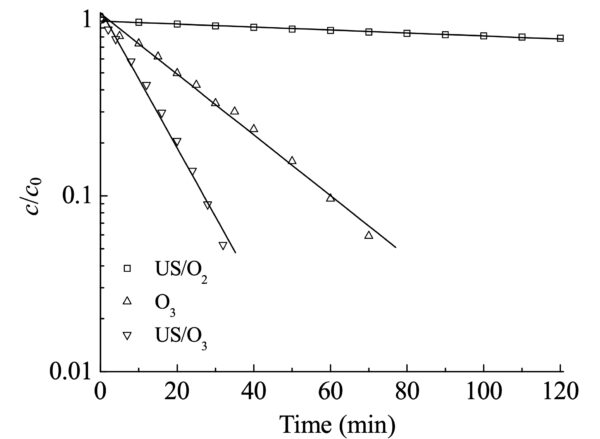
Деградација првог реда п-нитрофенола услед соникације са O2, озонизације и сонолитичке озонације. Проток гаса O3 на 40 мл / мин, пХ = 3, Т = 298 К. Почетна концентрација п-нитрофенола била је 50 мг / Л. Ултразвучна производња енергије претварача била је 125 В.
Графика и студија: © Ксу ет ал., 2005
Примене Соно-Озонатион
Sono-Ozonation is highly relevant for microbial inactivation. Ultrasound can physically disrupt microbial cells through shear forces, microjets, shock waves, and localized pressure changes. Ozone, meanwhile, oxidizes cell walls, membranes, enzymes, and genetic material. When both methods are applied together, the antimicrobial effect can be enhanced. Cavitation may weaken or damage cell structures, allowing ozone and radical species to attack more effectively. This combined action can improve disinfection performance against bacteria, fungi, algae, and other microorganisms. For applications where microbial control and organic contaminant degradation are both required, sono-ozonation offers a powerful multifunctional treatment approach.
Поред хемијске разградње и антимикробне активности, соно-озонирање може побољшати физикално-хемијска својства третираних течности. Ултразвучна кавитација повећава интензитет мешања, промовише отплињавање и дисперзију гаса и побољшава контакт између оксиданата и загађивача. Ови ефекти могу подржати смањење боје, мириса, хемијске потребе за кисеоником, замућености и одређених ватросталних органских фракција. У неким процесима, соно-озонирање такође може побољшати низводно третман претварањем упорних супстанци у више биоразградивих једињења, чиме се повећава ефикасност корака биолошког третмана.
Затворени реактори за ефикасну обраду и лако скалирање
 A practical advantage of sono-ozonation is that it can be implemented in closed reactor systems. Hielscher probe-type sonicators are particularly suitable for this type of integration because they deliver high-intensity ultrasound directly into the liquid through a titanium sonotrode. The probe can be mounted into a closed vessel or flow-through reactor using appropriate ports, flanges, or fittings. At the same time, ozone can be introduced through a gas inlet, diffuser, sparger, or recirculation loop. This allows ultrasound and ozone to act simultaneously within the same reaction volume.
Such a setup is straightforward and scalable. The closed reactor contains the liquid to be treated, while the ultrasonic probe transfers acoustic energy directly into the medium. Ozone flows continuously or intermittently through the reactor, depending on the process requirements. The ultrasound improves ozone dispersion and contact with the liquid phase, while the closed configuration helps contain ozone safely and enables controlled off-gas handling. Excess ozone can be directed to an ozone destructor or suitable exhaust treatment system. Important operating parameters include ultrasonic amplitude, power input, treatment time, ozone concentration, gas flow rate, temperature, pressure, pH, and reactor geometry.
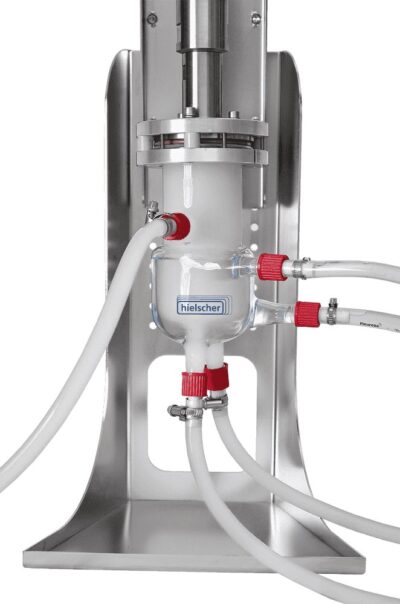
Соникатор UIP1000hdT са интерним реактором за соно-озонацију
Хиелсцхерови соникатори за озонацију и напредну оксидацију
Хиелсцхерови сонде-соникатори могу се користити за серијске или континуиране соно-озонационе процесе. У лабораторијском развоју, компактни ултразвучни апарати омогућавају истраживачима да процене кинетику реакција, разлагање загађивача и смањење микроорганизама под контролисаним условима. За пилот и индустријско работење, моћнији ултразвучни системи могу се интегрисати у веће резервоаре или реакторе са континуираним протоком. Пошто сонда-соникација уводи енергију ефикасно у течност, она је веома погодна за интензивирање процеса где је потребна јача кавитација и поуздана репродукibilност.
Соно -Озонатион представља високо ефикасну синергистичку методу која комбинује хемијску оксидацијску моћ озона са физичким и сонохемијским ефектима ултразвука. Процес повећава формирање радикала, побољшава пренос масе гас-течност, убрзава разградњу загађивача и побољшава антимикробну активност. Његова компатибилност са затвореним реакторима и директна интеграција Хиелсцхер сонде типа соницаторс чини соно-озонирање практичан и свестран приступ за третман животне средине, пречишћавање воде, санацију отпадних вода и напредне оксидацијске апликације.
Табела у наставку даје вам индикацију приближних капацитета обраде наших ултразвучних апарата:
| Батцх Волуме | Проток | Препоручени уређаји |
|---|---|---|
| 0.5 до 1.5 мЛ | на | ВиалТвеетер |
| 1 до 500 мл | 10 до 200 мл/мин | УП100Х |
| 10 до 2000 мл | 20 до 400 мл/мин | УП200Хт, УП400Ст |
| 0.1 до 20Л | 0.2 до 4Л/мин | УИП2000хдТ |
| 10 до 100 л | 2 до 10 л/мин | УИП4000хдТ |
| 15 до 150Л | 3 до 15 л/мин | УИП6000хдТ |
| на | 10 до 100 л/мин | УИП16000хдТ |
| на | већи | кластер оф УИП16000хдТ |
Дизајн, производња и консалтинг – Квалитет Маде ин Германи
Хиелсцхер ултрасоникатори су познати по свом највишем квалитету и стандардима дизајна. Робусност и једноставан рад омогућавају несметану интеграцију наших ултразвучних апарата у индустријске објекте. Хиелсцхер ултрасоникатори се лако носе са тешким условима и захтевним окружењима.
Хиелсцхер Ултрасоницс је ИСО сертификована компанија и ставља посебан нагласак на ултрасоникаторе високих перформанси са најсавременијом технологијом и једноставношћу за коришћење. Наравно, Хиелсцхер ултрасоникатори су усаглашени са ЦЕ и испуњавају захтеве УЛ, ЦСА и РоХ.

Хиелсцхер Ултрасоницс производи ултразвучне хомогенизаторе високих перформанси за апликације за мешање, дисперзију, емулзификацију и екстракцију у лабораторијским, пилотским и индустријским размерама.
Често постављана питања
Шта је напредни процес оксидације (АОП)?
Напредни оксидациони процес (AOP) је хемијска метода третмана која генерише високо реактивне врсте кисеоника, посебно хидроксилне радикале, како би оксидовала и разградилa упорне органске загађиваче у води, отпадним водама, ваздуху или процесним течностима.
Шта је озонизација?
Озонизација је оксидациони процес у којем се озонски гас уводи у течну или гасну струју да би реаговао са загађивачима, микроорганизмима, једињењима која изазивају мирис или бојама. Она може да делује директном оксидацијом озоном или индиректно кроз формирање радикалних врста.
Шта је озон?
Ozone is a triatomic form of oxygen with the chemical formula O₃. It is a highly reactive, unstable oxidizing gas that decomposes to oxygen and reactive oxygen species, making it useful for disinfection, deodorization, and contaminant degradation.
Литература / Референце
- Moretti, A., E. Gover, G. Bisson, C. Comuzzi, D. Goi, M. Marino (2026): Evaluating Low-Frequency Ultrasound as a Pretreatment to Improve Ozonation Antimicrobial Efficacy in Urban Wastewater Treatment. Water Environment Research 98, no. 3: e70322.
- Rossi, G., Mainardis, M., Aneggi, E. et al. (2021): Combined ultrasound-ozone treatment for reutilization of primary effluent – a preliminary study. Environmental Science and Pollution Research 28, 2021. 700–710.
- Xu XW, Shi HX, Wang DH. (2005): Ozonation with ultrasonic enhancement of p-nitrophenol wastewater. J Zhejiang Univ Sci B. 2005 May;6(5):319-323.
- висока ефикасност
- најсавременија технологија
- поузданост & робусност
- подесива, прецизна контрола процеса
- батцх & у реду
- за било коју запремину
- интелигентни софтвер
- pametne funkcije (npr. Programabilno, protokoliranje podataka, daljinski upravljač)
- једноставан и сигуран за рад
- минимално одржавање
- ЦИП (чишћење на месту)
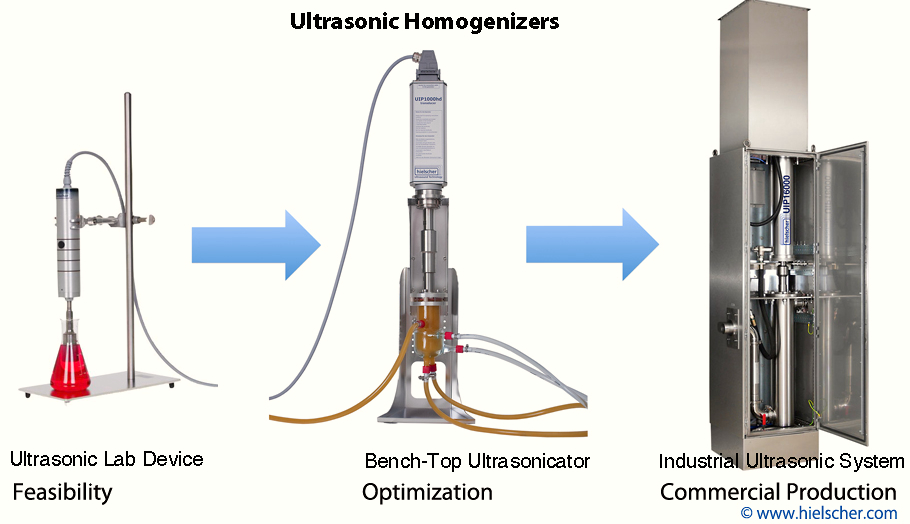
Хиелсцхер Ултрасоницс производи ултразвучне хомогенизаторе високих перформанси од лаб до индустријска величина.