Sono-Ozonatsiya: Soneximiya va Ozonatsiyaning ilg‘or oksidlanish uchun sinergiyalari
Sono-Ozonation is an advanced oxidation process that combines ultrasound with ozonation in a single treatment system. While both technologies are effective on their own, their simultaneous application often produces a stronger effect than either method alone. This synergy is particularly valuable in environmental applications, where persistent organic pollutants, microorganisms, colorants, pharmaceuticals, pesticides, industrial chemicals, and other contaminants must be degraded efficiently. By integrating acoustic cavitation with ozone chemistry, sono-ozonation enhances radical generation, improves mass transfer, and accelerates oxidative reactions in liquid media.
How Does Sonication Improve Ozonation?
The principle of sono-ozonation is based on the interaction between ultrasonic cavitation and ozone decomposition. When high-intensity ultrasound is introduced into a liquid, alternating compression and rarefaction cycles generate microscopic cavitation bubbles. These bubbles grow and violently collapse, producing localized hot spots with extremely high temperatures and pressures for very short periods of time. Under these extreme conditions, water molecules can dissociate into highly reactive hydroxyl radicals. These radicals are among the most powerful non-selective oxidants in aqueous systems and are able to attack a broad range of organic compounds.
Ishlab chiqarish tavsiyasini oling
Maqsadli natijani, oqim tezligi yoki partiya hajmini va afzal ko'rilgan ishlov berish rejimini ayting. Biz sizga ilg'or oksidlanish jarayoningiz uchun to'g'ri sonikator va konfiguratsiyani tanlashda yordam beramiz.
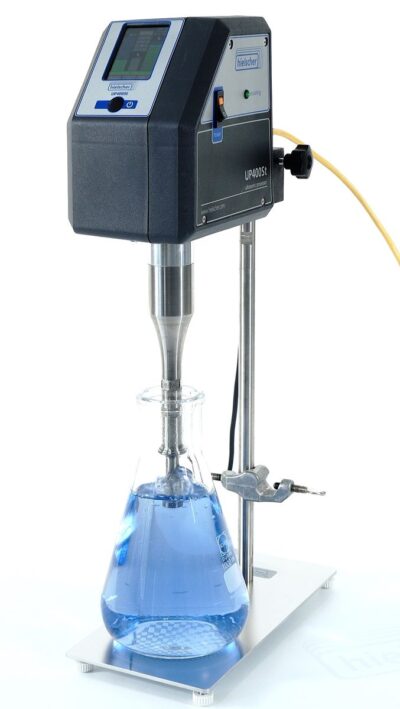
Zond tipidagi sonikator UP400St
Ultratovush yordamida ozonlashning afzalliklari
Ozone is also a strong oxidizing agent and is widely used for water and wastewater treatment. It can react directly with certain contaminants or decompose in water to form secondary oxidants such as hydroxyl radicals. However, ozonation can be limited by gas-liquid mass transfer, ozone solubility, and the selectivity of direct ozone reactions. Ultrasound helps overcome these limitations. Cavitation improves the dispersion of ozone gas in the liquid, reduces bubble size, renews the gas-liquid interface, and promotes turbulent micro-mixing. As a result, ozone dissolves more effectively and decomposes more readily into reactive radical species.
The combined effect is a more efficient oxidative environment. In sono-ozonation, ozone molecules may enter cavitation bubbles or concentrate near bubble interfaces, where they are exposed to intense thermal and mechanical conditions during collapse. This accelerates ozone decomposition and increases the formation of hydroxyl radicals and other reactive oxygen species. The process therefore improves the degradation rate of organic pollutants and can reduce treatment time compared with conventional ozonation. In many applications, sono-ozonation also improves mineralization, meaning that organic molecules are not only transformed into intermediate compounds but are further oxidized toward carbon dioxide, water, and inorganic ions.
One of the most important advantages of sono-ozonation is its ability to treat compounds that are resistant to conventional oxidation. Many environmental contaminants, including dyes, phenolic compounds, endocrine-disrupting chemicals, pharmaceutical residues, and surfactants, can be difficult to remove completely. Ozone may react selectively with electron-rich groups, while ultrasound-induced radicals can attack less selective molecular sites. The combination expands the range of oxidation pathways and improves the probability of contaminant breakdown. This makes sono-ozonation attractive for wastewater treatment, drinking water polishing, leachate treatment, process water recycling, and remediation of contaminated aqueous streams.
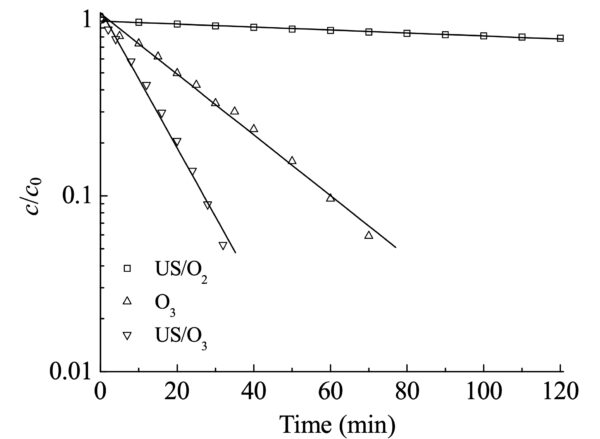
O2 bilan sonikatsiya natijasida p-nitrofenolning birinchi darajali parchalanishi, ozonlanish va sonolitik ozonatsiya. O3 gaz oqimi 40 ml/minut, pH=3, T=298 K. Dastlabki p-nitrofenol konsentratsiyasi 50 mg/L edi. Transduserning ultratovushli quvvat ishlab chiqarish quvvati 125 Vt edi.
Grafik va tadqiqot: ©Xu va boshq., 2005
Sono-Ozonatsiyaning qo'llanilishi
Sono-Ozonation is highly relevant for microbial inactivation. Ultrasound can physically disrupt microbial cells through shear forces, microjets, shock waves, and localized pressure changes. Ozone, meanwhile, oxidizes cell walls, membranes, enzymes, and genetic material. When both methods are applied together, the antimicrobial effect can be enhanced. Cavitation may weaken or damage cell structures, allowing ozone and radical species to attack more effectively. This combined action can improve disinfection performance against bacteria, fungi, algae, and other microorganisms. For applications where microbial control and organic contaminant degradation are both required, sono-ozonation offers a powerful multifunctional treatment approach.
Kimyoviy parchalanish va antimikrob faolligidan tashqari, sono-ozonlash ishlov berilgan suyuqliklarning fizik-kimyoviy xususiyatlarini yaxshilashi mumkin. Ultratovushli kavitatsiya aralashtirish intensivligini oshiradi, gazning tarqalishini va gazlarning tarqalishini rag'batlantiradi, shuningdek, oksidantlar va ifloslantiruvchilar o'rtasidagi aloqani kuchaytiradi. Bu ta'sirlar rang, hid, kimyoviy kislorod talabi, xiralik va ayrim o'ziga xos organik fraksiyalarning kamayishini qo'llab-quvvatlashi mumkin. Ba'zi jarayonlarda, sono-ozonlash ham barqaror moddalarni biologik parchalanadigan birikmalarga aylantirish orqali keyingi jarayonni yaxshilashi mumkin, bu esa biologik tozalash bosqichlarining samaradorligini oshiradi.
Samarali ishlov berish va oson kengaytirish uchun yopiq reaktorlar
 A practical advantage of sono-ozonation is that it can be implemented in closed reactor systems. Hielscher probe-type sonicators are particularly suitable for this type of integration because they deliver high-intensity ultrasound directly into the liquid through a titanium sonotrode. The probe can be mounted into a closed vessel or flow-through reactor using appropriate ports, flanges, or fittings. At the same time, ozone can be introduced through a gas inlet, diffuser, sparger, or recirculation loop. This allows ultrasound and ozone to act simultaneously within the same reaction volume.
Such a setup is straightforward and scalable. The closed reactor contains the liquid to be treated, while the ultrasonic probe transfers acoustic energy directly into the medium. Ozone flows continuously or intermittently through the reactor, depending on the process requirements. The ultrasound improves ozone dispersion and contact with the liquid phase, while the closed configuration helps contain ozone safely and enables controlled off-gas handling. Excess ozone can be directed to an ozone destructor or suitable exhaust treatment system. Important operating parameters include ultrasonic amplitude, power input, treatment time, ozone concentration, gas flow rate, temperature, pressure, pH, and reactor geometry.
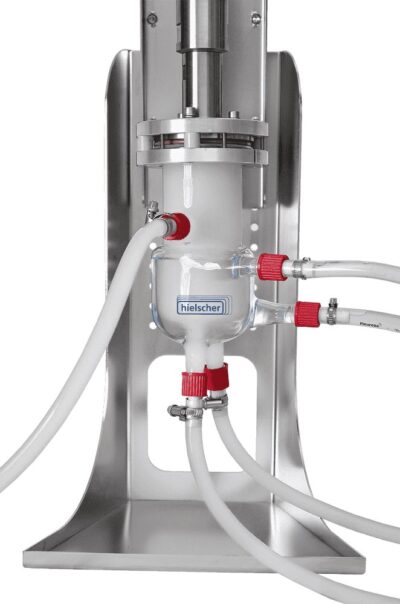
Sonicator UIP1000hdT sono-ozonatsiya uchun inline reaktor bilan
Hielscher sonikatorlari ozonlash va ilg'or oksidlanish uchun
Hielscher zond turidagi sonikatorlar partiyali yoki uzluksiz sono-ozonlash jarayonlarida ishlatilishi mumkin. Laboratoriya rivojlanishida ixcham ultrasonikatorlar tadqiqotchilarga nazorat ostida reaksiya kinetikasi, ifloslantiruvchi moddalarning parchalanishi va mikroblarni kamaytirishni baholash imkonini beradi. Pilot va sanoat uchun yanada kuchli ultratovush tizimlari katta tanklar yoki uzluksiz oqimli reaktorlarga integratsiya qilinishi mumkin. Proba sonikatsiyasi suyuqlikka energiyani samarali kiritadi, shuning uchun u kuchli kavitatsiya va ishonchli takrorlanish talab qilinadigan jarayonlarni kuchaytirish uchun juda mos keladi.
Sono-Ozonatsiya juda samarali sinergistik usul bo'lib, ozonning kimyoviy oksidlanish kuchini ultratovushning fizik va sonokimyoviy ta'siri bilan birlashtiradi. Jarayon radikal hosil bo'lishini oshiradi, gaz-suyuqlik massasini uzatishni yaxshilaydi, ifloslantiruvchi moddalarning parchalanishini tezlashtiradi va antimikrob faolligini oshiradi. Yopiq reaktorlar bilan mosligi va Hielscher zond turidagi sonikatorlarning to'g'ridan-to'g'ri integratsiyasi sono-ozonatsiyani atrof-muhitni tozalash, suvni tozalash, oqava suvlarni tozalash va ilg'or oksidlanish ilovalari uchun amaliy va ko'p qirrali yondashuvga aylantiradi.
Quyidagi jadvalda ultrasonikatorlarimizning taxminiy qayta ishlash quvvati ko'rsatilgan:
| To'plam hajmi | Oqim darajasi | Tavsiya etilgan qurilmalar |
|---|---|---|
| 0,5 dan 1,5 ml gacha | na | VialTweeter |
| 1 dan 500 ml gacha | 10 dan 200 ml / min | UP100H |
| 10 dan 2000 ml gacha | 20 dan 400 ml / min | UP200Ht, UP400St |
| 0.1 dan 20 L gacha | 0.2 dan 4L/min gacha | UIP2000hdT |
| 10 dan 100 l gacha | 2 dan 10 l / min | UIP4000hdT |
| 15 dan 150 litrgacha | 3 dan 15 l / min | UIP6000hdT |
| na | 10 dan 100 l / min | UIP16000hdT |
| na | kattaroq | ning klasteri UIP16000hdT |
Dizayn, ishlab chiqarish va konsalting – Germaniyada ishlab chiqarilgan sifat
Hielscher ultrasonikatorlari eng yuqori sifat va dizayn standartlari bilan mashhur. Mustahkamlik va qulay foydalanish ultratovush qurilmalarimizni sanoat ob'ektlariga silliq integratsiya qilish imkonini beradi. Qo'pol sharoitlar va talabchan muhit Hielscher ultrasonikatorlari tomonidan osonlik bilan hal qilinadi.
Hielscher Ultrasonics ISO sertifikatiga ega kompaniya bo'lib, eng zamonaviy texnologiya va foydalanuvchilarga qulaylik bilan ajralib turadigan yuqori samarali ultratovush apparatlariga alohida e'tibor beradi. Albatta, Hielscher ultrasonikatorlari Idoralar talablariga javob beradi va UL, CSA va RoHs talablariga javob beradi.

Hielscher Ultrasonics laboratoriya, uchuvchi va sanoat miqyosida ilovalar, dispersiya, emulsifikatsiya va ekstraktsiyani aralashtirish uchun yuqori samarali ultratovushli homogenizatorlarni ishlab chiqaradi.
tez-tez so'raladigan savollar
Ilg'or oksidlanish jarayoni (AOP) nima?
Kengaytirilgan oksidlanish jarayoni (AOP) – bu suv, oqova suv, havo yoki jarayon suyuqliklarida cho'ziluvchan organik ifloslantiruvchilarni oksidlash va parchalanishini ta'minlash uchun yuqori reaksiyaga kiruvchi kislorod turlarini, xususan gidroksil radikallarini hosil qiladigan kimyoviy davolash usuli.
Ozonatsiya nima?
Ozonatsiya – bu gaz yoki suyuqlik oqimiga ozon gazini kiritib, ifloslantiruvchi moddalar, mikroorganizmlar, hid birikmalari yoki rang beruvchi moddalar bilan reaksiyaga kirishish orqali amalga oshiriladigan oksidlanish jarayoni. U to'g'ridan-to'g'ri ozon oksidlash orqali yoki radikal turlar hosil bo'lishi orqali bilvosita harakat qilishi mumkin.
Ozon nima?
Ozone is a triatomic form of oxygen with the chemical formula O₃. It is a highly reactive, unstable oxidizing gas that decomposes to oxygen and reactive oxygen species, making it useful for disinfection, deodorization, and contaminant degradation.
Adabiyot / Adabiyotlar
- Moretti, A., E. Gover, G. Bisson, C. Comuzzi, D. Goi, M. Marino (2026): Evaluating Low-Frequency Ultrasound as a Pretreatment to Improve Ozonation Antimicrobial Efficacy in Urban Wastewater Treatment. Water Environment Research 98, no. 3: e70322.
- Rossi, G., Mainardis, M., Aneggi, E. et al. (2021): Combined ultrasound-ozone treatment for reutilization of primary effluent – a preliminary study. Environmental Science and Pollution Research 28, 2021. 700–710.
- Xu XW, Shi HX, Wang DH. (2005): Ozonation with ultrasonic enhancement of p-nitrophenol wastewater. J Zhejiang Univ Sci B. 2005 May;6(5):319-323.
- yuqori samaradorlik
- eng zamonaviy texnologiya
- ishonchlilik & mustahkamlik
- sozlanishi, aniq jarayon nazorati
- partiya & mos ravishda
- har qanday hajm uchun
- aqlli dasturiy ta'minot
- aqlli xususiyatlar (masalan, dasturlashtiriladigan, ma'lumotlarni protokollash, masofadan boshqarish)
- oson va xavfsiz ishlash
- past texnik xizmat ko'rsatish
- CIP (joyida toza)
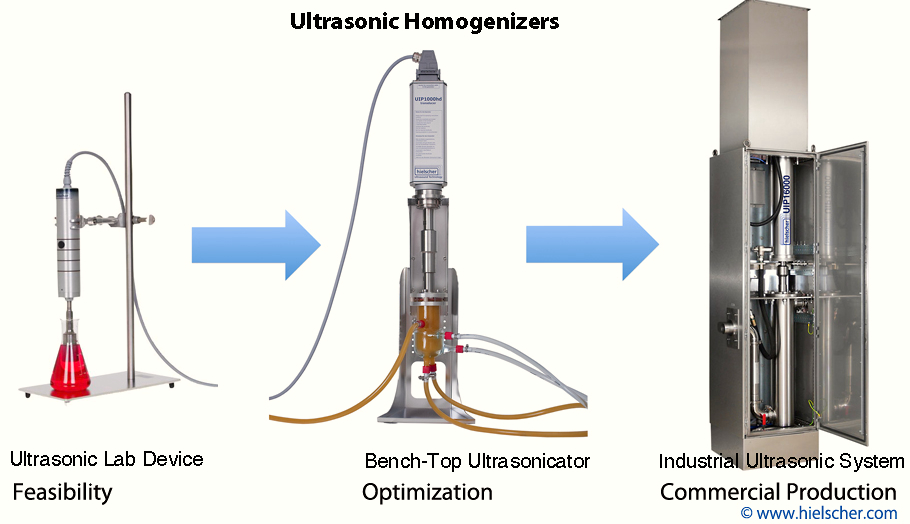
Hielscher Ultrasonics kompaniyasi yuqori samarali ultratovushli homogenizatorlarni ishlab chiqaradi laboratoriya uchun sanoat hajmi.