Palladium Nanohissəciklərinin Sonokimyəvi Azaldılması
Palladium (Pd) katalitik xüsusiyyətləri ilə tanınır və həmçinin material tədqiqatı, elektronika istehsalı, tibb, hidrogen təmizləmə və müxtəlif kimyəvi tətbiqlərdə geniş istifadə olunur. Sonokimyəvi üsulla palladium hissəciklərinin ölçüsü və morfologiyası PVP/Pd nisbətini tənzimləməklə idarə oluna bilər. Bu, ya çox incə, monodispers nanohissəciklərin, ya da daha böyük palladium aqregatlarının ultrasəs sintezinə imkan verir və hissəcik ölçülərinin optimal katalitik performans üçün uyğunlaşdırılmasına imkan verir.
Palladium nanohissəciklərinin ultrasəs istehsalı
 Ultrasonic palladium nanoparticle reduction offers a fast, reagent-efficient route to Pd(0) nanoparticles by using acoustic cavitation to generate localized high-energy conditions and reducing radicals in solution, enabling palladium ions to be reduced without conventional high-temperature processing.
A key advantage is process control: sonication time and stabilizer concentration, such as the PVP/Pd ratio, can influence whether the product forms as well-dispersed, rounded nanoparticles around 5 nm or as larger aggregates around 20 nm, which is industrially relevant because palladium performance in catalysis depends strongly on particle size, morphology, dispersion, and surface area. Since palladium nanoparticles are widely valuable as heterogeneous catalysts, electrocatalysts, and functional materials, ultrasonic reduction is attractive for producing finely dispersed Pd catalysts under comparatively mild liquid-phase conditions, with potential benefits for chemical synthesis, environmental catalysis, fuel-cell technologies, and other processes where high catalytic activity and efficient noble-metal utilization are economically important.

Industrial nanoparticle processing UIP2000hdT sonikatoru ilə
Sample Preparation Procedure
Nümunələr aşağıdakı kimi hazırlanmışdır:
Nümunələr üçün 30mL EG və 5·10 qarışıqları-6mol of PVP were preprared by magnetic stirring for 15 min. For the different samples, different amount of Pd(NO₃)₂ solution, 1.5mL and 2mL, were added. The sample mixtures were prepared with the ratio of 2·10-3mol Pd(NO₃)₂ in sample (a) and 2.66·10-3mol Pd(NO₃)₂ in sample (b). Both mixtures were sonicated in a 20mL vial using a probe-type ultrasonicator. Samples were taken after sonication times of 30, 60, 90, 120, 150, and 180 min.
Eksperimental nəticələrin təhlili göstərir ki:
- 1. Pd(II)-nin Pd(0)-a sonokimyəvi azalması sonication vaxtından asılıdır.
- 2. Yüksək PVP/Pd(II) molar nisbəti yuvarlaq formaya və təxminən 5nm orta diametrinə malik monodispers palladium hissəciklərinin əmələ gəlməsinə gətirib çıxarır.
- 3. Bununla belə, aşağı PVP/Pd(II) molar nisbəti 20nm-də mərkəzləşdirilmiş böyük ölçülü paylanma ilə palladium nanohissəciklərinin aqreqatlarının alınmasını nəzərdə tutur.
Palladium (II) ionlarının azaldılmasının sonokimyəvi yolu Pd(II) palladium atomlarına Pd(0) aşağıdakı kimi qəbul etmək olar:
- (1) Water pyrolysis: H₂O → •OH+•H
- (2) Radical formation: RH (Reducing agent) + •OH(•H) → •R + H₂O(H₂)
- (3) İonların azaldılması: Pd(II) + azaldan radikallar (•H, •R) → Pd(0) + R•CHO + H+
- (4) Hissəciklərin əmələ gəlməsi: NPd(0) → Pdn
Nəticə: PVP/Pd(II) nisbətindən asılı olaraq, dağılmış və ya yığılmış PdN əldə edilmişdi.
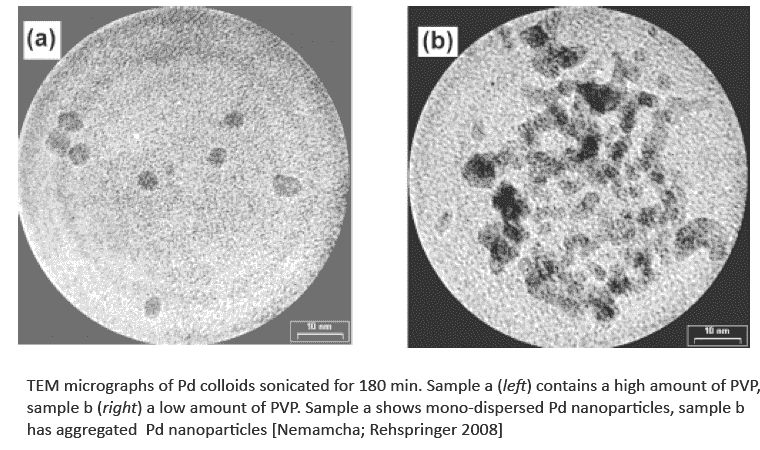
Sonochemical reduction of Palladium: sample a (left) contains a high amount of PVP, sample b (right) a low amount of PVP. Sonication time with UP100H: 180 min. Sample a shows mono dispersed Pd nano particles, sample b aggregated Pd nano particles.
Images and study: ©Nemamcha and Rehspringer, 2008
Təhlil və Nəticələr
UV-görünən udma analizləri palladium (II) ionlarının palladium (0) atomlarına sonokimyəvi azalması və ultrasəs sahəsində saxlama müddəti arasındakı əlaqəni təsdiqləyir. Palladium (II) ionlarının palladium (0) atomlarına azaldılması irəliləyir və sonikasiya müddətinin artması ilə tamamilə əldə edilə bilər. Transmissiya elektron mikroskopiyasının (TEM) mikroqrafikləri göstərir ki:
- Çox miqdarda PVP əlavə olunduqda, palladium ionlarının sonokimyəvi reduksiyası təxminən 5 nm orta diametrli səpməmiş palladium hissəciklərinin formalaşmasına səbəb olur.
- Az miqdarda PVP istifadə edilməsi isə palladium nanohissəciklərinin yığıntılarının əldə olunmasına səbəb olur. Dinamik işıq səpilməsi (DLS) ölçmələri göstərir ki, palladium nanohissəcik yığıntıları 20 nm ətrafında mərkəzləşmiş geniş ölçü paylanmasına malikdir.

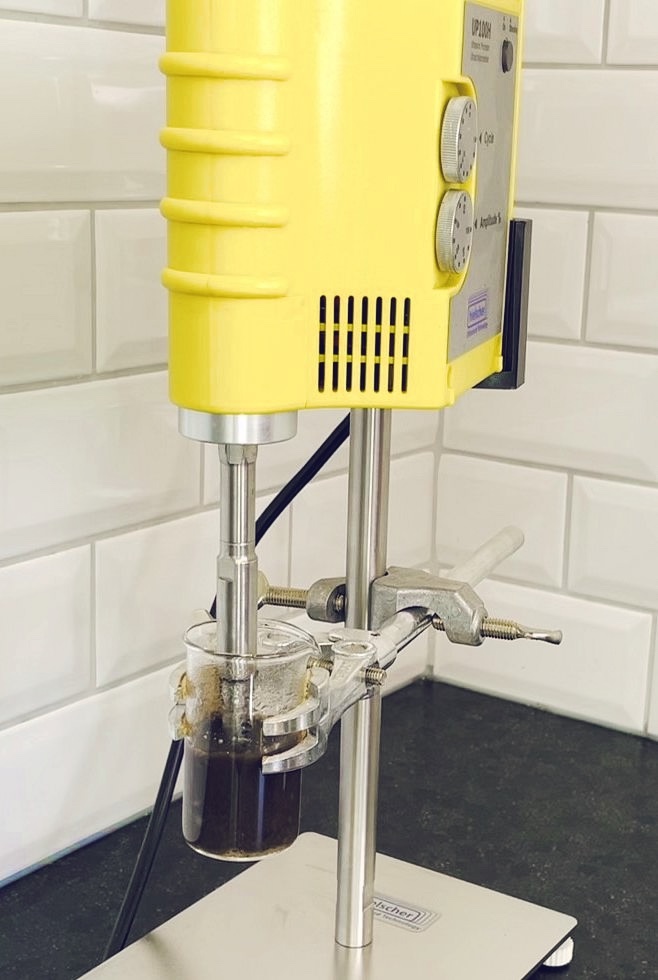
Laboratoriya sonikatoru UP100H palladium nanohissəciklərinin hazırlanması üçün istifadə edilmişdir.

Palladium (Pd) nanohissəcikləri sonikasiya yolu ilə hazırlana bilər
Dizayn, İstehsalat və Konsaltinq – Keyfiyyətli Almaniya istehsalı
Hielscher ultrasəs cihazları ən yüksək keyfiyyət və dizayn standartları ilə tanınır. Sağlamlıq və asan əməliyyat ultrasəs aparatlarımızın sənaye obyektlərinə rahat inteqrasiyasına imkan verir. Kobud şərtlər və tələbkar mühitlər Hielscher ultrasəs cihazları tərəfindən asanlıqla idarə olunur.
Hielscher Ultrasonics, ISO sertifikatlı bir şirkətdir və ən müasir texnologiya və istifadəçi dostu olan yüksək performanslı ultrasəs cihazlarına xüsusi diqqət yetirir. Əlbəttə ki, Hielscher ultrasəs cihazları CE-yə uyğundur və UL, CSA və RoHs tələblərinə cavab verir.
Ədəbiyyat / İstinadlar
- Nemamcha, A.; Rehspringer, J. L. (2008): Morphology of dispersed and aggregated PVV-Pd nanoparticles prepared by ultrasonic irradiation of Pd(NO₃)₂ solution in ethylene glycol. Rev. Adv. Mater. Sci. 18;2008. 685-688.
- Prekob, Á., Muránszky, G., Kocserha, I. et al. (2020): Sonochemical Deposition of Palladium Nanoparticles Onto the Surface of N-Doped Carbon Nanotubes: A Simplified One-Step Catalyst Production Method. Catalysis Letters 150, 2020. 505–513.
- Haitao Zheng, Mphoma S. Matseke, Tshimangadzo S. Munonde (2019): The unique Pd@Pt/C core-shell nanoparticles as methanol-tolerant catalysts using sonochemical synthesis. Ultrasonics Sonochemistry, Volume 57, 2019. 166-171.
Bilməyə Dəyər Faktlar
Palladium nədir?
Palladium nadir, gümüşü-ağ qiymətli bir metaldır, kimyəvi simvolu Pd və atom nömrəsi 46-dır. O, platin-qrup metallara aiddir və kimyəvi cəhətdən sabit olduğu, elektrik keçiriciliyi göstərdiyi, hidrogeni udduğu və əla katalizator kimi fəaliyyət göstərdiyi üçün qiymətləndirilir. Çox incə hissəciklər halında olan palladium hidrogenləşmə və dehidrogenləşmə reaksiyaları üçün xüsusilə təsirlidir, həmçinin qızdırılmış palladium hidrogenin içindən diffuziya etməsinə imkan verir ki, bu da onu hidrogenin ayrılması və təmizlənməsi üçün faydalı edir.
Palladium Nanohissəcikləri nə üçün istifadə olunur?
Palladium nanohissəcikləri əsasən yüksək səth sahəli katalizatorlar kimi istifadə olunur. Çünki nanohissəciklər toplu palladiumdan daha çox aktiv səth sahəsi açır, buna görə katalizator səmərəliliyini artıra və bahalı nəcib metalın miqdarını azalda bilər. Tipik tətbiqlərə kimyəvi sintez, hidrogenləşmə reaksiyaları, karbon-karbon birləşmə reaksiyaları, elektrokataliz, yanacaq hüceyrəsi tədqiqatı, hidrogen sensorluğu və saxlanma, ətraf mühit katalizi və antimikrob, fototermal və antixərçəng sistemləri kimi bəzi biotibbi tədqiqat sahələri daxildir. Palladium katalitik davranışı hissəcik ölçüsündən, morfologiyasından və dispersiyasından güclü şəkildə asılıdır.
Palladium nanohissəcikləri katalitik funksionallıqlara nail olmaq üçün digər hissəcikləri dope etmək üçün də istifadə olunur. Pd/N-BCNT-ni Fischer-Tropsch katalizatoru kimi sintez etmək üçün ultrasəs yolu haqqında daha çox oxuyun!
Palladium zəhərlidirmi?
Elemental metallic palladium is generally considered to have low toxicity and no known biological role, but palladium compounds, salts, dusts, and nanoscale forms should be handled carefully. Occupational or laboratory exposure can cause irritation or sensitization depending on the compound and route of exposure, and palladium chloride solutions, for example, may irritate mucous membranes. For industrial handling, the practical answer is: bulk metallic palladium is relatively low-risk, but palladium powders, soluble palladium salts, and palladium nanoparticles should be treated as potentially hazardous materials, with dust control, ventilation, gloves, eye protection, and proper waste handling.