Sonokemisk reduktion av palladiumnanopartiklar
Palladium (Pd) är välkänt för sina katalytiska egenskaper och används dessutom i stor utsträckning inom materialforskning, elektronikproduktion, medicin, vätgasrening och olika kemiska tillämpningar. Med hjälp av en sonokemisk metod kan storleken och morfologin hos palladiumpartiklarna kontrolleras genom att justera PVP/Pd-förhållandet. Detta möjliggör ultraljudssyntes av antingen mycket fina, monodispra nanopartiklar eller större palladiumaggregat, vilket gör att partikeldimensionerna kan anpassas för optimal katalytisk prestanda.
Ultraljud produktion av palladium nanopartiklar
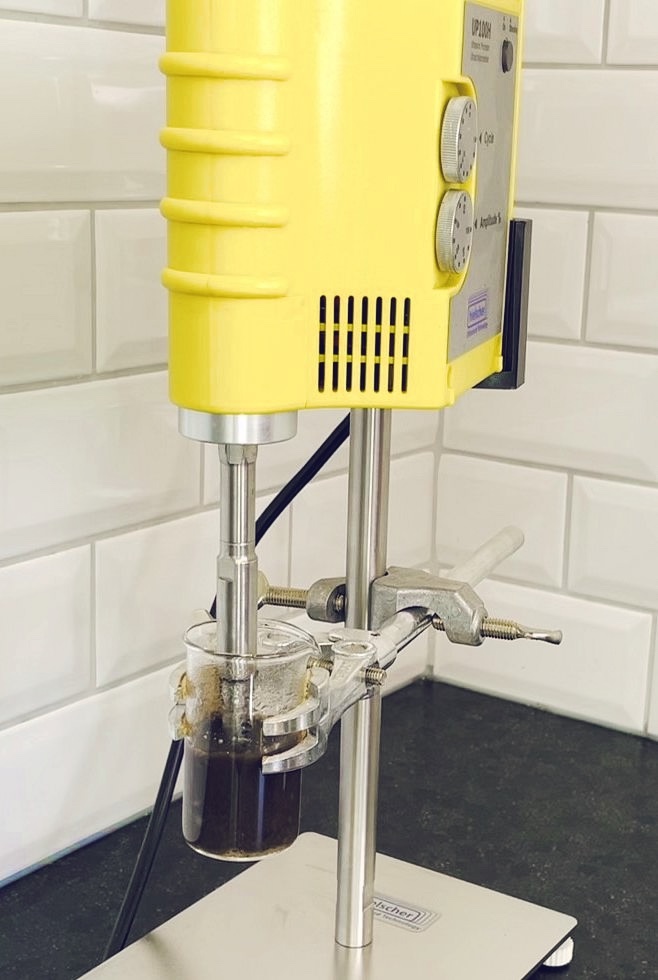 Reduktion av palladiumnanopartiklar med ultraljud erbjuder en snabb och reagenssparande metod för framställning av Pd(0)-nanopartiklar genom att använda akustisk kavitation för att skapa lokala högenergiförhållanden och reducerande radikaler i lösningen, vilket gör det möjligt att reducera palladiumjoner utan konventionell högtemperaturbehandling.
En viktig fördel är processkontrollen: ultraljudsbehandlingstiden och stabilisatorkoncentrationen, såsom PVP/Pd-förhållandet, kan påverka om produkten bildar välspredda, rundade nanopartiklar på cirka 5 nm eller större aggregat på cirka 20 nm, vilket är industriellt relevant eftersom palladiums prestanda vid katalys beror starkt på partikelstorlek, morfologi, dispersion och ytarea. Eftersom palladiumnanopartiklar är mycket värdefulla som heterogena katalysatorer, elektrokatalysatorer och funktionella material, är ultraljudsreduktion ett attraktivt alternativ för att framställa fint dispergerade Pd-katalysatorer under relativt milda förhållanden i vätskefas, med potentiella fördelar för kemisk syntes, miljökatalys, bränslecellsteknik och andra processer där hög katalytisk aktivitet och effektivt utnyttjande av ädelmetaller är ekonomiskt viktigt.

Industriell bearbetning av nanopartiklar med ultraljudsmätaren UIP2000hdT
Förfarande för provberedning
Proverna bereddes på följande sätt:
För proverna, blandningar av 30 ml EG och 5·10-6mol PVP bereddes genom magnetomrörning i 15 minuter. Till de olika proverna tillsattes olika mängder Pd(NO₃)₂-lösning, 1,5 ml respektive 2 ml. Provblandningarna bereddes i förhållandet 2·10-3mol Pd(NO₃)₂ i prov (a) och 2,66·10-3mol Pd(NO₃)₂ i prov (b). Båda blandningarna behandlades med ultraljud i en 20 ml-ampull med hjälp av en ultraljudsenhet av sondtyp. Prover togs efter ultraljudsbehandlingstider på 30, 60, 90, 120, 150 och 180 minuter.
Analysen av de experimentella resultaten visar att:
- 1. Den sonokemiska reduktionen av Pd (II) till Pd (0) beror på ultraljudsbehandling tid.
- 2. Det höga PVP/Pd(II) molförhållandet leder till bildandet av monodispergerade palladiumpartiklar med en rundad form och en medeldiameter på cirka 5nm.
- 3. Det låga PVP/Pd(II) molförhållandet innebär emellertid erhållande av aggregat palladiumnanopartiklar med en stor storleksfördelning centrerad vid 20nm.
Den sonokemiska vägen för att reducera palladium (II) joner Pd(II) till palladiumatomer Pd(0) kan antas vara följande:
- (1) Vattenpyrolys: H₂O → •OH + •H
- (2) Bildning av radikaler: RH (reduktionsmedel) + •OH(•H) → •R + H₂O(H₂)
- (3) Reduktion av joner: Pd(II) + reducerande radikaler (•H, •R) → Pd(0) + R•CHO + H+
- (4) Partikelbildning: NPd(0) → Pdn
Resultat: Beroende på PVP/Pd(II)-förhållandet, dispergerad eller aggregerad PdN erhölls.
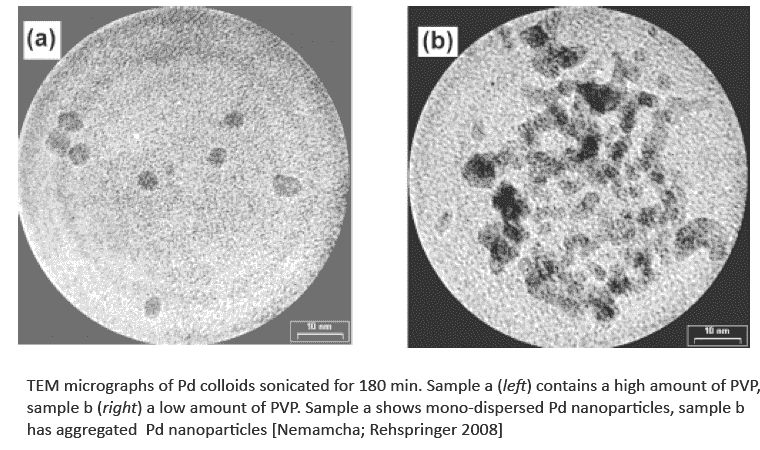
Sonokemisk reduktion av palladium: prov a (till vänster) innehåller en hög halt av PVP, prov b (till höger) en låg halt av PVP. Ultraljudsbehandlingstid med UP100H: 180 min. Prov a uppvisar monodispersa Pd-nanopartiklar, prov b aggregerade Pd-nanopartiklar.
Bilder och studie: ©Nemamcha och Rehspringer, 2008
Analys och resultat
De UV-synliga absorptionsanalyserna bekräftar sambandet mellan den sonokemiska reduktionen av palladium(II)-joner till palladium(0)-atomer och retentionstiden i ultraljudsfältet. Reduktionen av palladium(II) joner till palladium(0) atomer fortskrider och kan uppnås helt med ökande ultraljudsbehandling. Mikrobilderna av transmissionselektronmikroskopi (TEM) visar att:
- När en stor mängd PVP tillsätts leder den sonokemiska reduktionen av palladiumjoner till bildandet av monodispersa palladiumpartiklar med sfärisk form och en medeldiameter på cirka 5 nm.
- Genom att använda en liten mängd PVP erhålls aggregat av palladiumnanopartiklar. Mätningar med dynamisk ljusspridning (DLS) visar att aggregaten av palladiumnanopartiklar har en bred storleksfördelning med ett centrum vid 20 nm.

Laboratorieultraljudsapparaten UP100H har använts för framställning av palladiumnanopartiklar.

Palladium (Pd) nanopartiklar kan framställas genom ultraljudsbehandling
Design, tillverkning och rådgivning – Kvalitet tillverkad i Tyskland
Hielscher ultraljudsapparater är välkända för sina högsta kvalitets- och designstandarder. Robusthet och enkel drift möjliggör en smidig integration av våra ultraljudsapparater i industriella anläggningar. Tuffa förhållanden och krävande miljöer hanteras enkelt av Hielscher ultraljudsapparater.
Hielscher Ultrasonics är ett ISO-certifierat företag och lägger särskild vikt vid högpresterande ultraljudsapparater med den senaste tekniken och användarvänligheten. Naturligtvis är Hielscher ultraljudsapparater CE-kompatibla och uppfyller kraven i UL, CSA och RoHs.
Litteratur/Referenser
- Nemamcha, A.; Rehspringer, J. L. (2008): Morphology of dispersed and aggregated PVV-Pd nanoparticles prepared by ultrasonic irradiation of Pd(NO₃)₂ solution in ethylene glycol. Rev. Adv. Mater. Sci. 18;2008. 685-688.
- Prekob, Á., Muránszky, G., Kocserha, I. et al. (2020): Sonochemical Deposition of Palladium Nanoparticles Onto the Surface of N-Doped Carbon Nanotubes: A Simplified One-Step Catalyst Production Method. Catalysis Letters 150, 2020. 505–513.
- Haitao Zheng, Mphoma S. Matseke, Tshimangadzo S. Munonde (2019): The unique Pd@Pt/C core-shell nanoparticles as methanol-tolerant catalysts using sonochemical synthesis. Ultrasonics Sonochemistry, Volume 57, 2019. 166-171.
Fakta som är värda att veta
Vad är palladium?
Palladium är ett sällsynt, silvervitt ädelmetall med kemisk beteckning Pd och atomnummer 46. Det tillhör platinagruppen och är uppskattat eftersom det är kemiskt stabilt, leder elektricitet, absorberar väte och fungerar som en utmärkt katalysator. Finkornigt palladium är särskilt effektivt vid hydrerings- och dehydrogeneringsreaktioner, och upphettat palladium kan låta väte diffundera genom sig, vilket gör det användbart för separation och rening av väte.
Vad används palladiumnanopartiklar till?
Palladiumnanopartiklar används främst som katalysatorer med stor yta. Eftersom nanopartiklar har en betydligt större aktiv yta än palladium i fast form kan de förbättra katalysatoreffektiviteten och minska den mängd dyrt ädelmetall som krävs. Typiska tillämpningar är kemisk syntes, hydreringsreaktioner, kol–kol-kopplingsreaktioner, elektrokatalys, bränslecellsforskning, väteavkänning och -lagring, miljökatalys samt vissa biomedicinska forskningsområden, såsom antimikrobiella, fototermiska och cancerbekämpande system. Palladiums katalytiska egenskaper beror i hög grad på partikelstorlek, morfologi och dispersion.
Nanopartiklar av palladium används också för att dopa andra partiklar i syfte att uppnå katalytiska egenskaper. Läs mer om ultraljudsmetoden för att syntetisera Pd/N-BCNT som Fischer-Tropsch-katalysator!
Är palladium giftigt?
Metalliskt palladium i elementär form anses i allmänhet ha låg toxicitet och ingen känd biologisk funktion, men palladiumföreningar, salter, damm och former i nanoskala bör hanteras med försiktighet. Exponering i arbetsmiljön eller i laboratoriet kan orsaka irritation eller sensibilisering beroende på föreningen och exponeringsvägen, och exempelvis palladiumkloridlösningar kan irritera slemhinnorna. När det gäller industriell hantering är det praktiska svaret följande: metalliskt palladium i bulkform medför relativt låg risk, men palladiumpulver, lösliga palladiumsalter och palladiumnanopartiklar bör behandlas som potentiellt farliga ämnen, med dammkontroll, ventilation, handskar, ögonskydd och korrekt avfallshantering.