Reducerea sonochimică a nanoparticulelor de paladiu
Palladiul (Pd) este bine cunoscut pentru proprietățile sale catalitice și este, de asemenea, utilizat pe scară largă în cercetarea materialelor, producția de electronice, medicină, purificarea hidrogenului și diverse aplicații chimice. Prin utilizarea unei metode sonochimice, dimensiunea și morfologia particulelor de paladiu pot fi controlate prin ajustarea raportului PVP/Pd. Acest lucru permite sinteza ultrasonică fie a unor nanoparticule foarte fine și monodisperse, fie a unor agregate mai mari de paladiu, permițând adaptarea dimensiunilor particulelor pentru o performanță catalitică optimă.
Producția cu ultrasunete de nanoparticule de paladiu
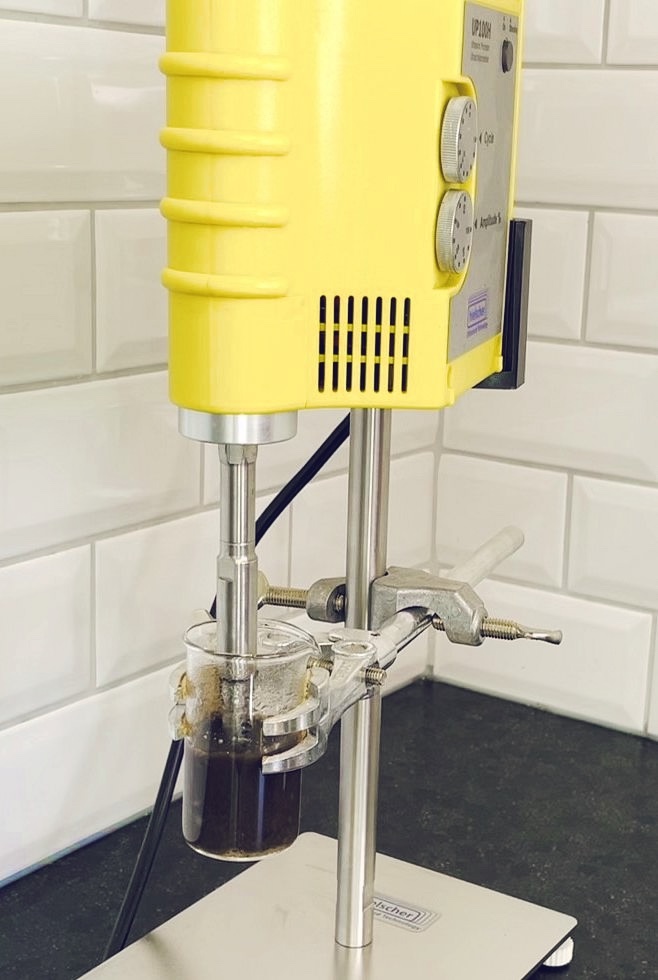 Reducerea cu ultrasunete a nanoparticulelor de paladiu oferă o metodă rapidă și eficientă din punctul de vedere al consumului de reactivi pentru obținerea nanoparticulelor de Pd(0), prin utilizarea cavitației acustice pentru a genera condiții localizate de energie ridicată și prin reducerea radicalilor din soluție, permițând reducerea ionilor de paladiu fără a fi necesară o prelucrare convențională la temperaturi ridicate.
Un avantaj esențial îl reprezintă controlul procesului: timpul de sonicare și concentrația stabilizatorului, precum raportul PVP/Pd, pot influența dacă produsul se formează sub formă de nanoparticule bine dispersate, rotunjite, de aproximativ 5 nm, sau sub formă de agregate mai mari, de aproximativ 20 nm, ceea ce este relevant din punct de vedere industrial, deoarece performanța paladiului în cataliză depinde puternic de dimensiunea particulelor, morfologie, dispersie și suprafață specifică. Deoarece nanoparticulele de paladiu sunt extrem de valoroase ca catalizatori eterogeni, electrocatalizatori și materiale funcționale, reducerea cu ultrasunete este o metodă atractivă pentru producerea de catalizatori Pd fin dispersați în condiții relativ blânde de fază lichidă, cu beneficii potențiale pentru sinteza chimică, cataliza ecologică, tehnologiile cu celule de combustibil și alte procese în care activitatea catalitică ridicată și utilizarea eficientă a metalelor nobile sunt importante din punct de vedere economic.

Prelucrarea industrială a nanoparticulelor cu sonicatorul UIP2000hdT
Procedura de pregătire a probelor
Probele au fost pregătite după cum urmează:
Pentru probe, amestecuri de 30 ml de EG și 5·10-6mol de PVP au fost preparați prin agitare magnetică timp de 15 minute. Pentru diferitele probe, s-au adăugat cantități diferite de soluție de Pd(NO₃)₂, respectiv 1,5 mL și 2 mL. Amestecurile de probe au fost preparate în proporție de 2·10-3mol de Pd(NO₃)₂ în proba (a) și 2,66·10-3mol de Pd(NO₃)₂ în proba (b). Ambele amestecuri au fost supuse tratamentului cu ultrasunete într-o fiolă de 20 mL, folosind un aparat cu ultrasunete cu sondă. Probele au fost prelevate după perioade de tratament cu ultrasunete de 30, 60, 90, 120, 150 și 180 de minute.
Analiza rezultatelor experimentale arată că:
- 1. Reducerea sonochimică a Pd(II) în Pd(0) depinde de timpul sonicare.
- 2. Raportul molar ridicat PVP/Pd(II) conduce la formarea particulelor de paladiu monodispersate având o formă rotunjită și un diametru mediu de aproximativ 5nm.
- 3. Cu toate acestea, raportul molar PVP/Pd(II) scazut presupune obtinerea de agregate de nanoparticule de paladiu cu o distributie dimensionala mare centrata la 20nm.
Metoda sonochimică de reducere a ionilor de paladiu (II) PD(II) la atomii de paladiu PD(0) se poate presupune că sunt următoarele:
- (1) Piroliza apei: H₂O → •OH + •H
- (2) Formarea radicalilor: RH (agent reducător) + •OH(•H) → •R + H₂O(H₂)
- (3) Reducerea ionilor: Pd(II) + radicali reducători (•H, •R) → Pd(0) + R•CHO + H+
- (4) Formarea particulelor: NPd(0) → Pdn
Rezultat: În funcție de raportul PVP/Pd(II), Pd dispersat sau agregatN au fost obținute.
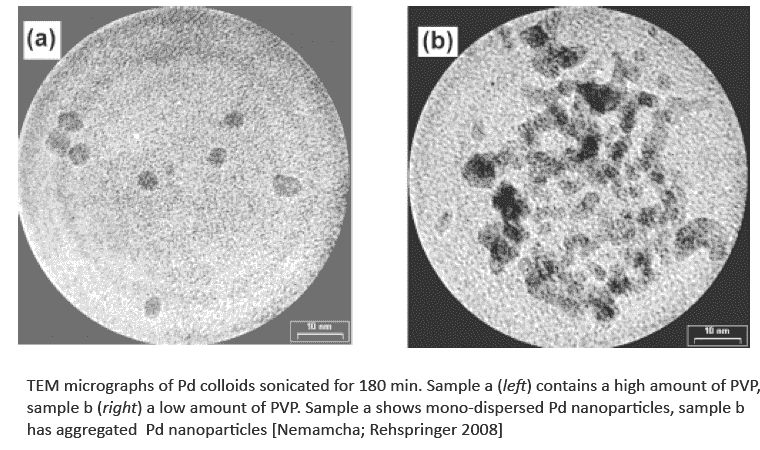
Reducerea sonochimică a paladiului: proba a (stânga) conține o cantitate mare de PVP, iar proba b (dreapta) o cantitate mică de PVP. Durata de sonicare cu UP100H: 180 min. Proba a prezintă nanoparticule de Pd monodisperse, iar proba b nanoparticule de Pd agregate.
Imagini și studiu: ©Nemamcha și Rehspringer, 2008
Analiză și rezultate
Analizele de absorbție vizibile UV confirmă relația dintre reducerea sonochimică a ionilor de paladiu (II) la atomii de paladiu (0) și timpul de retenție în câmpul ultrasonic. Reducerea ionilor de paladiu (II) la paladiu (0) atomi progresează și poate fi complet realizat cu creșterea timpului sonicare. Micrografiile microscopiei electronice de transmisie (TEM) arată că:
- Atunci când se adaugă o cantitate mare de PVP, reducerea sonochimică a ionilor de paladiu duce la formarea unor particule de paladiu monodisperse, de formă sferică, cu un diametru mediu de aproximativ 5 nm.
- Utilizarea unei cantități mici de PVP duce la obținerea unor agregate de nanoparticule de paladiu. Măsurătorile prin împrăștierea dinamică a luminii (DLS) arată că agregatele de nanoparticule de paladiu prezintă o distribuție largă a dimensiunilor, centrată la 20 nm.

Sonicatorul de laborator UP100H a fost utilizat pentru prepararea nanoparticulelor de paladiu.

Paladiu (Pd) nanoparticule pot fi preparate prin sonicare
Proiectare, fabricație și consultanță – Calitate Made in Germany
Hielscher ultrasonicators sunt bine-cunoscute pentru cele mai înalte standarde de calitate și design. Robustețea și funcționarea ușoară permit integrarea fără probleme a ultrasonicators noastre în instalații industriale. Condiții dure și medii solicitante sunt ușor de manipulat de ultrasonicators Hielscher.
Hielscher Ultrasonics este o companie certificată ISO și pune un accent deosebit pe ultrasonicators de înaltă performanță cu tehnologie de ultimă oră și ușurință în utilizare. Desigur, ultrasonicators Hielscher sunt conforme CE și îndeplinesc cerințele UL, CSA și RoHs.
Literatură/Referințe
- Nemamcha, A.; Rehspringer, J. L. (2008): Morphology of dispersed and aggregated PVV-Pd nanoparticles prepared by ultrasonic irradiation of Pd(NO₃)₂ solution in ethylene glycol. Rev. Adv. Mater. Sci. 18;2008. 685-688.
- Prekob, Á., Muránszky, G., Kocserha, I. et al. (2020): Sonochemical Deposition of Palladium Nanoparticles Onto the Surface of N-Doped Carbon Nanotubes: A Simplified One-Step Catalyst Production Method. Catalysis Letters 150, 2020. 505–513.
- Haitao Zheng, Mphoma S. Matseke, Tshimangadzo S. Munonde (2019): The unique Pd@Pt/C core-shell nanoparticles as methanol-tolerant catalysts using sonochemical synthesis. Ultrasonics Sonochemistry, Volume 57, 2019. 166-171.
Fapte care merită știute
Ce este paladiul?
Paladiul este un metal prețios rar, de culoare alb-argintie, cu simbolul chimic Pd și numărul atomic 46. Face parte din grupul metalelor din grupa platinei și este apreciat pentru stabilitatea sa chimică, capacitatea de a conduce electricitatea, de a absorbi hidrogenul și pentru rolul său de catalizator excelent. Palladiul fin divizat este deosebit de eficient în reacțiile de hidrogenare și dehidrogenare, iar palladiul încălzit permite difuzia hidrogenului prin el, ceea ce îl face util pentru separarea și purificarea hidrogenului.
La ce se folosesc nanoparticulele de paladiu?
Nanoparticulele de paladiu sunt utilizate în principal ca catalizatori cu suprafață specifică mare. Deoarece nanoparticulele prezintă o suprafață activă mult mai mare decât paladiul în stare masivă, acestea pot îmbunătăți eficiența catalizatorului și pot reduce cantitatea necesară de metal nobil scump. Aplicațiile tipice includ sinteza chimică, reacțiile de hidrogenare, reacțiile de cuplare carbon-carbon, electrocataliza, cercetarea în domeniul pilelor de combustibil, detectarea și stocarea hidrogenului, cataliza de mediu, precum și unele domenii de cercetare biomedicală, cum ar fi sistemele antimicrobiene, fototermice și anticanceroase. Comportamentul catalitic al paladiului depinde în mare măsură de dimensiunea particulelor, de morfologie și de dispersie.
Nanoparticulele de paladiu sunt utilizate și pentru doparea altor particule, în scopul obținerii unor funcționalități catalitice. Află mai multe despre metoda cu ultrasunete de sinteză a Pd/N-BCNT ca catalizator Fischer-Tropsch!
Este paladiul toxic?
Se consideră, în general, că paladiul metalic elementar are o toxicitate redusă și nu are un rol biologic cunoscut, însă compușii, sărurile, praful și formele la scară nanometrică ale paladiului trebuie manipulate cu precauție. Expunerea profesională sau în laborator poate provoca iritații sau sensibilizare, în funcție de compus și de calea de expunere; de exemplu, soluțiile de clorură de paladiu pot irita membranele mucoase. În ceea ce privește manipularea industrială, răspunsul practic este următorul: paladiul metalic în vrac prezintă un risc relativ scăzut, dar pulberile de paladiu, sărurile solubile de paladiu și nanoparticulele de paladiu trebuie tratate ca materiale potențial periculoase, cu măsuri de control al prafului, ventilație, mănuși, protecție pentru ochi și gestionarea corespunzătoare a deșeurilor.